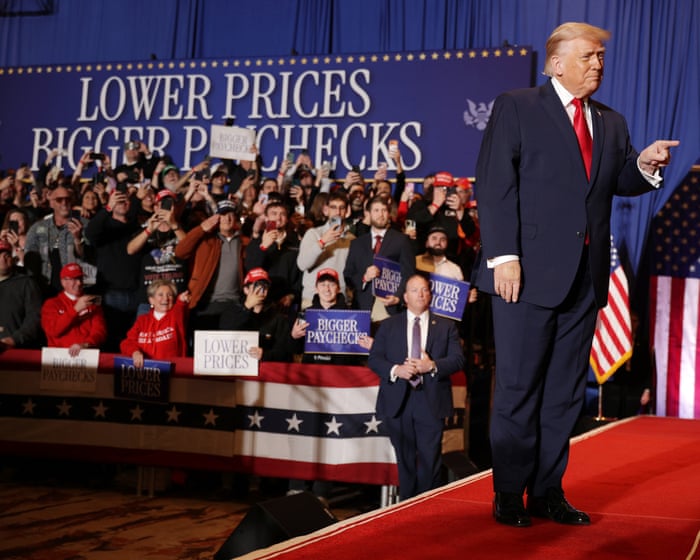
Moments into his second term, Donald Trump was unequivocal in his inaugural address. “The golden age of America begins right now,” he declared.
At a White House reception last weekend, just over ten months later, the president seemed to acknowledge how much his timeline had shifted. “We’re going to have… I say it’s the golden age of America,” Trump told his audience. “We have an age that’s coming up, the likes of which… this country has never seen. And I just look so forward to the results. You’re going to see results in six months to a year.”
The U.S. economy has faced pressure in 2025. The promised golden age did not immediately materialize after Trump returned to office in January.
On two key areas where the president pledged rapid improvement—jobs and prices—the results have so far been lackluster.
The labor market began the year steady. It had slowed but still expanded by an average of 168,000 jobs per month in 2024. However, during his joint address to Congress in March, Trump claimed to have inherited an “economic catastrophe” from the Biden administration and vowed to create jobs “like we have never seen before.”
In reality, job growth has stalled in 2025. Official data for the first eleven months of the year show an average of just 55,000 jobs added per month—a 67% drop from 2024. The U.S. lost 105,000 jobs in October and added 64,000 in November, according to delayed reports.
The headline unemployment rate, which fluctuated between 3.9% and 4.2% in the final year of Biden’s presidency, has risen under Trump, reaching 4.6% in November—its highest level in over four years.
During last year’s campaign, Trump promised a “new American industrialism” that would make the U.S. a “manufacturing powerhouse” again, with a resurgence in factory jobs. In reality, manufacturing employment has not increased this year. The economy has added factory jobs in only two of the ten months since Trump returned to office.
According to the White House, achieving this distant dream of an industrial renaissance will require ramping up the president’s flagship economic policy: tariffs. Trump has moved to do just that, raising the overall average effective U.S. tariff rate from 2.4% to 16.8%—the highest level since 1935, according to analysis by the Budget Lab at Yale.
The rollout of higher tariffs has been erratic, marked by uncertain deadlines, delays, and reversals. Trump’s chief of staff, Susie Wiles, conceded to Vanity Fair that the process has been “more painful than I expected.”
For all the internal challenges this agenda has caused the White House, economists have repeatedly warned of its potentially stark impact on millions of Americans. Tariffs on imported goods, often passed on by businesses, can lead to higher prices for consumers.
Officials and policymakers at the Federal Reserve have spent months debating whether Trump’s tariffs will result in a one-time price shock or something more lasting.
Inflation surged to its highest level in a generation in 2022 as the COVID-19 pandemic disrupted global supply and demand. By last year, however, the U.S. Consumer Price Index (CPI) was falling back toward typical levels—a trend that continued into early 2025.
Despite this, Trump has claimed his administration inherited an “inflation nightmare” from Biden and vowed to turn it around. In a primetime TV address on Wednesday, he declared, “I am bringing those high prices down and bringing them down very fast.”
But CPI has held firm since the spring.In November, inflation increased at an annual rate of 2.7%, according to data released by the Bureau of Labor Statistics on Thursday.
The president has repeatedly denied responsibility for inflation this year, dismissing concerns about prices as a “con job.” When asked by Politico this month how he would grade himself on the economy, he replied: “A-plus-plus-plus-plus-plus.”
During his TV address this week, Trump insisted he was “solving” grocery prices, claiming that turkey and egg prices had fallen sharply. “Everything else is falling rapidly,” he said. “And it’s not done yet, but boy, are we making progress. Nobody can believe what’s going on.”
‘Hard to see how 2026 will be better’
There have been signs, however, that the administration is taking steps to ease pressure in an economy the president rates so highly.
Last month, Trump moved to lower tariffs on some imports, including beef, tomatoes, coffee, and bananas. The administration has also unveiled $12 billion in economic assistance for farmers and has repeatedly floated the idea of stimulus checks for Americans, funded by tariffs.
Kicking off a nationwide tour to promote the idea of a “remarkable turnaround,” Trump appeared at a rally in Mount Pocono, Pennsylvania, last week in front of a large sign that read: “LOWER PRICES BIGGER PAYCHECKS.”
Is a golden age really on the horizon? Trump and his officials have an almost messianic belief that the economy will shift into a higher gear in the first quarter of next year, Axios reported earlier this week, citing administration advisers.
This confidence is said to be driven by projections that stimulus from Trump’s massive One Big Beautiful Bill Act tax-and-spending legislation will significantly boost household finances and spur business investment.
Outside the administration, economists are skeptical.
“Most lower-income Americans will be hurt (net) by these policies. And you need to add the increase in healthcare premiums on top of this,” said Simon Johnson, a Nobel Prize-winning economist and professor at MIT’s Sloan School of Management. “Hard to see how 2026 will be better for most people.”
The U.S. economy is forecast to grow by 2% this year, down from 2.8% in 2024. Samuel Tombs, chief U.S. economist at Pantheon Macroeconomics, expects only a “pretty small fiscal boost” from Trump’s policies next year.
“In addition, households’ relatively low confidence suggests many of them will save the windfall from larger-than-usual tax refunds in the spring,” said Tombs. “Accordingly, we expect GDP growth of about 2% again next year, well short of the administration’s hopes.”
Trump remains bullish. “We’re poised for an economic boom the likes of which the world has never seen,” he assured the nation this week.
Most Americans have yet to see this boom. But they’ve certainly heard a lot about it.
Frequently Asked Questions
Of course Here is a list of FAQs about the question of Donald Trumps promised golden age for the US economy framed in a natural tone with direct answers
BeginnerLevel Questions
1 What exactly did Trump promise for the economy
During his 2016 campaign and presidency Donald Trump promised a new golden age of American prosperity Key promises included sustained GDP growth of 34 or more the return of manufacturing jobs massive new infrastructure investment and trade deals that would heavily favor the US
2 Did the economy improve under Trump before the pandemic
Yes in several key areas prior to COVID19 The stock market hit record highs unemployment fell to 50year lows for many groups and GDP growth was steady This continued a trend from the previous administration but was boosted by a major tax cut and deregulation
3 So where is the golden age now Why doesnt it feel like one
Many people feel the promised broadbased prosperity hasnt fully materialized due to several factors the economic disruption of the pandemic high inflation that began in 2021 and eroded wage gains and a sense that the benefits of growth were unevenly distributed favoring the wealthy
4 What about the tax cuts Did they help most people
The 2017 Tax Cuts and Jobs Act lowered taxes for many individuals and corporations Most people saw a modest increase in their takehome pay However critics argue the benefits were skewed toward high earners and corporations and the individual cuts were set to expire for most people while corporate cuts were permanent
5 Did he bring back manufacturing jobs
Manufacturing job growth continued its postGreat Recession recovery adding about 500000 jobs before the pandemic However this did not represent the massive transformative return of factory jobs to prior levels that was promised The pandemic then caused significant losses in the sector
Advanced Nuanced Questions
6 How much of the prepandemic economic strength was due to Trumps policies versus the existing business cycle
This is a major point of debate among economists Most agree that