The unthinkable has occurred: the United States has become Europe’s adversary. The profound betrayal evident in the Trump administration’s national security strategy should end any further denial or hesitation in European capitals. Cultivating a “resistance” to Europe’s current path is now official Washington policy.
Yet within this crisis lies a gift of clarity. Europe must either fight or face decline. The encouraging news is that Europe holds strong cards.
America’s massive bet on artificial intelligence has grown so large that the pensions of every MAGA voter are tied to the survival of this precarious bubble. AI investment now rivals consumer spending as the main driver of U.S. economic growth, accounting for nearly all—92%—of GDP growth in the first half of this year. Without it, U.S. GDP grew only 0.1%. Despite Donald Trump’s confident posture, his economic footing is unstable.
Trump’s political coalition is also fragile. In July and again this month, he failed to persuade Senate Republicans to pass his AI moratorium bill, which would have prevented states from drafting their own AI regulations. The Steve Bannon wing of MAGA fears mass worker displacement by AI and is alarmed by what children encounter on digital platforms. MAGA voters deeply distrust big tech’s political power, making technology a dangerous topic for Trump.
European Commission President Ursula von der Leyen holds two cards that could burst the AI bubble—and with it, throw Trump’s presidency into crisis.
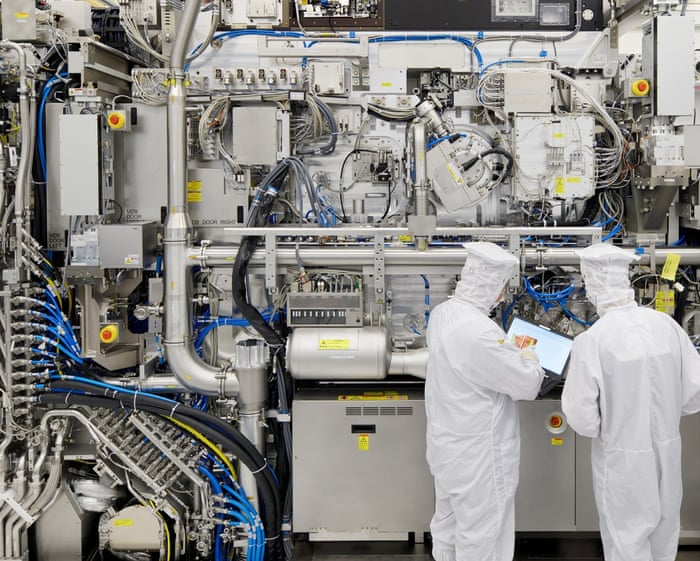
First, the Dutch company ASML holds a global monopoly on the advanced machines that use light to etch microchips onto silicon. These machines are essential for Nvidia, the AI chip giant that is now the world’s most valuable company. ASML itself is one of Europe’s most valuable firms, and European banks and private equity are heavily invested in AI. While withholding these machines would be difficult and painful for Europe—especially the Dutch economy—it would be far more damaging to Trump.
America’s feverish investment in AI and the data centers it relies on would stall if European export controls slowed or halted shipments to the U.S. and to Taiwan, where Nvidia produces its most advanced chips. Through this lever, Europe can effectively decide whether and by how much the U.S. economy grows or shrinks.
Second, and far easier for Europe, is enforcing the EU’s long-neglected data rules against major U.S. tech firms. Confidential corporate documents revealed in U.S. litigation show how vulnerable companies like Google are to even basic data regulation. Meanwhile, Meta has been unable to explain to a U.S. court what its internal systems do with user data, who can access it, or for what purpose.
This data free-for-all allows big tech to train AI models on vast amounts of personal information—a practice illegal in Europe, where companies must strictly control and account for how they use personal data. If Brussels simply cracks down on Ireland, which has long been a lax enforcement zone, the repercussions would extend far beyond Europe.
If the EU had the courage to apply this pressure, U.S. tech companies would need to rebuild their technologies from the ground up to handle data properly. They would also have to inform investors that their AI tools are barred from Europe’s valuable market until they comply. The AI bubble would unlikely survive this double shock.
MAGA voters did not vote to lose their liberties or constitutional rights. A Trump who grows more authoritarian yet fails to deliver economic stability—due to his ties to a despised tech industry—would likely become deeply unpopular by the 2026 midterm elections.
The balance of risk now demands that European leaders move to weaken Trump. They have learned from a year of timid submission that such behavior only makes it easier for him to push them around. The reasons for caution are fading.The furious response from MAGA leaders to the relatively modest €120 million fine the European Commission recently imposed on X shows that holding back will not satisfy them. Trump’s “28-point plan” for Ukraine shattered any hope that European compromises would bring back America’s military support.
With its democracy now openly at risk, Europe must follow the lead of India, Brazil, and China in standing up to Trump. Brazil’s president, Luiz Inácio Lula da Silva, offers a model for how to do this. He has remained dignified and firm despite extraordinary bullying from Trump. In just one month—September—he publicly stated in an open letter to Trump that Brazil’s democracy and sovereignty are not up for negotiation, responded to Trump’s tariffs with tariffs of Brazil’s own, and passed a new law requiring digital platforms to protect Brazilian children from sexual harassment and other online dangers.
Then, just before Trump was due to speak, Lula delivered a powerful rebuke to him in a UN General Assembly speech. Because Lula refused to be intimidated, Trump quickly softened his tone. Lower tariffs are now anticipated following talks between the two leaders.
Earlier in December, Trump claimed that Europe’s leaders are weak. He does not think they will protect Europeans’ freedoms and hard-won democracy from him. So far, European leaders’ reactions are proving him right. But what Trump has yet to realize is that Ursula von der Leyen holds significant leverage over the U.S. economy and his presidency. She must find the courage to act in ways she never has before. In short, if she strikes where it hurts, Europe can win this fight.
Johnny Ryan is director of Enforce, a unit of the Irish Council for Civil Liberties.
Frequently Asked Questions
Of course Here is a list of FAQs about the concept of Europes secret weapon against Trump potentially disrupting an AI bubble framed in a natural conversational tone
Beginner Definition Questions
1 What is this secret weapon people are talking about
Its not a physical weapon It refers to the European Unions AI Actthe worlds first comprehensive binding law to regulate artificial intelligence Its considered a weapon because it sets strict global rules that even powerful US tech companies must follow if they want to operate in the massive EU market
2 What is an AI bubble
An AI bubble is a period of extreme hype and overinvestment in AI companies where their perceived value and stock prices are driven more by excitement and speculation than by proven sustainable business models or realworld profitability
3 How could a European law affect Trump or the US AI industry
The EU AI Act creates a Brussels Effect Like with data privacy companies worldwide often adopt the strictest global standard to simplify operations If the US under a potential Trump administration pushes for minimal regulation to fuel rapid AI growth it could create a clash US firms wanting to access Europe would still have to comply with the EUs stricter rules potentially popping a bubble built on unregulated risky AI applications
Mechanisms Impact Questions
4 How exactly would this law pop a bubble
By enforcing strict transparency safety and fundamental rights requirements This increases development costs slows down the release of flashy but potentially unethical or unsafe AI products and forces companies to prove their systems are robust and accountable This reality check could deflate speculative hype
5 What are some specific rules in the AI Act that would challenge US AI companies
Key rules include
Ban on certain AI Like realtime facial recognition in public spaces and social scoring
HighRisk AI Regulations Rigorous testing data governance and human oversight for AI used in hiring critical infrastructure law enforcement etc
Transparency Requirements Clearly labeling AIgenerated content and ensuring users know they are interacting with an AI