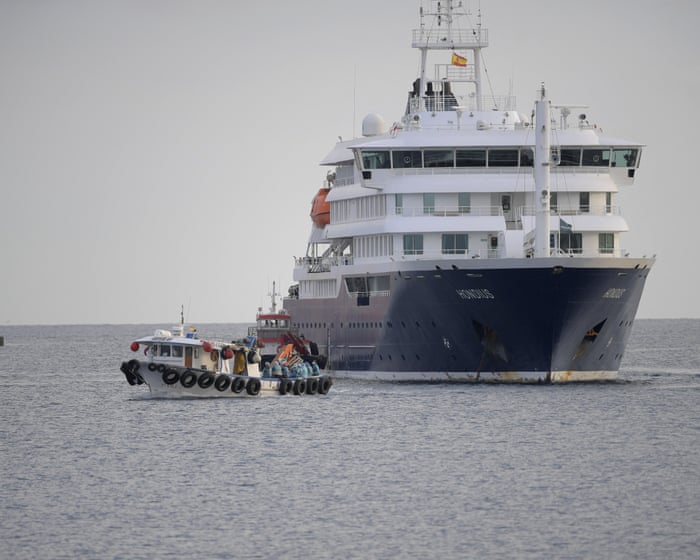
A French woman and an American national who were evacuated from the cruise ship at the center of a deadly hantavirus outbreak have tested positive for the virus. The complex effort to bring everyone on board back home continued on Monday.
The French woman was one of five French passengers who left the ship in Tenerife on Sunday and were flown to a hospital in Paris.
French Health Minister Stéphanie Rist said the woman was in serious condition on Monday. Rist explained that the woman began feeling very unwell on Sunday night, and “tests came back positive.” Speaking to France Inter radio, Rist added, “Unfortunately, her symptoms got worse overnight.” She is now being treated in a specialized infectious diseases unit at a Paris hospital.
An American passenger, who was flown to Nebraska along with 16 others on Sunday evening, also tested positive but showed no symptoms. The US health department reported that one American evacuated from the ship had tested positive for the Andes strain—the only hantavirus strain that can spread between people—and another had “mild symptoms.”
On Sunday, workers in full-body protective gear and breathing masks began escorting travelers from the ship to shore in Tenerife, in the Canary Islands, and this effort continued on Monday. More than 100 people from 23 different countries are being evacuated in less than 48 hours, in what Spanish authorities describe as a “complex” and “unprecedented” operation.
Spain’s health ministry said on Monday that “all possible measures had been taken from the start to cut off any potential chains of transmission.” It added that passengers had health checks and their temperatures taken when the ship arrived off Tenerife on Sunday.
The ministry also noted that the French woman who developed a fever during the evacuation flight did not have a high temperature when she was examined on the MV Hondius.
Three passengers from the MV Hondius—a Dutch couple and a German woman—have died, and others have fallen ill with this rare disease, which usually spreads among rodents.
There are no vaccines or specific treatments for hantavirus, which is common in Argentina, where the ship departed in April.
However, health officials say the risk to global public health is low and have downplayed comparisons to the Covid-19 pandemic.
Rist said 22 French nationals had been identified as potentially coming into contact with the virus. This includes eight people who were on a flight from Saint Helena to Johannesburg on April 25, and 14 more on a flight from Johannesburg to Amsterdam.
The Dutch woman who died was on the flight to Johannesburg and briefly boarded a flight to Amsterdam but got off before takeoff.
Health authorities in several countries have been tracking passengers who had already left the ship, as well as anyone who may have been in contact with them.
French Prime Minister Sébastien Lecornu was scheduled to hold a meeting with medical advisers and ministers on Monday afternoon to follow up on the issue.
French government spokesperson Maud Bregeon told BFMTV that it was important not to create a sense of “panic.” She said, “We are monitoring the situation with the utmost caution, knowing that this is a virus we are familiar with, that a 42-day isolation period has been decided, and the goal remains the same: protecting the French people.”
Spanish Health Minister Mónica García said the repatriation operation had evacuated 94 people from 19 different countries on Sunday.
Of the 54 people still on board—22 passengers and 32 crew—28 will leave the ship today and be evacuated on a Dutch flight to the Netherlands. The MV Hondius will then sail to the Netherlands with the remaining 26 crew members.
García added that a second plane, which was supposed to fly passengers back to Australia, would not come to Tenerife due to timing issues.The captain of the MV Hondius praised the crew and passengers for how they handled the situation. “I want to take this time to thank every guest and crew member on board, as well as our colleagues back home,” Jan Dobrogowski said in a video message. “The past few weeks have been extremely challenging for all of us. What touched me the most, what moved me the most, was your patience, your discipline, and the kindness you showed to each other throughout.”
Passengers wearing blue medical suits began leaving the Dutch-flagged ship on Sunday to reach the small industrial port of Granadilla on Tenerife. They boarded Spanish army buses and traveled in a convoy to Tenerife South airport, where they boarded their repatriation flights.
The World Health Organization recommends a 42-day quarantine and “active follow-up,” which includes daily checks for symptoms like fever, said Maria Van Kerkhove, the UN body’s lead for epidemic and pandemic preparedness and prevention, speaking in Geneva.
Frequently Asked Questions
Here is a list of FAQs about the hantavirus cases linked to the MV Hondius evacuation written in a natural clear tone
1 What is hantavirus
Hantavirus is a rare but serious virus spread by rodents like mice and rats It can cause a severe lung infection called Hantavirus Pulmonary Syndrome
2 How do people catch hantavirus
People usually catch it by breathing in dust that has been contaminated with the urine droppings or saliva of an infected rodent It is not spread from person to person
3 Why are passengers from the MV Hondius being tested for this
Some passengers who were evacuated from the ship have tested positive This means health officials are checking everyone who was on board to see if they were exposed to the virus during the trip
4 How could passengers on a cruise ship get exposed to rodents
Its unusual but possible if rodents got onto the ship The virus is not on the ship itselfit comes from the rodents Investigators are looking for signs of mice or rats in areas passengers visited
5 What are the symptoms of hantavirus
Early symptoms are like a bad flu fever muscle aches fatigue headache and chills Later it can cause coughing and severe shortness of breath as the lungs fill with fluid
6 How quickly do symptoms appear after exposure
Symptoms usually show up 1 to 8 weeks after breathing in the virus but most often within 2 to 4 weeks
7 Is there a cure or treatment for hantavirus
There is no specific cure or vaccine Treatment focuses on supporting the patient often in an intensive care unit with oxygen or a machine to help them breathe
8 Is this outbreak dangerous
Yes hantavirus is serious About 1 in 3 people who develop HPS die from it However it is very rare and health authorities are acting quickly to monitor and treat anyone exposed
9 Should I be worried if I traveled recently but not on that ship
No This is a very isolated situation linked to one specific voyage There is no general risk to the public from travel
10 What are health officials doing about this
They are contacting all passengers and crew from the affected voyage testing them for the virus and