Donald Trump has arrived in Beijing, marking the first visit by a US president to China in nearly a decade. He’s hoping to restore the power and prestige that have been weakened by the war in Iran.
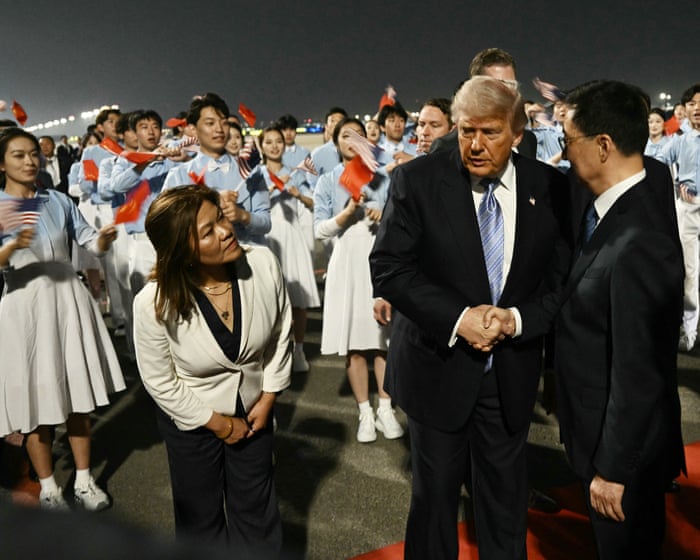
Trump pumped his fist as he came down the steps of Air Force One, then walked along a red carpet lined with 300 young Chinese people dressed in light blue and white. They waved red flags and chanted welcomes. On Wednesday evening, he was greeted by China’s Vice-President Han Zheng, Vice-Minister of Foreign Affairs Ma Zhaoxu, a military band, and an honor guard.
[Image description: Eric and Lara Trump, along with Elon Musk, walk off Air Force One upon arriving in Beijing. Photo: Brendan Smialowski/AFP/Getty Images]
Trump was joined by his son Eric and daughter-in-law Lara, as well as tech leaders like Elon Musk from Tesla and Jensen Huang from the chipmaker Nvidia. The US president has plans for big, attention-grabbing deals and previously predicted that China’s leader, Xi Jinping, would “give me a big, fat hug when I get there.”
The big questions hanging over the Trump-Xi meeting in China
Read more
But the Middle East conflict that Trump started—and seems unable to finish—will cast a long shadow over two days of talks. There are concerns that he might be tempted to weaken US support for Taiwan, the self-governing democracy that China claims, in exchange for Xi’s help.
“I don’t think we need any help with Iran,” Trump told reporters before leaving the White House on Tuesday. “We’ll win it one way or the other—peacefully or otherwise.”
[Image description: Donald Trump speaks to the press before walking to board Marine One as he departs from the White House. Photo: Kent Nishimura/AFP/Getty Images]
He also tried to downplay tensions with Beijing, saying Xi had been “relatively good” during the crisis and insisting that Washington had “Iran very much under control.”
The war has now entered its third month. Tehran is tightening its grip over the Strait of Hormuz, and Washington is struggling to turn a fragile ceasefire into a lasting peace.
Behind the scenes, US officials have spent weeks urging China—Iran’s biggest oil customer and one of the few countries with influence in Tehran—to pressure Iran into reopening the Strait of Hormuz. About a fifth of the world’s oil supply normally passes through that strait. The US also wants China to push Iran to accept American peace terms.
The US recently sanctioned several Chinese companies accused of helping with Iranian oil shipments and providing satellite imagery allegedly used in Iranian military operations. China condemned these measures as “illegal unilateral sanctions” and invoked a rarely used law that blocks Chinese companies from following them.
[Image description: Workers prepare the Temple of Heaven for Trump’s visit. Photo: Kevin Frayer/Getty Images]
Chinese officials have publicly called for stability while carefully avoiding openly siding with Washington. Last week, Foreign Minister Wang Yi hosted his Iranian counterpart, Abbas Araghchi, in Beijing and defended Iran’s right to develop civilian nuclear energy.
Xi has also indirectly criticized the US over the war. He said that upholding international rule of law is essential and “must not be selectively applied or disregarded,” and that the world should not be allowed to revert “to the law of the jungle.”
Still, neither side seems eager to let the Iran crisis derail broader diplomatic and economic engagement. This is the first of four possible meetings between Trump and Xi over the next year.
[Image description: Chinese Foreign Minister Wang Yi (right) hosted Iranian Foreign Minister Abbas Araghchi in Beijing last week. Photo: Iranian Foreign Ministry/UPI/Shutterstock]
The two countries are still locked in a fragile tariff truce reached last autumn, after tensions nearly sparked a full-scale trade war. Trump has long complained about China’s trade surplus with the US, while Beijing has been frustrated by American export controls and sanctions.
White House officials said Trump would travel with a de…A delegation of more than a dozen U.S. business leaders, including Elon Musk and Tim Cook, is traveling to China, signaling that both governments still seek economic cooperation despite their strategic rivalry. According to Bloomberg, a sale of 500 Boeing 737 Max jets—one of the largest orders in the company’s history—will be announced during the trip. Trump and Xi will also discuss creating a new trade board to manage what China should buy from the U.S. and vice versa.
Beijing also has reasons to avoid escalating tensions. China’s economy is still weighed down by weak domestic demand and a prolonged property crisis, while the closure of the Strait of Hormuz has highlighted its heavy reliance on Middle Eastern energy supplies.
Trump’s visit will be closely watched in Taiwan for any signs of weakening U.S. support. On Monday, he said he would discuss U.S. arms sales to Taiwan with Xi, breaking from the historic U.S. stance of not consulting Beijing on its support for the island.
He also insisted that his personal relationship with Xi would prevent a Chinese invasion of Taiwan. “I think we’ll be fine,” he said. “I have a very good relationship with President Xi. He knows I don’t want that to happen.”
Another key focus will be artificial intelligence, as both countries face calls to cooperate on global standards and safeguards. Bernie Sanders, an independent U.S. senator, urged Trump and Xi to agree on allowing top scientists to share technical information and establish “AI redlines” for dangerous behavior. Sanders said, “At the height of the Cold War, Reagan and Gorbachev found a way to negotiate nuclear arms control. The existential risk posed by AI demands nothing less from Trump and Xi.”
In Beijing, security has been visibly tightened ahead of the visit, with police stationed at major intersections and increased checks on the metro system.
The summit itinerary includes a formal welcome ceremony, private meetings between the two leaders, and a tour of the Temple of Heaven—a 15th-century religious complex symbolizing the connection between Earth and heaven. Trump will attend a state banquet on Thursday evening and then have tea and a working lunch with Xi on Friday before departing.
The U.S. president, who has been criticized for focusing on foreign policy at the expense of domestic issues in his second term, will be eager to project strength and present the trip as a success. Anna Kelly, the White House principal deputy press secretary, told reporters on a call Sunday, “President Trump cares about results, not symbols. But even still, the president has a great relationship with President Xi, and the upcoming summit in Beijing will be both symbolically and substantively significant.”
However, the U.S. approach is likely to be pragmatic and transactional, with little emphasis on structural reform. Scott Kennedy, a senior adviser on Chinese business and economics at the Center for Strategic and International Studies in Washington, said, “China and Xi Jinping come into this meeting in a much stronger position than the United States. China has goals they’d like to achieve: extending the ceasefire, reducing tech restrictions on semiconductor imports, and lowering tariffs. But even if they don’t get much on any of those fronts, as long as the meeting doesn’t blow up and President Trump doesn’t leave looking to re-escalate, China basically comes out stronger.”
Frequently Asked Questions
Here is a list of FAQs about Trumps meeting with Xi Jinping in China with the Iran situation as a backdrop
BeginnerLevel Questions
Q Why is Trump meeting with Xi Jinping in China
A They are meeting to discuss major issues between the US and China especially trade The goal is to try to reach an agreement that benefits both countries
Q What does the threat of war with Iran have to do with this meeting
A Its a big distraction While Trump is in China talking about trade the US is also dealing with a serious military standoff with Iran This makes the meeting more tense and complicated
Q Is this a friendly visit
A Its a highstakes business meeting not a casual visit Both leaders are under pressure so the atmosphere is likely very serious and formal
Q What is Trump hoping to get out of this meeting
A He wants China to buy more US products and change its trade practices to be fairer to American companies He also wants to avoid a fullblown trade war
IntermediateLevel Questions
Q How does the Iran situation affect the trade talks between Trump and Xi
A It creates a major conflict of interest The US wants China to stop buying oil from Iran but China needs that oil This puts Xi in a difficult position cooperate with Trump on Iran or protect Chinas energy supply
Q What is the threat of war specifically referring to
A It refers to the US sending military forces to the Middle East and increasing pressure on Iran after accusing Iran of planning attacks The risk is that a small incident could escalate into a direct military conflict
Q Could Trump use the Iran situation as leverage in the talks
A Yes possibly He might say to Xi If you help me solve the Iran problem Ill be more flexible on trade Or he could threaten to make things harder for China if it doesnt cooperate
Q What is Chinas main goal at this meeting