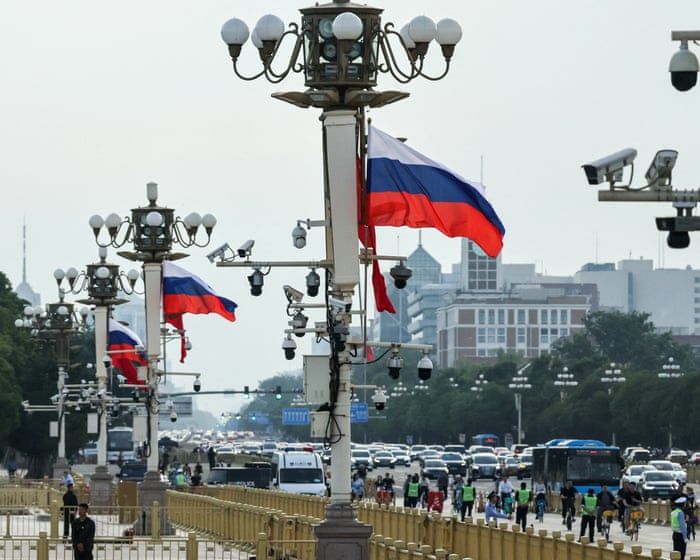
Vladimir Putin is set to arrive in Beijing on Tuesday for a state visit, just four days after Donald Trump left China.
This trip—Putin’s 25th to China, according to Chinese state media—shows Beijing’s growing confidence on the world stage as a hub of global diplomacy.
It also highlights the close bond between Putin and China’s leader, Xi Jinping. The two have met more than 40 times, far more than Xi has met with any Western leader.
“Hosting two of the most powerful leaders in the world within days shows China’s growing confidence in its place and standing globally,” said William Yang, a senior analyst at the International Crisis Group.
He added that Xi “likely wants to remind Trump that Beijing has other strong, reliable relationships it can depend on, so Washington can’t easily isolate or harm Beijing if it tries.”
Putin’s visit comes as he enters what may be the toughest period of his long rule. His tough-guy image at home is starting to weaken, as Russia has made little progress on the battlefield in Ukraine this year. Russia’s growing economic troubles are steadily increasing its reliance on China, turning what the Kremlin calls an equal partnership into a much more one-sided relationship.
On the eve of his visit, Putin released a video address to China. He said China-Russia relations had reached “an unprecedented level,” pointing to booming bilateral trade, the fact that payments are now almost entirely in rubles and yuan instead of US dollars, and mutual visa-free travel for Chinese and Russian tourists.
China’s foreign ministry spokesperson, Guo Jiakun, said on Tuesday that “the friendship between China and Russia will be further deepened and take deeper root in people’s hearts” thanks to the strategic guidance from Xi and Putin.
This year marks 30 years since Beijing and Moscow signed a strategic partnership agreement, and 25 years since they signed the “treaty of good-neighbourliness and friendly cooperation.”
Putin’s comments about non-dollar transactions highlight how much the two countries have been working to strengthen their ability to withstand Western sanctions, which rely on the US dollar’s dominance to be effective.
China does not follow Western sanctions on Russia. Since the full-scale invasion of Ukraine began, China has bought more than $367 billion worth of Russian fossil fuels, according to data from the Centre for Research on Energy and Clean Air.
Analysts will be watching to see if Putin and Xi agree on any deals to deepen energy cooperation further. The most high-profile project under discussion is the Power of Siberia 2, a 1,600-mile (2,600 km) natural gas pipeline that would add 50 billion cubic meters of gas capacity to Russia’s exports to China. The pipeline would run through Mongolia and is seen by the Kremlin as key to making up for lost European export markets.
An additional overland energy supply from Russia would reduce China’s reliance on the Strait of Hormuz, which has been disrupted by the US war with Iran. But it could also make China too dependent on Russia at a time when China wants to boost its own energy self-sufficiency.
Putin has been a background figure in Xi’s delicate relationship with the US. When Xi gave Trump a rare tour of his private residence in Beijing last week, the Chinese leader mentioned that Putin was one of the few foreign leaders who had also been invited into the Zhongnanhai compound, sometimes called China’s Kremlin. “Good,” Trump replied.
China has also faced Western sanctions as a result of the war in Ukraine.This month, the Chinese embassy in the UK lodged “strong representations” over London’s decision to add two Chinese entities to its sanctions list related to Russia. Western countries have criticized Beijing for continuing to support Russia through economic ties and the export of dual-use equipment that can be used for military purposes.
Ukraine was not mentioned in detail in either the US or Chinese summaries of the main bilateral meeting between Trump and Xi last week. However, the Financial Times later reported that, according to people familiar with the US assessment of the summit, Xi told Trump that Putin might end up regretting the war. China’s foreign ministry has denied these reports.
If these comments turn out to be accurate, they likely reflect China’s growing awareness of Russia’s struggles, both on the battlefield and at home. The war in Ukraine has largely reached a stalemate, while Ukrainian long-range drone and missile strikes have caused significant damage to Russia’s energy infrastructure and military facilities.
On Tuesday, a Russian deputy from Siberia called for a “swift conclusion” to the war, warning that Russia’s economy would “not withstand a prolonged continuation of the special military operation” — a rare public acknowledgment of the strain the conflict is placing on the country.
Additional research by Yu-chen Li
Frequently Asked Questions
Here is a list of FAQs regarding Vladimir Putins state visit to Beijing following Donald Trumps recent activities
BeginnerLevel Questions
Q Why is Vladimir Putin going to Beijing right now
A He is making an official state visit to meet with Chinese President Xi Jinping Its about strengthening the partnership between Russia and China
Q Is this visit related to Donald Trump
A Its happening right after Trumps reelection Many analysts believe Putin wants to show that Russia and China are still close regardless of who is in the White House
Q What will Putin and Xi talk about
A They will likely discuss trade energy deals military cooperation and their shared views on challenging US influence in the world
Q Is this a normal visit for a leader
A Yes state visits are normal However this one is getting extra attention because of the timing and because both leaders are under Western sanctions
IntermediateLevel Questions
Q How does this visit challenge the United States
A It signals that the RussiaChina alliance is solid They are coordinating their policies to counter US sanctions and expand their influence in Asia the Middle East and Africa
Q What specific agreements might come out of this visit
A Look for new energy contracts deals to use Chinas yuan for trade and joint military exercises
Q Why is the timing on the heels of Trump significant
A Trump has hinted at improving relations with Russia but is tough on China Putins visit reminds Washington that Moscow and Beijing are a united front making it harder for the US to play them against each other
Q How are other Asian countries reacting
A Countries like Japan South Korea and India are watching closely They worry about a stronger ChinaRussia bloc in the region which could affect their security and trade
AdvancedLevel Questions
Q Could this visit lead to a formal military alliance between Russia and China