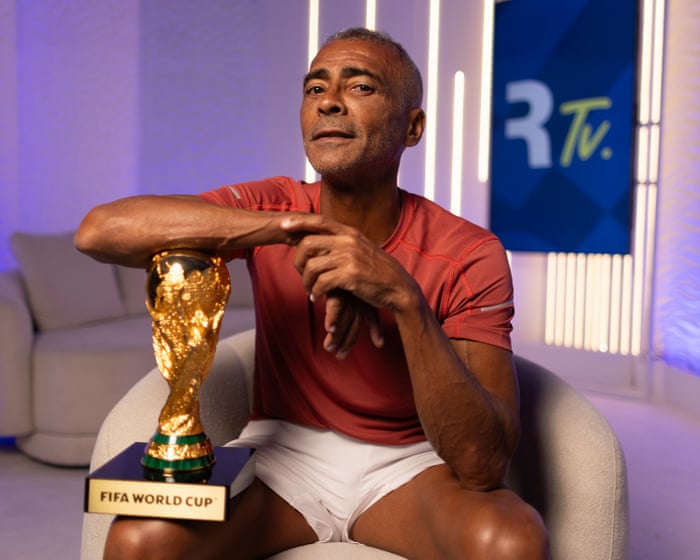
Not many people have interviewed Neymar, Robert Lewandowski, Xavi Hernández, and Iker Casillas in the past year. But then again, not many interviewers have the star power of Romário. Thirty-two years after the former Brazil striker became world champion and best player at the 1994 World Cup, he’s traveling far and wide to talk with football legends for his YouTube channel.
Romário started his “face to face with the man” project a year ago. “This whole Romário TV thing is completely new for me,” he says. “I’m really happy and enjoying it. It’s so cool.”
“It’s definitely a way to reconnect with my past. I stopped playing in 2006. This role as an interviewer takes me right back to moments I’ve lived through, especially when I talk to people from my generation. That’s probably one of the main reasons I’m enjoying what I’m doing now.”
Romário is one of the greatest players not just in Brazilian football, but in world football, and he’s not shy about saying so. “I consider myself one of the five greatest players of all time,” he says with his usual confidence.
When asked who else makes his list, he comes up with a top six. “Pelé, Maradona, Messi, Cristiano Ronaldo, me, and Ronaldo. That’s it. I’d give myself an 11 out of 10 as a player.”
The 11 rating also goes back to the number he wore early and late in his club career, and for most of his 71 appearances for Brazil, including at the 1994 World Cup. He was never a big fan of training or putting in a lot of effort, and he was criticized for his behavior, but he defends himself strongly.
“Romário was lazy,” he says, repeating a common accusation. “Romário didn’t practice the way many people thought I should. But I scored goals.”
“I was a force to be reckoned with on the pitch, and the rest didn’t matter. They had to deal with me. Anyone who didn’t like it just had to put up with it.”
Romário’s era was very different. It was a world without social media, which let him have a busy life off the field without being recorded or pressured by fans. Romário never hid his love for nightlife, and if he played today, he would have to behave differently, though he might also get more recognition for what he achieved on the pitch.
“I would have liked social media in my generation. I’m sure I would have wanted that back in my day. The internet really shows who you truly are. In football, for example, maybe 50% of Brazil didn’t have access to my matches and didn’t know how much I played. Today, everyone knows everything.”
“But there’s the other side. People didn’t know about the stupid stuff I did. That would have been a nightmare, but it’s part of life. If social media had existed in my era, I probably wouldn’t have done as much stupid stuff either. But the little I did do, people would have known about.”
Romário is smiling. His provocative personality pushed him after football into politics, a career he’s committed to alongside his life as a YouTuber. He started 16 years ago with PSB, Brazil’s socialist party, and was elected as a federal deputy in 2010 and a senator in 2014.
In 2017, he moved to the centrist party Podemos, and four years later, during the wave of populism under then-president Jair Bolsonaro, he accepted an invitation to join PL, the ruling far-right party at the time. Unlike Bolsonaro, who is under house arrest for an attempted coup, Romário opposes liberalizing gun ownership. He is pushing for more investment in education, which is not a priority for PL.
“My foHis focus is on education, health, social issues, and sports,” he says. “I fight for people with disabilities and for inclusion. I don’t pressure anyone to sign my project in exchange for something, like legalizing drugs. Legalizing abortion? I won’t sign that. Arming the country? I won’t sign that either. I only sign projects I believe are good.”
So how would he rate himself as a politician? Another 11, he says.
Romário’s independent path in politics, with his party changes and refusal to follow the party line, has drawn criticism from both sides. Presidential elections are scheduled for October, with Luiz Inácio Lula da Silva seeking re-election, and Flávio Bolsonaro, Jair Bolsonaro’s son who took over as the PL candidate after his father was declared ineligible, as the frontrunners.
Romário hopes Carlo Ancelotti’s team can first win Brazil’s sixth World Cup and bring the country back to more peaceful times. “We’re in a situation very similar to 1994,” he says. “Politically, the country is a mess. There’s this polarization between left and right, and violence is too high.”
“There’s a lot of negative news everywhere in the country. I’m saying this from personal experience because I lived through it: a win for Brazil would bring relief and joy to our people who are suffering. I’m sure it will ease the tensions in the country. The World Cup title brings hope for better days, hope for good things. I really hope Brazil wins the World Cup, but it’s going to be very difficult.”
Romário’s pessimism about Brazil’s chances comes more from the players’ performances for the national team than the squad’s quality, although he feels the country hasn’t produced greats like it did in his time with Ronaldo and Ronaldinho, and before that with Zico and many others.
“Brazil has players who perform well for their clubs. They play very well in the Premier League and La Liga. They’re idols on their teams. But when they put on the Brazil jersey, they fail to deliver. I hope that’s behind them now and that they can at least perform at 80% of the level they show for their clubs. If they can do that, Brazil will have a chance of winning the title.”
Romário believes a lack of “spectacular” players has boosted his popularity. “I think I’ve become even more important than I was before. Years ago, you had Romário, you had Ronaldo, but today there’s no one.”
“That’s why we remain important. We hold this great significance in Brazilian football because in our day we achieved and represented the country. Unfortunately, today, no one else represents it.”
Romário says there are five teams better than Brazil, but England isn’t one of them. “Brazil has a stature, and the Brazil shirt carries a weight that people respect a lot. England is a good team, but I see the other sides as better.”
“I like Harry Kane, Jude Bellingham, and Bukayo Saka. They’re smart players with great technique who make a difference. They might cause a bit of a stir, but I wouldn’t put them among the favorites. My favorites are France, Spain, Portugal, Argentina, Germany, and Brazil.”
The “short man,” as Romário is known, owes his life to football, but he’s not a big fan of watching the game. He generally prefers a day at the beach to an afternoon watching matches, though he makes exceptions for Brazil and the Premier League, where Pep Guardiola, a former Barcelona teammate, has been a draw.
“Pep was always a man with a very different kind of intelligence.”Even though he was the youngest player in a team full of stars like Hristo Stoichkov, José Mari Bakero, Ronald Koeman, and Miguel Ángel Nadal, he really stood out. He knew how to control the game.
“Johan Cruyff had a lot of faith in him. Pep was a young guy who really paid attention to Cruyff’s talks. He was always focused during training. He brought that same attitude into his coaching career, and that’s why he’s the best. He’s among the top two or three of all time.”
“He used to say that when I was in the dressing room, if I had my head down and was quiet, it was going to be a bad day. But if I was lively and dancing, no one could stop me. Everyone has days when things just don’t go their way. It was the same for me, but those days were rare.”
Before leaving, Romário takes over the conversation and interviews himself in what he calls the “greatest interview of all time.”
“Romário, how did you manage to play so much while putting in so little effort?” he asks. “Others were sleeping while you were out on the streets. Others were eating while you were having ice pops on the beach. How did you do it?”
“Now Romário is going to answer… I’ve always had a lot of confidence in myself. I was sure that if I had followed the path of a disciplined athlete, I wouldn’t have gotten where I did.”
“I was born in the favela Jacarezinho, then I moved to Vila da Penha, a suburb. I used to play barefoot. I hurt the tip of my toe a lot. I had to play football the way I felt comfortable, the way I felt happy. That’s why I was the way I was.”
Frequently Asked Questions
Here is a list of FAQs about Romário based on his famous quote and career
BeginnerLevel Questions
Q Who is Romário
A A Brazilian former professional footballer widely considered one of the best strikers in history He was famous for his incredible finishing dribbling in the box and a confident personality
Q Why did he say hes an 11 out of 10
A He genuinely believes he was one of the absolute best ever He wasnt just a 10 he felt he was even above that level in terms of his goalscoring ability and impact on the game
Q What is he most famous for
A Scoring goals He was a master at finding space in the penalty area and his ability to finish with both feet and his head was unmatched He also led Brazil to victory in the 1994 World Cup
Q Did he play for big clubs
A Yes He played for top clubs like PSV Eindhoven Barcelona Flamengo and Vasco da Gama He was a superstar in Brazil Spain and the Netherlands
Q What was his playing style like
A He was a short stocky striker who was incredibly quick and agile in tight spaces He didnt run much but he was deadly when the ball came near the goal
Advanced Controversial Questions
Q How does his 11 out of 10 claim compare to Pelé or Maradona
A Romário respects Pelé but often dismisses Maradonas greatness compared to his own He argues that his goalscoring record and technical skill in the box were superior Most experts rank him just below Pelé and Maradona but Romário disagrees
Q Was he really lazy off the ball
A Yes famously He was known for walking around the pitch for most of the game His logic was Why run if the ball isnt coming to me He conserved energy to explode into action when the chance came
Q What is his relationship with other Brazilian stars like Ronaldo