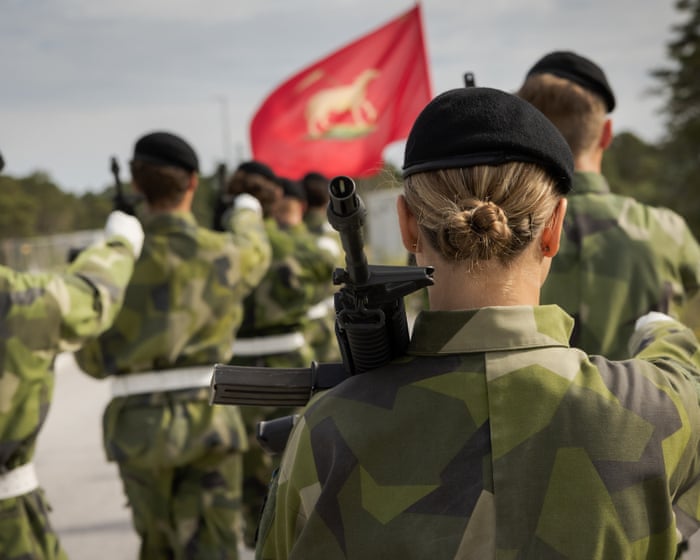
Just four months ago, Ella Adman had finished school and had never held a gun before. Now, the 19-year-old conscript stands in the shade between drills at a military base on Gotland, a strategically important Swedish island in the Baltic where she grew up, carrying a powerful assault rifle. In a few days, she’s set to carry out her first official mission in Stockholm: guarding the royal family.
At first, Adman was surprised by the length of her 15-month compulsory military service and the grueling 16-hour days she spends training and living alongside her male peers. Now, she’s getting used to it. “You find out what you’re capable of and how strong you become as a group,” she said.
Adman is one of hundreds of conscripts sent to the base near the medieval walled city of Visby as part of a rapid remilitarization on Gotland, a popular summer holiday spot for Swedes, amid the country’s wider rearmament. At the height of the Cold War, Gotland had four regiments and could mobilize 25,000 soldiers. But in 2005, its last regiment, P18, was shut down, leaving only a reduced Home Guard battalion.
Located 275 kilometers (171 miles) from Kaliningrad—the militarized Russian exclave between Lithuania and Poland—and 87 kilometers from the Swedish mainland, Gotland is seen as an ideal spot for Russian President Vladimir Putin to gain a foothold in the Baltic, sometimes called the “NATO sea,” from which to attack the alliance. As Sweden’s largest island, home to 60,858 people and host to the country’s political leaders for Almedalen—an annual democracy festival started in 1968 by Olof Palme, who became prime minister the next year—an attack would also carry huge symbolic weight.
In Swedish defense plans for 2025-30, a surprise attack on Gotland—either by air or sea, aimed at setting up air and naval defense zones near the island—was listed as one of seven potential situations needing priority planning. According to Swedish defense chiefs, from Gotland you can control sea and air operations in the Baltic Sea region and block reinforcements from reaching the Baltic states.
“If you can control Gotland, you can control the Baltic Sea too,” said Colonel Andreas Gustafsson, the commanding officer for the Swedish army on Gotland, after inspecting the conscripts. “So we need to keep control of Gotland—for Sweden, but also for NATO’s sake.”
Since being re-established in 2018 amid growing fears of a Russian attack, P18 has been built up at an unprecedented speed—only accelerated by Russia’s full-scale invasion of Ukraine. Since Sweden joined the alliance, the island has become a regular host for NATO training exercises.
This week, NATO leaders and Ukrainian President Volodymyr Zelenskyy will visit Ankara for a NATO summit (July 7-8), amid US complaints about European defense contributions and with the war in Ukraine still ongoing. In recent years, Sweden has been keen to show its commitment, raising its defense contributions to 2.8% of GDP by 2026 and 3.1% from 2028, and changing rules to expand conscription.
But despite this, rearmament is proving difficult as much of Europe rushes to increase defense spending, said Gustafsson. “NATO is currently in a major growth phase, which means everyone is out looking for military hardware. That makes it take time to get military equipment, especially artillery systems, and it limits how fast we can expand our capabilities.”
For now, there isn’t a single…Gustafsson said there is no immediate threat of a “conventional attack” on Gotland, with espionage and sabotage being more likely, but it can’t be ruled out. He added that the island could be especially vulnerable if there’s a ceasefire or peace deal with Ukraine, because Russian forces could then be quickly moved back toward Finland and the Baltic states. “The risk is always that Russia becomes desperate. The more pressure Russia is under, the more desperate they can be as well.”
The medieval city of Visby is a popular summer holiday destination for Swedes. Photograph: Karl Melander/The Guardian
If Russia were to attack, Sweden says it plans to defend itself and keep most civilians where they are. When mobilized, the combat group protecting the island is about 4,500 strong. “Of course, we would defend Gotland and do everything we can to stop Russia from getting a foothold there,” said Gustafsson.
But the hope is that remilitarization will be enough of a deterrent. Gotland is also being used as a test platform for defending all of Sweden, especially in terms of civilian preparedness.
Eva Rinblad comes out of her chicken and duck coop holding a two-week-old chick in each hand. “They’re getting panicky,” she says, with colorful duck tattoos visible on her arm. The doctor has long been interested in growing her own vegetables and keeping poultry at her rural Gotland home. But a year ago, as authorities issued more warnings, the 49-year-old decided to step up her focus on self-sufficiency. She set up an emergency preparedness group in her neighborhood, and they quickly formed a working team.
Eva Rinblad tends to her garden in Gotland, Sweden. Photograph: Karl Melander/The Guardian
Following advice from the Stark socken (strong parish) scheme, a civil preparedness initiative across Gotland, they started by taking a collective inventory of supplies in the neighborhood, including water, electricity, and communication. Next, they plan to map all available water sources. Gotland regularly faces water shortages, but many rural residents have their own wells.
Rinblad also plans to set up a local safety hub in case of emergency, where residents can get updated information, find warmth, cook, charge phones, and sleep overnight if needed. At home, they have a dedicated food cellar, large fruit and vegetable patches shared with another family, chickens, ducks, solar panels, and rain collection barrels.
If Russia were to attack tomorrow, Rinblad hopes local authorities would help the most vulnerable, but that wider society should continue daily life as much as possible. “Society should try to go on as normal – preschools should be open, schools should be open, you should go to work.”
Later this year, Gotland will run a test emergency evacuation of several hundred people from one part of the island to another.
Mikael Frisell, the director general of the Swedish Civil Contingencies Agency (MSB), said: “We have a very serious world situation, and we see out on the Baltic Sea that it’s an area where we are very close to Russia, and there are incidents both above and below the surface.”
To ensure “total defense” of Gotland, Frisell said a military presence and a “strong, robust, and resilient civilian defense” are needed. “If we have that, it contributes to the whole of NATO’s collective defense in this region.”
In case of attack, Gotland risks becoming “isolated” and having supply flows disrupted, said Frisell. “We are working to make Gotland as self-sufficient as possible, since it’s an island in the Baltic Sea.” As part of that, they are strengthening emergency services.Using findings from Ukraine, the island has improved its ability to handle mass casualties, manage unexploded ammunition, and search through damaged buildings.
Russia reportedly conducted drone surveillance of European nuclear sites over an 18-month period.
Because of its geography, Gotland is ahead of much of Sweden in terms of preparedness. The Swedish Civil Contingencies Agency (MSB) is using Gotland as a model for the rest of the country. Sweden’s approach to civilian defense is also drawing interest from other nations, including the UK, according to Frisell, who recently met with the British ambassador to Sweden.
Emil Edenborg, a Stockholm University professor who studies the changing role of the Baltic islands, said that while most people support the return of the military to Gotland, the changes haven’t been without tension. Besides debates over building permits and the impact on wind farm development, he noted that some people see the military presence as a “wet blanket on island life.” “Complaints aren’t really about the local armed forces, but about Stockholm and bureaucrats, who are seen as ignoring the interests of islanders,” he said.
Standing in Visby harbor as a ferry full of holidaymakers arrives, Per Wikberg, Gotland’s preparedness strategist, describes the ferry as the “highway” to the island. While Gotland is well on its way to being self-sufficient, there’s still a lot of work to do.
“You can never be finished,” he said. “When things go wrong, what happens then? Is our planning good enough, or do we need to make changes?”
Frequently Asked Questions
Here is a list of FAQs based on the headline The risk is that Russia becomes desperate the Swedish island in the Baltic Sea is getting ready for a possible invasion
BeginnerLevel Questions
1 Which Swedish island is getting ready for a possible invasion
The island is Gotland a large island in the Baltic Sea
2 Why is Gotland preparing for an invasion
Because of the war in Ukraine there is a fear that Russia might become desperate and attack a NATO member like Sweden Gotland is a strategic military location
3 What does Russia becomes desperate mean in this context
It means if Russia starts losing the war in Ukraine they might take extreme risks like attacking a NATO country to try to change the situation
4 Is Sweden part of NATO now
Yes Sweden officially joined NATO in March 2024
5 What is Gotland doing to get ready
Sweden is sending more soldiers air defense systems and military vehicles to the island They are also building up bunkers and fortifications
6 Is an invasion actually happening soon
No This is a preparation for a possible future risk not an immediate threat Swedish officials say they are taking the threat seriously but an attack is not imminent
IntermediateLevel Questions
7 Why is Gotland so important strategically
It sits right in the middle of the Baltic Sea If Russia controlled Gotland they could block sea routes to NATO countries like Poland Germany and the Baltic states
8 How does this connect to the war in Ukraine
Russias military is heavily tied up in Ukraine The worry is that if they face a major defeat there they might lash out elsewhere to prove they are still a global power or to distract from their losses
9 What specific military changes are happening on Gotland
Permanent garrison Sweden has stationed a permanent mechanized battalion there
Air defense New radar systems and antiaircraft missiles are being deployed
Civil defense Bunkers are being reopened and evacuation plans are being updated
10 What does the Swedish government say about the risk level
They say the risk of an attack on Sweden is