“It looks like something Shrek would throw up,” sniffed one online commentator, unflatteringly comparing Rotterdam ROCKS! — the recently unveiled proposal for a waterfront site in Europe’s largest port — to the vomit of a cartoon ogre. Designed by Dutch architectural firm MVRDV, which gave London the supremely underwhelming Marble Arch Mound in 2021, Rotterdam ROCKS! (the emphatic capitals suggesting an in-your-face energy) won a major architectural competition meant to create “a new world wonder.”
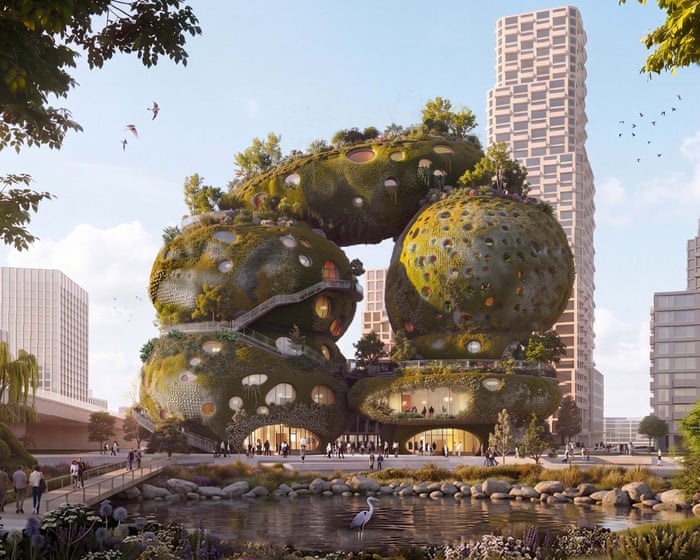
But instead of a modern Hanging Gardens of Babylon or a contemporary Colossus of Rhodes, MVRDV’s slick renderings show a pile of artificial “rocks” (or ROCKS!) stacked together in a huge, tottering cairn, wrapped in suspiciously lush greenery and drenched by an absurd waterfall.
Conceived as a paying visitor attraction that will promote sustainability and green living, the €240m (£205m) project is the ambitious brainchild of Dutch entrepreneur Don Ritzen, who made his name through Rockstart, a venture capital fund for green tech startups. Ritzen’s mission is to speed up the world’s shift to a green economy through his non-profit organisation Shift, which provided the push for this radical new landmark — to be built on a site previously earmarked for football club Feyenoord’s new stadium.
The project will anchor the Waterkant, a more architecturally ordinary large-scale urban development on the south bank of the Maas. Rotterdam’s docklands, flattened during the Second World War, have been a blank canvas for architectural experimentation, but with its over-the-top, Flintstones-like primitivism, Rotterdam ROCKS! will be by far the most strikingly offbeat offering to date.
Hyperbole is everywhere. Described as “a stacked landscape of living rocks that turns architecture into a regenerative, urban ecosystem and a new landmark for the city: rocks that breathe,” the project also includes more practical features like a hotel, conference centre, food court, and viewing deck. At its core is an immersive experience called the Elysium, which will showcase models of sustainability and circular living, elevating them into “something individuals, companies and organisations can feel, experience and act on.”
In theory, visitors paying between €20 and €45 will leave feeling energised and motivated to spread a new green gospel that goes beyond recycling their rubbish and offsetting their short-haul flights. But in practice, it might just end up being a wallet-draining wander around a strange-looking building, much like visiting a funfair.
If the disappointing Marble Arch Mound is anything to go by, MVRDV has its work cut out. Optimistically planned as a temporary artificial hill dotted with lush vegetation, the Mound was plagued by cost overruns, shoddy construction, and visitor indifference. Its patchy sides of stuck-on turf were described by one critic as “more like an ensemble of ill-matched carpet tiles than a greensward,” drawing comparisons to those scrubby winter wonderlands that pop up every Christmas to let down festive revellers.
Computer-generated renderings are always a gamble, and MVRDV went all out on Rotterdam ROCKS!, no doubt to win over the competition jurors. But already some design elements are being toned down — the gushing waterfall has been quietly dropped — as the sobering reality sets in.The realization of how this absurd creation might actually be constructed starts to set in. A non-computer-generated photo shows architect Winy Maas (the M in MVRDV) holding a pile of moss-covered pebbles.
There are plenty of other contradictions too. Ritzen clearly believes in history’s “great man” theory, where idealistic outsiders and entrepreneurs heroically save the world, and progress is driven by “charismatic” individuals (like the Musks and Zuckerbergs) rather than the messy, collective efforts of politics and society.
But in an era increasingly shaped by the idea that “the greenest building is the one that already exists,” the notion of building a hugely expensive, flashy ornament that’s likely to age poorly seems like a massive mistake—designed only to boost egos and attract online attention.
View image in fullscreen
Doubly doomed … a rendering of Rotterdam ROCKS! Illustration: MVRDV
Wouter Vanstiphout, a leading Dutch architectural historian, summed it up: “It’s as if MVRDV has let the entire fundamental conflict between architecture and sustainability collapse in a gesture of self-loathing, a metaphorical ruin of the very concept of architecture, caving in under its own weight, chewed on and overgrown by a nature that has turned against humanity out of spite.”
The final twist was that Rotterdam ROCKS! was revealed during the peak of Europe’s scorching summer, when the real-world consequences of the climate crisis became even more painfully obvious, as wildfires destroyed large areas of countryside. The low-lying Netherlands (often called the Maldives of Europe) is doubly cursed, with more than half its land also at risk of flooding. Nearly all of Rotterdam sits below sea level, so if things keep going down the predicted disastrous path, Rotterdam ROCKS! might one day end up underwater. Which could be exactly where it belongs.
Frequently Asked Questions
Here is a list of FAQs based on the headline ranging from basic to advanced
General Background
Q What is this miracle project in Rotterdam
A Its a massive experiment to dump millions of tons of rocks into the North Sea The idea is to use crushed volcanic rock to soak up carbon dioxide from the atmosphere and trap it in the ocean for centuries
Q Why are they doing this in Rotterdam
A Rotterdam is Europes largest port and a major industrial hub Its a practical base for shipping huge amounts of rock and the North Sea nearby is the test site It also helps the port and local industries meet climate targets
Q How does throwing rocks in the ocean fight climate change
A Its called Enhanced Weathering Rain and seawater naturally react with volcanic rock pulling CO out of the air and turning it into a stable mineral Crushing the rock into sand makes this natural process happen much faster
Q Is this a new idea
A The natural process is as old as the Earth but using it deliberately on a huge scale to fight climate change is very new This Rotterdam project is one of the first largescale tests of the idea
The Cost The Criticism
Q Why does it cost 240 million Is that a waste of money
A Critics say yes its a vanity project The cost covers mining crushing shipping and spreading millions of tons of rock The concern is that this money could be spent on proven solutions like solar panels or wind farms instead of a risky experiment
Q If it costs that much what do we get for it
A We get data The project will tell us if this method actually works on a big scale how much CO it really removes and what the side effects are on ocean life Its a research cost not a permanent solution
Q Will this actually lower the temperature
A No not on its own Even if it works perfectly the amount of CO it removes is a tiny drop in the bucket compared to what we emit Its meant to be one tool in the box not a replacement for cutting emissions
Q Wont the rocks just sink and disappear