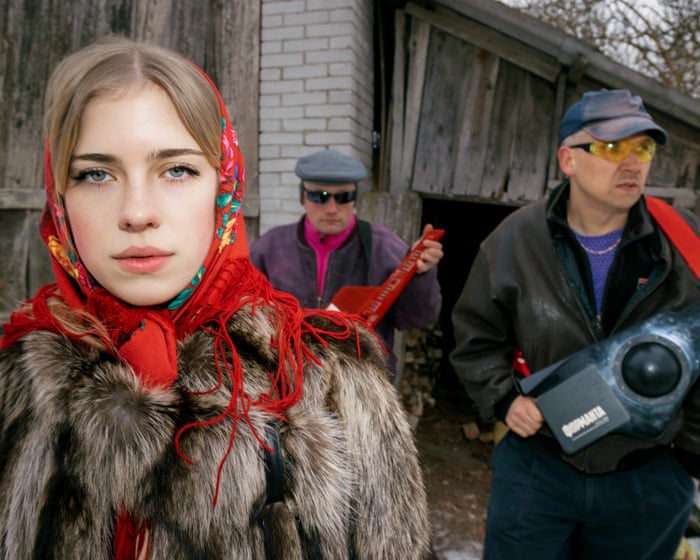
It’s 6pm on the first day of the OFF festival in Katowice, and a crowd is gathering in front of one of the stages to watch newcomers Tercet Imperial. Dressed in disco-style nylon jackets, tracksuits, and Chicago Bulls caps, keyboardist Piotr Zabrodzki plays sharp, resonant acid melodies, while drummer Jan Emil Młynarski keeps up a fast, uneven rhythm that recalls the scattered beats of footwork—the ghetto-house style that emerged from Chicago in the late 90s.
Few of those dancing in front of the stage are likely to realize they’re hearing something distinctly Polish: the oberek, a traditional dance in triple meter whose name comes from the Polish verb “to spin,” because it usually goes with couples twirling across the dancefloor in circles.
“We play traditional music, but on different instruments,” says lead singer Joanna Sztucka. On Tercet Imperial’s debut album, Prymat, the melodies and lyrics of traditional songs are woven into modern production: violins and snare drums are swapped for synthesizers and drum pads. “It’s an attempt to create an alternative history,” Młynarski says. “We’re doing it mainly for people who know nothing about traditional music and don’t need to know anything at all.”
Tercet Imperial are part of a bigger movement. Far away in Chicago, Footberk Suite, by drummer Gary Gwadera (real name: Piotr Gwadera), is a concept album about an imagined meeting between the oberek and Chicago footwork. Its roots go back to the influential footwork compilation Bangs & Works Vol 1, released by Planet Mu in 2010, which inspired Gwadera. “I suddenly realized that the grooves and pulse of footwork were typical of the oberek, and I wanted to combine them,” he says. To record it, he used a dżaz—a minimalist percussion kit from the Polish countryside—along with a Roland TR-808 and electronic pads.
Musician Mateusz Kowalski offers a different take on this traditional music with his groups Radical Polish Ansambl, Tęgie Chłopy, and Warszawska Orkiestra Sentymentalna. On his first solo album, released last year under the name Sam Kowalski, he replaced the violin with a gitalele (a small instrument that blends a classical guitar and a ukulele) and slowed the tempo, with no percussion—turning the oberek’s nervous phrasing into a gentle, melancholic flow reminiscent of Appalachian folk music.
Elsewhere, Polish duo Opla first translated the oberek’s triple rhythms and raw energy onto electric guitar and drums, and later onto electronic pads, adding effects and looped guitar parts. Polish-French jazz quartet Lumpeks sound like Ornette Coleman on a long wander through the Polish countryside. Suferi, meanwhile, mixes oberek rhythms with electrified violin, an effects-heavy guitar, and a hip-hop groove on the drums.
Often, even a trained ear won’t immediately catch the traditional dance’s influence—and that’s exactly the point. As Kowalski explains, when releasing his self-titled album, he didn’t label it as traditional music. “Rather, I wanted to say: listen without any preconceptions and see what this music does to you. The idea is for people to be surprised when they find out this is traditional material,” he says.
The renewed interest in Polish tradition and its creative expressions stems from the turbulent history of rural music in Poland. Before World War II, it was part of everyday life—weddings, celebrations, and rituals—and passed down by ear. But war and migration broke the continuity of music across regions. During the communist era, a state-approved version of folklore emerged, represented by the official song-and-dance ensembles Mazowsze and Śląsk. After the country’s political transformation in the late 1980s and early 1990s,In the 1990s, Poland’s own style of popular dance music, disco polo, took over the role that village bands used to play in social life. It mixed a few traditional folk touches with Italo disco beats, aiming to be simple, affordable, and perfect for weddings.
Oddly enough, just as rural areas were moving away from traditional music, city people started looking for it again. The Dom Tańca social centre, set up in Warsaw in the 1990s, was key in bringing traditional music back. Young musicians went out to find older rural players, recording and learning from them directly, while also bringing back the custom of village dances.
“For my generation, traditional music was something we were initially embarrassed about. Honestly, nobody in my circle knew anything about it,” says Gwadera. “I didn’t have the key to understand that music, and I saw it as a bit shameful.”
Hubert Zemler from Opla admits that he had listened to Hindu raga before he ever heard a truly interesting oberek. “For a long time, I linked folk music with Mazowsze and the Śląsk ensemble – a polished, official version of tradition. Obereks have a triple, danceable rhythm; they’re round dances that people used to play for hours. But they never made it into disco polo or pop. Why isn’t there any hip-hop in 3/4 time?”
Since 2020, this musical interest in rural life has gone hand in hand with a wider “peasant turn” in Polish culture and public discussions. Books like Adam Leszczyński’s A People’s History of Poland and Kacper Pobłocki’s Chamstwo, along with the Netflix series 1670 (whose recently released third season has been the most popular Polish show this year), have moved historical stories away from kings, nobles, and intellectuals. They sparked debates about the peasant roots of most Polish society: the experience of serfdom, the history of moving up in the world, and the suppression of rural heritage.
Nowadays, says Gwadera, traditional music is increasingly “seen as part of our own heritage and the forgotten history of most people – it has become a way to meet the need for a sense of community.”
The oberek no longer has to be a nod to the past or a folkloric decoration – it’s becoming the language of modern creativity. Młynarski says: “I’m sure that if this old rural melodic tradition had survived and hadn’t been replaced by disco polo and party music in the 1990s, people would still be playing it today – but on synthesisers and in tracksuits.”
Tercet Imperial play at Unsound festival in Kraków from 8–11 October, Le Guess Who? in Utrecht from 5–8 November, and Unsound London from 25–26 November 2026.
Frequently Asked Questions
Here is a list of FAQs about the intersection of hiphop and Polish folk dance specifically focusing on the 34 time signature
Beginner Questions
1 Wait why is it weird to have hiphop in 34 time
Most hiphop is in 44 time which means four beats per measure It creates that steady headnodding boombap groove 34 time has three beats per measure which feels like a sway or a circle dance Its a completely different rhythmic feel so producers rarely use it because it doesnt naturally fit the standard hiphop template
2 What is a Polish folk dance and why are they putting it with hiphop
Polish folk dances like the Polonez Kujawiak or Mazur are traditional dances The Polonez is a stately procession while the Kujawiak is a lyrical sliding dance Artists are blending these traditional melodies and dance steps with modern hiphop beats and rap delivery to create a new hybrid sound that honors their heritage while making it relevant for younger audiences
3 So is this just a gimmick or does it actually sound good
It can sound amazing When done well its not a gimmick The driving rhythm of the hiphop beat provides a new backbone for the folk melody The syncopation of the rap can play against the waltzlike sway of the 34 time creating a really unique and hypnotic groove that feels both nostalgic and brand new
4 Which Polish folk dance is in 34 time
Most of the national Polish dances are in 34 time including the Polonez Kujawiak and Mazur The Krakowiak is in 24 time When people discuss hiphop in 34 they are usually referring to the Polonez or Kujawiak
5 Who is actually doing this Can you name some artists
Its a growing niche scene mostly in Poland Artists like