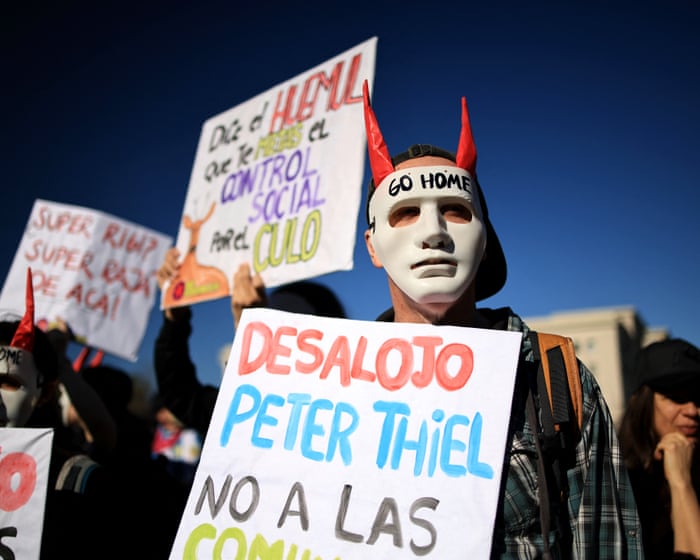
Dozens of protesters gathered outside Peter Thiel’s mansion in Buenos Aires this week, following a congressional session that raised questions about the billionaire’s presence in the country. Wearing white masks, they held signs reading “Peter Thief” and “No to the Peter Thiel law” in front of the wrought-iron gates of the $12 million (£8.9 million) home, which Thiel purchased in April when he relocated his family to Argentina.
There is widespread unease about the tech magnate’s arrival in the country. His move has been described as part of a strategy to prepare for the possibility of World War III: Argentina, with its rich agriculture and location deep in the southern hemisphere, might be the perfect place for a tech billionaire to ride out a global catastrophe. But recent events in the country suggest Thiel may have more practical reasons in mind.
Last week, Argentina’s chamber of deputies held a six-hour debate on a series of sweeping regulatory changes proposed by Javier Milei’s right-wing government, shortly after Thiel moved to Buenos Aires. Lawmakers invited Thiel, Milei, and an official linked to Argentina’s intelligence services to answer questions.
“None of them responded, and none of them showed up to the meeting,” said Juan Marino, a member of the chamber of deputies and leader of the Piquetero party. Marino described the new laws as a “technofascist legislative package” aimed at strengthening the influence of US tech billionaires in the country. Thiel has not publicly supported these measures, but Marino and others argue the timing is telling.
The congressional session came after deputies from several parties formally requested information from the government about Thiel, his meetings, and his business dealings. None of those requests have been answered.
One of the proposed laws, known as the “super RIGI,” would create an investment framework offering foreign companies a minimal tax rate and a 30-year guarantee against regulatory changes. It specifically highlights AI data centres as a target for investment. Another proposal, which failed, sought to remove most restrictions on foreigners buying land in Argentina. A final decree would require certain civilian government departments to share large amounts of personal data on Argentine citizens with state intelligence agencies.
There is no evidence that Thiel has directly lobbied for these laws. However, in the months after moving to Buenos Aires, he held closed-door meetings with Milei and key presidential advisers. It is unusual for a foreign investor to have such level of access.
In the regulatory package, Marino and others see the influence of Thiel’s broader techno-libertarian agenda. The decree granting state intelligence agencies access to vast amounts of personal data comes as Argentine deputies have increasingly pressed for answers on whether Palantir, the company Thiel co-founded, has undisclosed contracts with the state—so far without response.
Marino suggested the land law could have opened the door to semi-autonomous “startup cities,” similar to the controversial Próspera project in Honduras, which Thiel has promoted as a way for libertarians to create zones outside government control.
“Argentina is kind of a laboratory,” said Cecilia Nicolini, who represents Argentina in the Mercosur regional parliament. US tech billionaires, she said, “are using Argentina as a laboratory, because they have a person in power.”Milei, who is even more extreme than they are, wrote an article in the Financial Times over the summer advocating for the creation of “non-human corporations” – entities run by AI agents or robots. This idea aligns with a vision put forward by OpenAI’s CEO, Sam Altman, who predicted in 2024 that AI-owned companies could soon run the world. It also raises serious and complex questions about the legal responsibilities of such entities.
Nicolini commented, “It’s not just that [Thiel] chose Argentina because it’s a safe place to live in a world facing wars and other issues. But really, behind it, I think there’s a clear plan. And it’s connected to the reforms Milei is trying to push through, with some success in certain areas and backlash in others.”
Thiel was contacted for comment.
Frequently Asked Questions
Here is a list of FAQs regarding Peter Thiels move to Argentina ranging from beginner to advanced levels with clear and direct answers
BeginnerLevel Questions
1 Did Peter Thiel actually move to Argentina
Yes he has confirmed that he spends most of his time in Buenos Aires Argentina He has been shifting his primary residence there since around 2020
2 Is he really moving there because he thinks the world is ending
Not exactly He has said he wants to escape the doom he feels in the US and California He views Argentina as a place with a will to survive and less political stagnation rather than a literal bunker for an apocalypse
3 Is he doing this for tax reasons
Its a factor but not the only one Argentina currently offers a tax amnesty for undeclared assets and he has invested in Argentine tech startups However he has publicly stated that his main motivation is cultural and philosophical not purely financial
4 What does he mean by the end of the world
He often refers to the end of the world metaphoricallymeaning the decline of Western institutions particularly in the US and Europe He sees a lack of innovation overregulation and a culture of safetyism as signs of civilizational decay
5 Is he building a bunker or a survivalist compound there
No He lives in a normal neighborhood in Buenos Aires He is not hiding in a remote bunker he is integrating into the citys business and social scene
IntermediateLevel Questions
6 Why Argentina specifically instead of Texas or Florida
He argues that Texas and Florida are still part of the US system he is unhappy with Argentina offers a clean slate with different cultural values He is particularly drawn to the Argentine concept of viveza criolla and their experience with economic collapse which he believes makes them more resilient and less naive than Americans
7 What is his actual business plan in Argentina
He is heavily investing in Argentine tech startups through his venture capital firm Founders Fund He is also involved with the Patagonia region as a hub for libertarianminded entrepreneurs He wants to prove that you can build a tech ecosystem outside of the US