My dream holiday is a trip back in time. Not to see the ruins of Pompeii or the 15th-century city of Machu Picchu—though I love both—but to a place built between the mid-1950s and 1970s, when cities were getting strange. I love postwar architecture tourism, exploring urban planning at its most frantic and hopeful. I’ve really enjoyed trips to Niemeyer’s Brasília and Le Corbusier’s Chandigarh in India, where the grand, visionary modernist buildings and interiors feel out of step with the tiny population. So La Grande-Motte, a retro-futurist resort town on the southern coast of France, about a 30-minute drive from Montpellier, had been on my “must visit” list for a long time.
The tourist board of this Occitanie seaside town likes to point out some surface similarities between it and those cities, but this isn’t a high-concept capital or administrative center. It was built in the late 1960s and early 1970s purely to persuade the French to stop going south to Spain’s Costa Brava. As part of a French government initiative, a stretch of windy, mosquito-filled coast between Montpellier and Perpignan—including Gruissan and Port Leucate—was reimagined as an alternative to the Côte d’Azur, with several new beach towns. La Grande-Motte would be the strangest project. It was made for fun. It’s also well placed for visiting the nearby salt marshes and the 13th-century walled town of Aigues-Mortes, when you want to feel like you’ve checked off a few more holiday boxes.
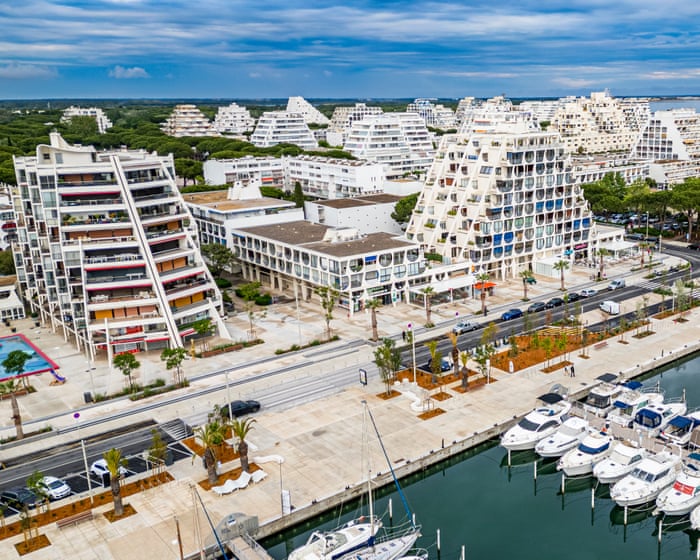
The mastermind behind the town’s architecture, Jean Balladur, drew inspiration from temples and Mesoamerican pyramids from the first century, imagining what the 21st century would look like from a 1970s perspective. Why shouldn’t modernist apartments be shaped like a Maya pyramid or an intergalactic curve? I rented a tiny studio with my husband in the Incas building for part of my trip, and while the interior wasn’t high design, being on that terrace put us right in a time warp.
Walking around Point Zéro (named for being the site of the earliest construction), home to La Grande-Motte’s main beach, everything looks fairly standard: families playing on the sand, couples sipping cocktails outside cafes. The beach earned a Blue Flag award for environmental management and water quality in 2025. But the place is unique: the ferris wheel is solar powered, and the buildings make you feel like you’re on another planet entirely—there are no rectangular blocks and few right angles to be seen. The urban planning is driven by pedestrian paths and bike routes, dotted with thousands of trees.
It seems a renaissance is underway, as the grandchildren of the people who first bought apartments here are discovering it.
On the beach, there are concrete sculptures by artist Joséphe Chevry, which look like the tips of wartime sound mirrors in Dungeness, Kent. Chevry created them to help shape the dunes (also known as “the big mound”) but also to serve as functional windbreaks and shade when Point Zéro was built. They’re now mostly buried in the sand. Time has moved on, but they will always be central to the town’s concept.
The place has had ups and downs. Like many seaside towns, it fell out of favor in the 1980s. It was seen as tacky. In 2014, fashion designer Simon Porte Jacquemus created a nostalgic collection and book in tribute to the town and told AnOther Magazine about its “trashy reputation,” but he also said he found it “inspiring and exciting” and remembered his childhood holidays there. And it seems a renaissance is underway, as the grandchildren of the people who first bought apartments here are discovering it.
The balconies jut out.The balconies jut out like theatre boxes, creating an optical illusion that makes the building look slanted. I’d recommend the fabulously vintage three-star Hotel Le Quetzal (doubles from €114 room-only) as an interesting base. It has a brilliant 1970s feel, being part of the town’s original development, but it was refurbished a few years ago, so the essentials are fresh and modern. Its design is as intriguing as anything in town: the balconies stick out like theatre boxes, giving the building a slanted appearance. There’s no restaurant, but people microwave meals in the lobby or grab a margherita from nearby L’Atelier de la Pizza to enjoy on their balcony.
A couple of days by the pool here are great—fending off seagulls from your pain au chocolat at breakfast and watching stray cats wander around the loungers; the same families have been coming for years. Nearby, L’Innatendu is a better restaurant than anything on the seafront (I particularly recommend the squid with black rice), although the most enjoyable meal I had was a bunch of simple marinated skewers at La Guinguette des Alizés, opposite the seafront carousel on Avenue du Couchant that looks like a piece of pop art.
Strolling around La Grande-Motte’s apartment blocks was as fascinating to me as a visit to the Colosseum. I walked through the open-air theatre that looks like a derelict World’s Fair site but is used for shows regularly, around the elegant white bow shape of Saint-Augustin’s church, down to the water and the Big Pyramid apartment complex facing the yachts on the dock, and to the low, curved buildings of Le Couchant. I spent hours photographing stairwells and walkways, and the hundreds of balconies that make the town the sum of its geometric parts—graphic beauty reminiscent of the Bauhaus, Saul Bass posters, and Verner Panton furniture. La Grande-Motte is a sunny, gleaming white vision of a future that we could never live up to. Or perhaps deserve.
Frequently Asked Questions
Here is a list of FAQs about the retrofuturistic seaside town near Montpellier known as La GrandeMotte
General Background
1 What exactly is Architourism
Its travel specifically to see and experience famous or unique architecture Instead of going for the beach or the food you go to see buildings that are considered works of art or historical landmarks
2 Where is this town and what is it called
Its called La GrandeMotte Its located on the Mediterranean coast about a 30minute drive east of Montpellier in southern France
3 Why does it look like a scifi movie set
It was built in the 1960s and 70s by architect Jean Balladur He was inspired by preColumbian pyramids and the futuristic visions of the time The result is a town full of curved pyramidshaped buildings that look like they belong on a distant planet
4 Is this an old town that was renovated or was it built from scratch
It was built entirely from scratch on empty marshland The French government created it as a new tourist resort to handle the growing demand for beach holidays
5 Is it just a bunch of ugly concrete blocks
Not at all While it is concrete its very sculptural and organic The shapes are curved and smooth and the buildings are designed to blend with the sky and sea Many people find it beautiful poetic and surprisingly elegant
Visiting Practicalities
6 Can I just walk around and look at the buildings or do I need a tour
You can absolutely walk around for free The architecture is public However to get access to the rooftops or the interiors of some of the private residences youll need to join a guided tour organized by the local tourist office
7 Is this a good place for a family beach holiday or is it just for architecture nerds
Its excellent for both The beach is wide sandy and safe for kids Parents can enjoy the retro vibe while kids play Its a very functional resort so you get the best of both worlds
8 When is the best time of year to visit
For the golden hour photos and pleasant weather visit in