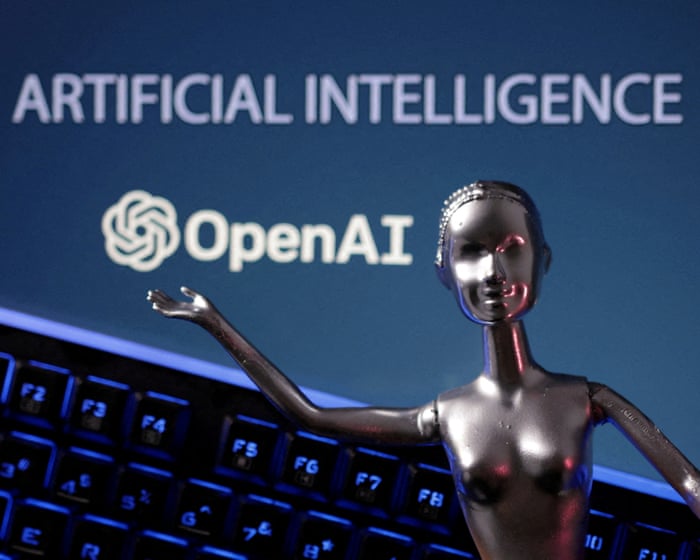
It was a week that left mathematicians stunned. Right after a wave of cases where artificial intelligence advanced the field, OpenAI claimed a major victory: its latest AI model had solved a Millennium Prize Problem, a puzzle with a $1 million reward that had stumped humans for decades.
The achievement looked nothing like how mathematical problems are usually solved. A private company worth nearly a trillion dollars had unleashed 10,000 agents—AI systems that perform tasks on their own—on the problem. The cost was estimated at $15 million.
The path toward AI capable of superhuman math has long been clear, but solving such a significant problem so quickly sent shock waves through the field. Mathematicians are asking what will be left for them if work in progress is swept up and claimed by others, and how they should train the next generation when even the toughest assignments can be solved at the push of a button.
“I feel slightly shell-shocked,” said Prof Colva Roney-Dougal, head of pure mathematics at the University of St Andrews. At a recent public lecture, she said she believed AI was unlikely to do anything remarkable soon. “Three months later, I’m totally wrong,” she says. “We’re all just waiting to see what happens. It’s coming so fast.”
Prof David Silvester, a mathematician at the University of Manchester, said the field feels “very unstable” given the pace of change. “All the open math problems could fall with enough resources,” he said. “This is irreversible. This is not going to change.”
Prof James Robinson, a mathematician at the University of Warwick, said hard problems are the fuel of mathematics, driving creative approaches across generations. “It’s frustrating to see these big tech companies burning this fuel up just so they can show off about how great their latest model is,” he said. “It seems like immature playground boasting writ large, backed by billions of dollars and the potential for significant environmental damage in an age when climate change is probably the biggest challenge we face.”
One reason Silvester went into math was the thrill of cracking a problem. For many mathematicians, it is the weeks, months, and years spent circling a problem, breaking it down, trying one approach after another, and never giving up that appeals. “Without that, the subject seems completely different to me,” Silvester said.
Mathematicians already spend considerable time verifying each other’s proofs. It was this kind of review that found a gap in Andrew Wiles’s work on Fermat’s Last Theorem in 1993, prompting a year of further effort to fix the flaw. Silvester suspects mathematicians might find themselves poring over ever more proofs dashed out by AI. “It’s more like becoming an accountant, you’re auditing, you’re checking,” he said.
There are knock-on effects throughout the field. Mathematicians are hired based on their published papers, but problems they have been working on for months might now be solved by AI in days. “There’s a real sense of ‘I could spend the next month thinking about something and somebody else does it by pushing a button,'” says Roney-Dougal. “That’s horrible, and I think it’s going to be horrible for a few years.”
It’s also a headache for teaching undergraduates. Universities routinely give students problems and quizzes to work through at home. That kind of coursework is now dead. “There’s no point in doing it because we can’t vouch for its authenticity,” says Silvester. Lecturers now have to tell students not to use AI for some problems, while making sure they can use it for others: after all, AI-assisted math is the future.
For all the upheaval, Prof Alexander Paseau, who studies the philosophy of mathematics at the University of Oxford, believes math will not lose much of its appeal. “The challenge“It still remains, even if AI eventually becomes better than humans at research,” he said. “You’ll still want to understand the mathematics yourself. And we’ll still enjoy it and appreciate its beauty: the sheer enjoyment and beauty of a mathematical proof will always be there. AI won’t take any of that away.”
Much of AI’s mathematics doesn’t solve problems from scratch but builds on human work, he added. The OpenAI breakthrough, for example, relied heavily on work by Madrid-based mathematicians Diego Córdoba and Luis Martinez-Zoroa.
OpenAI’s work described a solution to the Navier-Stokes problem, which involves equations that predict how fluids, and even the weather, behave. It is one of seven Millennium Prize Problems published by the Clay Mathematics Institute in 2000. The company’s announcement on Tuesday has led to further concerns in the community. OpenAI set its latest model to work after hearing rumours that two Millennium Problems had been solved by mathematicians. Professor Tristan Buckmaster at New York University and Levent Alpöge at Anthropic were doing related work on Navier-Stokes and had used OpenAI’s products in the process. They suspected OpenAI’s model had learned from their work in progress. After an investigation, OpenAI denied this was the case.
Some mathematicians are still wary, however. “The big story now in mathematics is that nobody wants to share anything,” Buckmaster told the Guardian. “Mathematics is different today than it was only a few days ago. We have to decide what to do about that.”
Frequently Asked Questions
FAQs Immature Playground Boasting Mathematicians Uneasy at OpenAIs Latest Conquest
Beginner Questions
What does immature playground boasting mean here
Its a phrase critics use when AI companies brag about solving hard problems in a way that feels like kids saying my dad can beat up your dad more about winning attention than advancing real understanding
What did OpenAI actually do
OpenAI announced that one of its AI models helped solve or contribute to a longstanding open problem in mathematics Mathematicians responded with a mix of interest and irritation
Why are mathematicians upset
Not because AI helped with math but because of how the result was announced Many feel the framing exaggerated the AIs role skipped over human contributions and turned serious research into a publicity stunt
Did the AI really solve a math problem on its own
Usually no In most cases like this the AI generated candidate ideas or partial proofs and human mathematicians verified refined and completed the work
Is this just hype or is something real happening
Both AI genuinely can assist with mathematical exploration but the announcements often oversell what happened
Intermediate Questions
Whats the difference between a proof and a candidate proof
A proof is a complete logically airtight argument that other mathematicians can verify A candidate proof is a proposed argument that still needs checking it may have gaps errors or hidden assumptions
Why does verification matter so much in math
Math is built on certainty A result isnt accepted until experts can check every step AI output that looks like a proof isnt the same as a proof
Whats a concrete example of this pattern
When DeepMinds AlphaGeometry and later systems tackled geometry problems the results were real but narrow the systems were trained on specific problem types Media coverage often blurred that distinction
Why do companies frame AI math results so dramatically
Because AI solves unsolved math problem is a powerful headline It attracts investors talent and public attention Careful honest framing gets far less coverage
Whats the harm in a little boasting
It distorts public understanding of both AI and math overshadows the human researchers involved and can mislead policymakers and funders about what AI can actually do
Advanced Questions