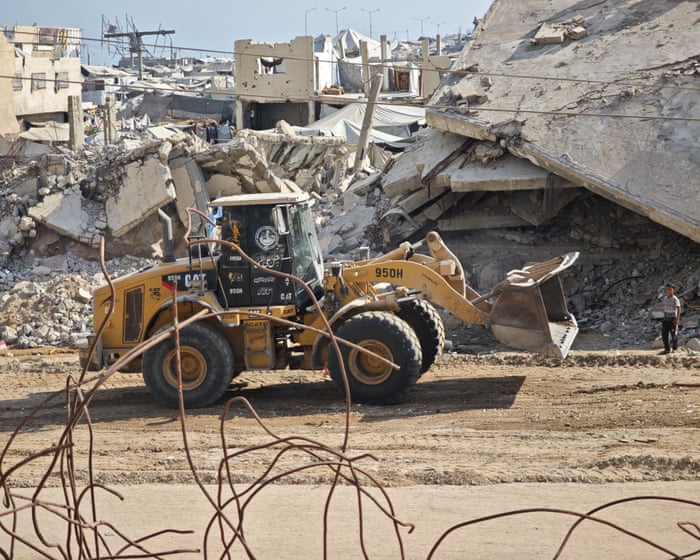
It took all day to clear one section of road in the Tel al-Hawa neighbourhood of Gaza City. By the end, Ahmed Alyan, a UN engineer, was exhausted, surrounded by mountains of rubble despite the day’s work.
“I feel as if we are holding a spoon and trying to empty the sea,” Alyan said, sweat trickling down his forehead after a long, hot summer day.
Alyan is part of a World Food Programme (WFP) team working on Beirut Street, once a busy main road lined with shops, offices and homes, filled with traffic and people. Now it is almost deserted.
The road was blocked by piles of rubble, stones and the wreckage of destroyed shops. Nearby, a tower leaned after some of its concrete foundations were damaged, while displaced families continued to live inside. In some parts of the road, sewage flowed from the ground after the drainage system was damaged and blocked by Israeli bombardment.
The UN estimates that clearing most of the rubble in the Gaza Strip could take at least seven to 10 years and cost billions of dollars. That would make clearing war debris in Gaza one of the largest rubble-clearance operations in modern history.
“The estimate of the total amount of rubble in Gaza is 61m tonnes. It is approximately 20 times the amount of rubble generated in all wars across the world over the last 18 years,” said Jaco Cilliers, the UN Development Programme’s special representative in Palestine.
The task is being carried out in extremely difficult and dangerous conditions. The clearance teams are working in ruins containing countless dead bodies and unexploded bombs. So far, 580km of roads have been cleared, which has made it possible for aid trucks, relief teams and residents to move around.
However, rebuilding Gaza is a huge challenge for international and local organisations. After more than two years of work, about 907,000 tonnes of rubble have been removed and more than 300,000 tonnes recycled and reused. But this is only about 1.5% of the total rubble.
To make things harder, the Israeli authorities have banned the necessary equipment from entering Gaza, arguing that almost any aid that is not food or medicine could be “dual-use” and could somehow benefit Hamas.
Initially, the WFP’s work was limited to removing debris from the roads and pushing it to the sides to create a passage for trucks. But the sheer quantity was overwhelming, and continued Israeli bombardment during the nearly year-old ceasefire kept adding to the enormous task. Some roads had to be reopened several times.
Meanwhile, the so-called yellow line, a demarcation established at the start of the ceasefire last October, keeps creeping forward as Israeli troops seize more territory. The area still accessible to people and aid workers is barely 30% of the whole Gaza Strip, making the problem of what to do with the rubble even more urgent.
“One of the ways we have tried to address this problem is by recycling and reusing the rubble in different ways,” Cilliers said.
The UNDP has begun managing five rubble-crushing sites across Gaza, where debris collected from roads and damaged critical infrastructure is processed for reuse. The rubble is first sorted to remove non-concrete materials, including metal and steel rods. The concrete is then crushed into smaller pieces, eventually down to roughly the size of a marble or a very small rock.
UNDP relies on seven crushers across Gaza, all of which were already in the territory before the war. Two of the seven were rebuilt by local enEngineers in Gaza have spent the past year working with the machinery they had on hand, since no new equipment could be brought into the strip.
At one of the UNDP’s concrete crushing sites in Deir al-Balah, where debris is processed for reuse, piles of rubble are stacked across a large yard that once held UN warehouses. Trucks arrive loaded with debris, stop on a weighbridge, and tip their cargo onto the piles. The area roars constantly as the machine breaks concrete into smaller pieces, and the air is thick with dust.
The condition of the machinery is a major challenge for the teams doing this work. Most of the equipment in Gaza is severely worn out and breaks down often, partly because of an acute shortage of spare parts, engine oil, and other supplies needed to keep it running.
In July 2025, 8 million tonnes of the debris created in Gaza was potentially hazardous.
With major restrictions still in place on bringing in construction materials, engineers reuse the crushed rubble for several essential purposes. Much of it goes to repairing roads and filling potholes, while some is placed beneath tents and shelters to raise them above rainwater and sewage.
Nehal Abu Hassan, a member of the WFP team, said: “These materials cannot be compared with the natural materials normally used to build roads. Their quality is lower, and they are difficult to work with. But there is no alternative. These solutions have been forced on us by the reality we are living in.”
Removing some of the rubble has already made a big difference. “The road has become wider, the problem of rodents and insects has decreased, and cars can pass through more easily,” said Ibrahim Daradona, a displaced man from Jabaliya now living in the Tel al-Hawa area of Gaza City. “The rubble was even a danger to children playing here.”
More than 2.1 million displaced people are living in tents and temporary shelters, as dire humanitarian conditions persist after nearly three years. Rubble has become part of the environment they live in every day.
Clearing rubble has also helped revive Gaza’s local economy by creating space for people to start new activities and reopen shops and small businesses. “One of the things we have seen is that when we clear rubble in front of damaged shops and businesses, many of them reopen within around 20 days,” Cilliers said.
Despite all the efforts to remove rubble and restore access to residential areas, the remains of homes carry a particular sensitivity. Every metre of rubble may hide things that cannot be seen from the outside.
“Rubble in some areas does not represent just debris to people; it represents their entire life and memories. In some cases, there may be bodies still under the rubble. That is why removing it is a very sensitive issue for families and communities,” said Abu Hassan.
The presence of human remains still buried under the rubble remains one of the most urgent humanitarian issues in Gaza. According to estimates cited by the UNDP, between 8,000 and 10,000 bodies may still be buried.
The UNDP has said it is working with organisations including the International Committee of the Red Cross to identify locations where human remains may be buried and prioritise them during rubble-removal and recovery operations.
“We are also working on a forensic process to identify remains, to ensure that they are handled properly and that relReligious burial rights are respected, and the necessary documentation and certificates are provided for families. This is extremely important for families in Gaza,” Cilliers said.
Unexploded ordnance in rubble and on roads is a serious challenge for teams clearing the debris. UNDP and WFP teams coordinate with the UN mine-clearing arm, Unmas, the British charity the Halo Trust and other organisations before beginning clearance work, to identify unexploded ordnance and protect workers and returning families.
Given the limited capacity to remove explosive ordnance in Gaza, these organisations cannot disarm or remove all unexploded items. But they can identify hazardous areas and mark them.
View image in fullscreen
Clearing the debris is a dangerous task, with unexploded ordnance and asbestos amid the rubble. Photograph: Amjed Tantesh/The Guardian
Alongside the danger from explosives, rubble may contain other hazardous materials, including asbestos, which can pose a serious health risk when its fibres are inhaled.
Partly standing damaged buildings pose another risk. Some families return to their homes believing they are safe, only for the structures to collapse suddenly. Assessing the safety of damaged buildings before residents return is therefore an important part of the recovery process.
“The progress in early recovery is slow, we are trying to do what we can despite the limitations on bringing in the equipment and services we need,” Cilliers said.
Get in touch
Contact us about this story
The best public interest journalism relies on first-hand accounts from people in the know. If you have something to share on this subject, you can contact us confidentially using the following methods:
Secure Messaging in the Guardian app
The Guardian app has a tool to send tips about stories. Messages are end to end encrypted and concealed within the routine activity that every Guardian mobile app performs. This prevents an observer from knowing that you are communicating with us at all, let alone what is being said.
If you don’t already have the Guardian app, download it (iOS/Android) and go to the menu. Select ‘Secure Messaging’.
SecureDrop
If you can safely use the tor network without being observed or monitored you can send messages and documents to the Guardian via our SecureDrop platform.
Our guide at theguardian.com/tips lists several ways to contact us securely, and discusses the pros and cons of each.
Show more
Frequently Asked Questions
FAQs Clearing 61 Million Tonnes of Rubble in Gaza
The Basics
What is this 61 million tonnes of rubble
Its the estimated amount of debris left across Gaza after months of bombardmentdestroyed buildings roads and infrastructure For comparison its roughly 14 times the rubble left after the 911 attacks in New York
Why does the rubble matter so much
Two big reasons its blocking aid shelter and medical care for survivorsand it may be hiding thousands of dead bodies that families want to recover and bury properly
How many bodies are we talking about
Aid workers estimate up to 10000 people could be buried under the debris The exact number is unknown because many areas remain too dangerous to search
Who is doing the clearing
Mostly Palestinian civil defense crews UN agencies like UNMAS and international aid groups Theyre working with limited equipment and staff
Why is clearing it so hard
The rubble is mixed with unexploded ordnance hazardous materials like asbestos and human remains Theres also no safe place to put 61 million tonnes of debris
Deeper Questions
What is unexploded ordnance and why does it slow things down
Unexploded ordnance is bombs shells or grenades that were dropped or fired but never detonated They can explode if moved or stepped on so every pile of rubble has to be checked before crews can dig
What kind of hazardous materials are in the rubble
Asbestos from old buildings industrial chemicals medical waste and fuel residues Breathing dust from this stuff can cause serious longterm health problems
Why cant they just bulldoze everything and sort it later
Bulldozing can crush human remains set off unexploded bombs and spread toxic dust Aid workers have to go slowlyoften by hand or with small machinesto avoid making things worse
Where does the rubble go once its cleared
Some can be recycled for rebuilding roads or foundations But most has to be trucked to temporary dump sites and theres a shortage of safe approved locations
How long will this take
UN officials estimate it could take 14 to 15 years just