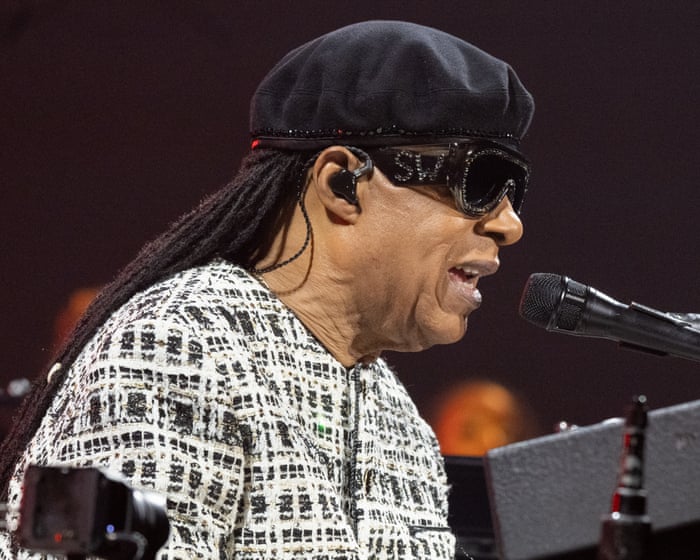
Seated among a bank of keyboards, Stevie Wonder speaks to the audience at the opening night of his tour celebrating the 50th anniversary of Songs in the Key of Life, his most celebrated album. He says that performing it in full like this had long been an ambition: the problem was that it required so many people to make it happen. He actually achieved that ambition a decade ago in North American arenas in 2014 and 2015, and the 50th anniversary shows follow the same template—complete with Superstition added as an encore—but even so, his point about the number of people involved still stands. There really are a lot of musicians up there: three percussionists, a string section, five brass players, six backing vocalists, two guitarists, and three keyboard players, including Wonder himself, who plays a range of vintage and modern synthesisers, a grand piano, an upright tack piano, and, on Ngiculela/Es Una Historia/I Am Singing, a strange stringed instrument called a harpejji that hadn’t even been invented when Stevie Wonder last released an album, let alone when Songs in the Key of Life was made. Harpejji or not, that still counts as a dramatic scaling down compared to the album’s actual sessions. Made by a man who could do pretty much everything himself, its recording nevertheless involved 108 musicians: eight people are credited for handclaps. Its lavishness said a great deal both about the commercial expectations placed on it and about the artistic challenge of topping what Wonder had recently achieved. Having threatened to retire from music entirely before making it, Wonder changed his mind and ended up signing what was, in 1975, the biggest recording contract in history, worth around $230m in today’s money. And in barely two years, he had released Music of My Mind, Talking Book, Innervisions and Fulfillingness’ First Finale, a display of talent so overwhelming that when Paul Simon won the 1976 best album Grammy, his acceptance speech thanked Wonder for not releasing anything that year and thus giving everyone else a chance. View image in fullscreenLavish … Wonder with his sizeable band. Photograph: Katja Ogrin/Getty Images for ABAThe remarkable thing about the Songs in the Key of Life live show is not that it reminds you how extraordinary the album was, and is—given that everyone from Michael Jackson to Elton John to George Michael has called it the greatest album ever made, that hardly needs pointing out—but that it enhances it. Not because of the expanded arrangements, lovely though they are: it’s debatable whether Village Ghetto Land is much improved when played by live strings rather than Wonder’s layered synthesisers, since the studio version was already pretty incredible. It’s because it is firmly a live performance, rather than a perfect recreation. Wonder fluffs his harmonica solo on Easy Goin’ Evening (My Mama’s Call) and insists the band restart Isn’t She Lovely, unhappy with the first version (“Stop!” he cries. “Sue me!”). He also stretches songs out at will, the band locking into the tough funk of All Day Sucker and Black Man, and adds to the album’s already packed tracklisting. Its first half now comes with another instrumental as well as the intricate, jazz-fusion-influenced Contusion. You could, at a push, call it a jam, full of call-and-response audience participation, but that feels like underselling its dramatic, symphonic soul. Stevie Wonder releases four unheard songs from Songs in the Key of Life sessionsRead moreFor all its peerless reputation, there’s a certain risk in performing Songs in the Key of Life live, more or less in order (and including the four songs from the A Something’s Extra EP that was bundled with the original album). Risky because the album opens in a relatively understated style: Love’s In Need of Love Today, Have a Talk With God and Village Ghetto Land are inThey are credible songs by any standard, but they are downbeat, sombre, and often desperate in tone, reflecting a man so disillusioned with mid-70s America that he was seriously thinking of moving to Ghana and dedicating himself to charity work. This is hardly the dazzling opening you might expect from an arena show. On the night, it doesn’t matter, perhaps because the audience knows what to expect, or perhaps because the lyrics describing a US desperately lacking empathy, trapped in appalling inequality, and run by people whose supposed Christian devotion seemed to have no effect at all on their actions could just as easily have been written in 2026. They are received ecstatically, though not quite as ecstatically as the reliably joyful Sir Duke and I Wish. In fact, you spend much of the show with your jaw on the floor. Even with its reputation, Songs in the Key of Life can still astonish you with the remarkable quality it sustains throughout: it is an album on which the deep cuts would be other artists’ showstoppers — Saturn, Knocks Me Off My Feet, Joy Inside My Tears. As the deep soul of the last of these finally fades, an earnest voice calls out from the back of the arena. “That,” it cries, audibly stunned, “was really good.” Stevie Wonder plays 3Arena, Stockholm, 22 October; returning to tour the UK 3-11 November.
Frequently Asked Questions
FAQs Stevie Wonder Playing His Greatest Album in Full He Blows Everyone Away
What is this review about
Its a review of a Stevie Wonder concert where he performed one of his classic albums from start to finish live on stage
Which album did he play in full
The review centers on him performing his greatest album in its entirety widely considered to be Songs in the Key of Life
Why is playing an album in full such a big deal
Its rare Most artists only play a few hits from an album Performing every track in order gives fans the complete experience the way the record was meant to be heard
What does he blows everyone away mean
It means the audience was completely amazed His performance was so good it exceeded all expectations
Did the crowd enjoy it
Yes the review says the audience was thrilled and the energy in the room was incredible throughout the show
What made the performance so special
Stevie Wonders voice musicianship and stage presence were all at their peak and hearing a beloved album live felt like a onceinalifetime event
Did he play any other songs besides the album
Reviews of shows like this usually note that he added extra hits and fan favorites after the full album set
Is Stevie Wonder still a good live performer today
Yes This review makes clear that even decades into his career he remains one of the greatest live performers in music
Whats the main takeaway of the review
That seeing Stevie Wonder perform his greatest album live is an unforgettable experience and he proves hes still at the top of his game
Should I see him live if I get the chance
Absolutely If this review is anything to go by its a show worth any effort or cost to attend
What if I dont know the album well will I still enjoy it
Yes His performances are so engaging that even casual fans come away impressed and youll likely leave wanting to explore the album afterward
Where can I read the full review
Check the original publication or website where the review was posted for the complete details and the critics full impressions