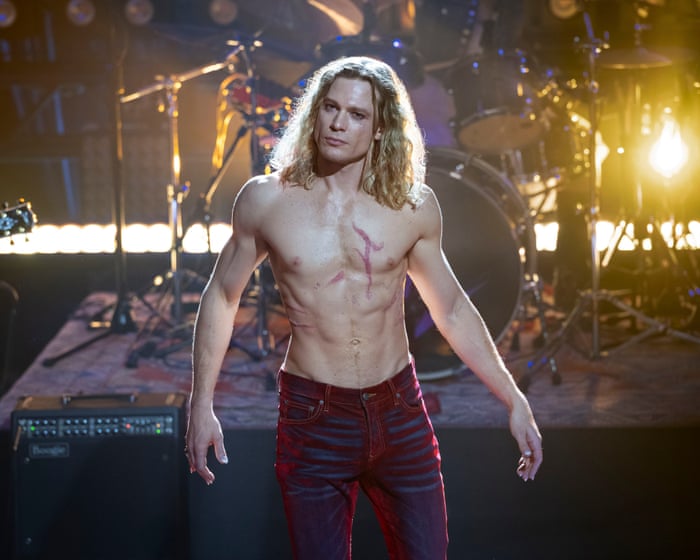
If you want TV audiences to forgive a fictional man for absolutely anything, just give him fangs and dress him in velvet. Case in point? The steamy musical drama The Vampire Lestat, which became a cult hit in the US earlier this year. The show has now landed in the UK, and Sam Reid’s intense performance as Lestat has fans completely hooked.
The Vampire Lestat review – a wildly fun glam-rock musical … with bloodsucking
Read more
The first two seasons, under the title Interview With the Vampire, focused on the “interview” where Louis (Jacob Anderson) tells a journalist about his toxic relationship with Lestat. Now, the spotlight has shifted to Lestat – hence the new title and new narrator – as the golden-haired prince of darkness trades centuries of secrecy for glam-rock fame.
View image in fullscreen
Toxic love … Jacob Anderson as Louis de Pointe du Lac in The Vampire Lestat. Photograph: BBC/© 2026 AMC All Rights Reserved/Sophie Giraud
Reid looked to bootlegs of David Bowie’s 1974 Cracked Actor tour for inspiration on the “showmanship, magic and mystery” needed to captivate an arena, and the result is that Lestat now radiates a magnificent “dandy of the underworld” vibe. He writhes, growls, and grinds on stage while playing the fiddle and belting out hilariously campy songs. He wears glittery eyeshadow, his hair is in ribboned pigtails, and he seems to have permanently lost his shirt, baring his scarred chest to adoring fans while singing lines like “Don’t wanna learn another TikTok dance / Wanna stay in bed, eating black liquorice” and “You can’t fuck away the loneliness / It’ll wait til you’re done / Til you come / Like a vampire.” Off-stage, he’s in a sexual relationship with his mother, gets high on LSD-laced blood, and drops lines like: “I carry with me an immortal erection.”
View image in fullscreen
Breakthrough role … Alexander Skarsgård in True Blood. Photograph: Collection Christophel/Alamy
This isn’t the first time a vampire has captivated audiences. Eric Northman’s full-frontal scene as he lounges on an ice peak reading a book in True Blood was Alexander Skarsgård’s breakthrough role, while Lady Gaga’s The Countess in season five of American Horror Story proved that bloodlust is the ultimate high-fashion accessory. Endlessly seductive vamps also show up in The Vampire Diaries, Supernatural, and the entire cast of What We Do in the Shadows, who are somehow ridiculously attractive despite being total idiots (Matt Berry has ruined normal men for me). Claes Bang in the BBC’s otherwise messy Dracula was undeniably easy on the eyes, and even Jeff’s brief stint as a vampire in Community‘s “Horror Fiction in Seven Spooky Steps” episode sees Annie swoon over her tame bloodsucker, breathlessly sighing, “Look how much I’ve changed you!” when he starts quoting literature at her.
View image in fullscreen
High vamp … Lady Gaga as the Countess in American Horror Story: Hotel. Photograph: Suzanne Tenner/AP
Why are we so hooked? Vampires embody absolute freedom, power, immortality, beauty, and often forbidden love. They also tap directly into our darker selves, serving as the ultimate canvas for the toxic romantic tropes we secretly enjoy on screen. (Think about it: pop culture has long trained us to desire the romcom hero who relentlessly pursues a female lead despite being told no until he wears her down, like Joe Fox (Tom Hanks) in You’ve Got Mail or Joe Goldberg (Penn Badgley) in You.) When it comes to vampires as romantic figures, we’re leaning hard into the ultimate “I can fix him” trope. What’s more intoxicating than a dangerous immortal who wipes out entire towns, yet kneels at your feet?
Just look at Spike in Buffy the Vampire Slayer – the ultimate leather-clad bad boy who is literally “changed” by the love of a good slayer. On the flip side, there’s Angel, whose curse means that one night of mind-blowing sex with Buffy literally breaks his brain, shatters his morality, and turns him back into a psychopathic monster.There’s even more beneath the surface of camp leather jackets, bad-boy redemption arcs, and jawlines sharp enough to cut glass. In her 2024 book, Vampires: A Handbook of History & Lore of the Undead, Agnes Hollyhock looks at how gothic fiction used vampires to challenge Victorian moral panic. In a society that strictly banned non-traditional intimacy, the vampire’s bite stood for forbidden desire—a complete loss of control, an exchange of bodily fluids, and a rejection of polite society.
Vampires break heteronormative expectations by living entirely outside the normal human timeline. They don’t fit into conventional family structures or rigid gender roles. Their power comes from charisma and seduction, not traditional masculinity or femininity. Lestat embodies all of this in his flashy, powerful, and unapologetically queer presence, which is why we can’t stop thinking about his wild romance with Louis (that passionate kiss that turns into a skull-smashing murder in season two is unforgettable for fans). It’s why he’s become the ultimate symbol of sexual freedom. And why we can all apparently accept his scandalous relationship with Gabriella (Jennifer Ehle), the lover he turned into a vampire—who also happens to be his mother.
Is it the danger? The immortal good looks? The longing to break free from society’s rules? The TV vampire is simply irresistible. No wonder so many of us are lining up for a bite from Lestat. The Vampire Lestat is available on iPlayer now in the UK and on AMC+ in Australia and the US.
Frequently Asked Questions
Here is a list of FAQs based on the topic ranging from casual curiosity to deeper analysis
General Definitions
Q What does brainmelting sex actually mean in the context of vampire shows
A Its a fan term for the hyperintense often surreal or boundarypushing sexual chemistry and scenes in vampire TV Its less about realism and more about overwhelming passion power dynamics and supernatural allure that feels mindaltering to watch
Q Why are leatherclad bad boys such a staple of vampire TV
A Leather is a visual shorthand for rebellion danger and a gritty antiestablishment attitude It pairs perfectly with the vampires predatory nature and immortality making them look timeless yet edgy The bad boy trope taps into the fantasy of taming someone powerful and dangerous
Q What does queer triumph mean in this context
A It refers to the way vampire narratives have historically been and increasingly are a safe space for LGBTQ stories Vampires are othered by nature so their stories often explore forbidden love fluid identity and found familythemes that resonate deeply with queer audiences and allow for explicit celebrated representation
Q Is this just about Interview with the Vampire or all vampire shows
A Its a trend across many modern shows but Interview with the Vampire is the current gold standard Other examples include What We Do in the Shadows Buffy the Vampire Slayer and True Blood
The Appeal Psychology
Q Why do we find vampires so sexually attractive Theyre dead
A Its the ultimate taboo Vampires represent forbidden desire immortality and a release from social norms The bite is a metaphor for losing control intimacy and exchanging life forcewhich is a heightened fictional version of real human passion
Q What does queer triumph actually look like on screen