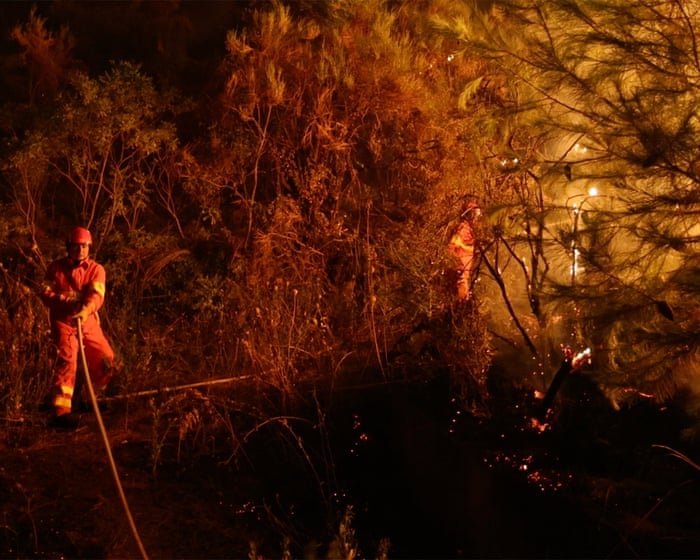
The world is getting hotter as carbon pollution from burning fossil fuels traps more and more heat. But Europe is warming twice as fast as other continents. This is already having deadly consequences, with tens of thousands of people dying in heatwaves this summer alone.
So why is Europe hit so hard by global warming?
Land heats up more quickly than the vast, deep oceans, so all continents are warming faster than the seas. But Europe is especially vulnerable for four reasons: shifting weather patterns, its proximity to the Arctic, reduced snow cover, and cleaner air.
As a result, Europe is now about 2.5°C hotter than before the large-scale burning of fossil fuels—almost double the global average rise of 1.4°C. Since the mid-1990s, temperatures in Europe have climbed by 0.56°C per decade, compared with 0.42°C in North America, 0.36°C in Africa, and 0.27°C in South America.
How have Europe’s weather patterns changed?
Changes in how the atmosphere moves over Europe have led to more frequent and intense summer heatwaves. This includes the worst one on record, in June 2026, when a huge area of hot air got stuck under a stationary “heat dome.”
Scientists are still studying how much global warming is driving these shifts in atmospheric circulation, but a connection seems more and more likely.
Dr. Samantha Burgess, from the EU’s Copernicus Climate Change Service, said: “We see statistically significant changes in surface pressure patterns and other measures of circulation when we look at trends over the last 40 or more years. On this timescale, they are more likely linked to climate change than to natural variability.”
This may be tied to changes in the jet stream—a fast, high-altitude wind that strongly influences Europe’s weather and is itself affected by rising temperatures.
Why does the Arctic matter?
The Arctic is warming faster than any other region on Earth, even though it has no land. That’s because the white polar ice cap, which normally reflects most sunlight back into space, is melting quickly. As it melts, the darker ocean underneath absorbs much more heat, which then melts more ice—creating a vicious cycle. Since much of Europe is relatively close to the Arctic, temperatures there are rising faster too.
What about snow cover?
In the past, most of Europe got snow in winter. Like Arctic sea ice, this snow reflected sunlight and kept the continent cooler. But climate change is shrinking snow-covered areas.
In March 2025, Europe’s snow cover was about 1.3 million square kilometers below the 1991–2020 average—a 31% drop. That lost area is roughly the size of France, Italy, Germany, Switzerland, and Austria combined. It was the third lowest snow cover since records began in 1983.
Why does cleaner air affect temperatures?
Air pollution kills millions of people worldwide every year, so Europe’s success in cutting toxic emissions in recent decades is clearly a good thing. However, cleaner air is also exposing the full effect of rising carbon dioxide levels.
Pollution particles can reflect the sun’s rays, either directly or by helping clouds form, which stops some heat from reaching the ground. With fewer particles, there’s less reflection, so more heat from greenhouse gases is felt. Lower pollution might even be linked to more frequent blocking weather patterns.
How important is each of these four factors?
The short answer is that scientists don’t know yet, but they hope to have an estimate next year.
Burgess said: “What we can say is that the importance of each factor must vary with season. Proximity to the Arctic matters more in autumn and winter, while circulation changes since the late 1970s are more statistically significant in summer.”
The drop in air pollution is most noticeable in winter, due to less coal heating in homes, and snow cover is also a winter issue. In recent decades, winter warming in Europe has been strongest in the north, whileSummer warming has been strongest in the southeast. What are the consequences? The rapid heating is causing more deaths, more intense wildfires, and worse droughts. Storms, heavy rainfall, and floods are also becoming more powerful because of the extra heat in the climate system. These effects are deeply impacting lives and livelihoods across the continent, and they will keep getting worse until emissions reach net zero. We urgently need to cut CO2 pollution quickly and roll out measures to protect people.
The UN climate chief, Simon Stiell, said in late July: “The awful costs of this climate crisis – both human and economic – are now reaching national emergency levels. What needs to be done is clear: leave coal, oil, and gas behind faster, scale up renewables, and protect people.”
The Guardian’s climate forum 2026: On Tuesday 20 October, join Damian Carrington and our panel of experts, including Professor Andy Haines, Katie White MP, Asad Rehman, Shruti Suresh, Gareth Thomas, and Amy Fairman, for a hopeful and solutions-focused evening. Book tickets here or at guardian.live.
Skip past newsletter promotion. Free newsletter | Weekly. Sign up to Down to Earth. The planet’s most important stories. Get all the week’s environment news – the good, the bad, and the essential. Enter your email. Sign up. After newsletter promotion.
This article was amended on 12 August 2026. An earlier version said the snow blanket covering Europe in March 2025 was 1.3 million square kilometers; this should have said it was 1.3 million square kilometers below the 1991-2020 average.
Frequently Asked Questions
Here is a list of FAQs about why Europe is warming faster than other continents written in a natural and accessible tone
General Beginner Questions
1 Is it true that Europe is warming faster than the rest of the world
Yes Europe is the fastestwarming continent on Earth Over the past few decades temperatures in Europe have risen at roughly twice the global average rate
2 Why is Europe heating up so much faster than say North America or Asia
Its a mix of geography and physics Europe sits next to the Atlantic Ocean and the Arctic and its right in the path of major weather systems As the planet warms these specific systems are changing in ways that funnel extra heat directly into Europe
3 Does this mean Europe is just having a few hot summers or is this a longterm trend
This is definitely a longterm trend The last five years have been Europes hottest on record and the continent is seeing a steady decadebydecade increase in average temperatures not just random hot spells
4 Is the Gulf Stream stopping Is that why its getting hotter
Its not stopping but it is slowing down The Gulf Stream brings warm water from the tropics up to Europe As it weakens it actually causes a complex effect it can cool the far north but it messes with weather patterns in a way that pushes hot dry air from Africa up over the rest of Europe more often
5 Is Europes warming just part of a natural cycle like the Medieval Warm Period
No The current warming is happening much faster and is much more widespread than natural cycles Scientists have proven that the rapid increase is directly linked to human activities like burning fossil fuels rather than natural solar or volcanic cycles
Causes Science
6 What exactly is Arctic Amplification and how does it affect Europe
Arctic Amplification means the Arctic is warming about four times faster than the rest of the globe As the white sea ice melts it exposes dark ocean water that absorbs more sunlight instead of reflecting it This weakens the polar jet streamthe river of air that normally keeps cold air locked up north When the jet stream gets wobbly it lets hot air push further north into Europe and cold air dip