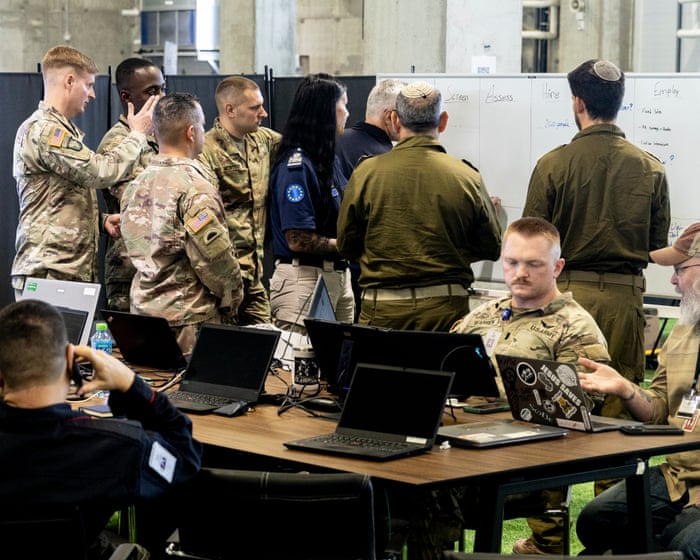
Israeli operatives are conducting widespread surveillance of U.S. forces and allies at a new U.S. base in southern Israel, according to sources familiar with disputes over the open and covert recording of meetings. The extensive intelligence gathering at the Civil-Military Coordination Center (CMCC) led the U.S. base commander, Lt. Gen. Patrick Frank, to summon an Israeli counterpart and demand that “recording has to stop here.”
Staff and visitors from other countries have also expressed concerns about Israeli recording inside the CMCC. Some have been advised to avoid sharing sensitive information due to the risk of it being collected and exploited.
The U.S. military declined to comment on Israeli surveillance activities. The Israeli military declined to comment on Frank’s demand to stop recording, noting that conversations inside the CMCC are unclassified. In a statement, the Israeli military said, “The IDF documents and summarizes meetings in which it is present through protocols, as any professional organization of this nature does in a transparent and agreed-upon manner. The claim that the IDF is gathering intelligence on its partners in meetings which the IDF is an active participant is absurd.”
The CMCC was established in October to monitor the ceasefire, coordinate aid, and develop plans for Gaza’s future under Donald Trump’s 20-point plan to halt the war. Large copies of that document are displayed around the building. Soldiers stationed there were tasked with supporting an increase in essential supplies to Gaza, as part of the agreement.
Israel has frequently restricted or prevented shipments of food, medicine, and other humanitarian goods into Gaza. A complete siege this summer pushed parts of the territory into famine.
When the CMCC began operations, U.S. and Israeli media reported that Israel was transferring authority over what enters Gaza to the U.S. military. However, two months into the ceasefire, a U.S. official stated that while Washington has significant leverage, Israel retains control of Gaza’s perimeter and what enters the territory. “We didn’t take over [aid]. It is an integration. It is hand in glove. They [the Israelis] remain the hand, and the CMCC have become the glove over that hand,” the official said anonymously.
Among the U.S. forces deployed to the CMCC were logistics experts experienced in navigating natural disasters or trained to find supply routes through hostile terrain. They arrived eager to increase aid flows but soon found that Israeli controls on goods entering Gaza were a greater obstacle than engineering challenges. Within weeks, several dozen had left.
Diplomats say discussions at the CMCC have been crucial in persuading Israel to modify lists of supplies barred or restricted from entering Gaza on the grounds of “dual use”—items that could be repurposed for military as well as humanitarian purposes. These include basics like tent poles and chemicals needed for water purification.
Dutch Foreign Minister David van Weel said he was briefed at the CMCC about “one of the dual-use barriers that was being lifted as a result of the conversations [there].” Other items, such as pencils and paper needed to restart schools, have been banned from shipment into Gaza without explanation.
The CMCC brings together military planners from the U.S., Israel, and other allied countries, including the UK and the United Arab Emirates. Diplomats posted to Israel and occupied Palestine, as well as humanitarian organizations operating in Gaza, have also been invited to join discussions on aid supplies and the territory’s future.
Trump’s plan recognizes Palestinian aspirations for statehood and commits to Gaza’s reconstruction.Palestinians are given seats in a temporary administration but are completely excluded from the CMCC. No representatives from Palestinian civilian or humanitarian organizations, or the Palestinian Authority, are stationed there or invited to join discussions. Even attempts to include Palestinians via video calls were repeatedly cut off by Israeli officials, according to sources involved in or briefed on the talks.
U.S. military planning documents reviewed by the Guardian avoid using the words “Palestine” or “Palestinian,” instead referring to the territory’s residents as “Gazans.”
Israeli Prime Minister Benjamin Netanyahu has portrayed the CMCC as a purely bilateral project. In a statement after visiting the base last month, he described it as a “joint Israeli-American effort,” made no mention of other partners, and official photos from the visit showed only Israelis and Americans. An Israeli military source said the visit was arranged outside working hours for security reasons and that the U.S. military decided which counterparts should attend.
A Dystopian Startup
The CMCC is housed in a multi-story building in the industrial zone of Kiryat Gat, an unremarkable town about 12 miles (20 km) from the Gaza border. The building was previously used by the Gaza Humanitarian Foundation, whose food distribution sites became death traps for hundreds of Palestinians. Some branded products from the now-disbanded GHF remain piled in the basement.
Israelis and Americans each have a floor, with additional offices for key allies. The interior feels like a dystopian startup. A cavernous, windowless main hall is carpeted with astroturf, and clusters of whiteboards divide the space into informal meeting areas where soldiers mix with diplomats and aid workers.
The language of corporate America has arrived with its troops. Palestinians in Gaza are sometimes called “end users,” and insensitively casual mnemonics are used to direct teams. “Wellness Wednesdays” focus on restoring Gaza’s hospitals—which have faced relentless attacks—and schools that have not operated for two years. “Thirsty Thursdays” are for public services, in a place where children have been killed trying to collect water and poor sanitation is spreading disease.
Many diplomats and aid workers are deeply uneasy about being at the CMCC. They worry the center may violate international law, excludes Palestinians from planning their own future, operates without a clear international mandate, and blurs military and humanitarian work. Yet they also fear that staying away would leave discussions about Gaza’s future solely to Israel and the newly arrived U.S. military planners, who know very little about Gaza or the broader political context.
“We are really unsure how much time and energy to invest,” one said. “But this is the only chance we have of [the Americans] listening to us.”
The CMCC’s role may already be fading, as dozens of U.S. military personnel sent there in October have returned to their home bases after their official mandate ended, sources said.
Designing an abstract future for Gaza in a political vacuum that excludes Palestinians has proven far easier than past negotiation attempts. It is unclear how much of the CMCC’s planning will ever be tested in Gaza.
Israel says the ceasefire will not advance until Hamas is demilitarized, and neither the U.S. nor its allies have a plan to achieve what Israeli troops could not despite two years of brutal attacks. A UN commission of inquiry found earlier this year that Israel is committing genocide in Gaza, a conclusion echoed by numerous humanitarian organizations.
When asked about a timeline for implementing plans drawn up at the CMCC, the U.S. official declined to comment.”The US military is not central to this issue,” he said. “It’s more of a political matter.”
Frequently Asked Questions
Of course Here is a list of FAQs based on reports of Israeli surveillance targeting a USallied joint base used for Gaza aid and security operations
BeginnerLevel Questions
1 What is this story about
Reports indicate that Israeli surveillance has targeted a joint military base used by the United States and its allies This base was central to planning security for aid deliveries into Gaza and other operations
2 Who was reportedly targeted
The surveillance reportedly targeted communications and activities of American British Canadian and possibly other allied personnel working at the joint base
3 Why is this a big deal
It is highly unusual and a serious breach of trust for one ally to conduct surveillance on another especially when they are coordinating on sensitive humanitarian and security missions It raises questions about espionage operational security and diplomatic relations
4 What was the base being used for
The base was a coordination hub for planning the security and logistics of delivering humanitarian aid into Gaza via a temporary pier as well as for broader regional security operations
5 Has Israel confirmed this
No Israeli officials have not publicly confirmed these reports and typically have a policy of not commenting on intelligence matters
Advanced Detailed Questions
6 What type of surveillance are we talking about
While specific methods are not detailed in public reports it likely involved signals intelligenceintercepting communications emails or phone callsand potentially monitoring the movements and meetings of personnel at the base
7 What possible motive would Israel have for surveilling its closest allies
Analysts suggest potential motives include 1 Gaining operational insight to anticipate USallied plans regarding Gaza Iran or Lebanon 2 Understanding the full scope of US diplomatic pressure and red lines 3 Assessing the sincerity and details of aid plans to understand their impact on the conflict dynamics
8 Isnt intelligence sharing common between allies Whats the difference
Yes formal intelligence sharing is common The key difference here is unilateral undisclosed surveillance This is the collection of intelligence without the partners knowledge or consent which is treated as espionage
9 What are the potential legal and diplomatic consequences
Diplomatically it can lead to formal protests reduced intelligence sharing and