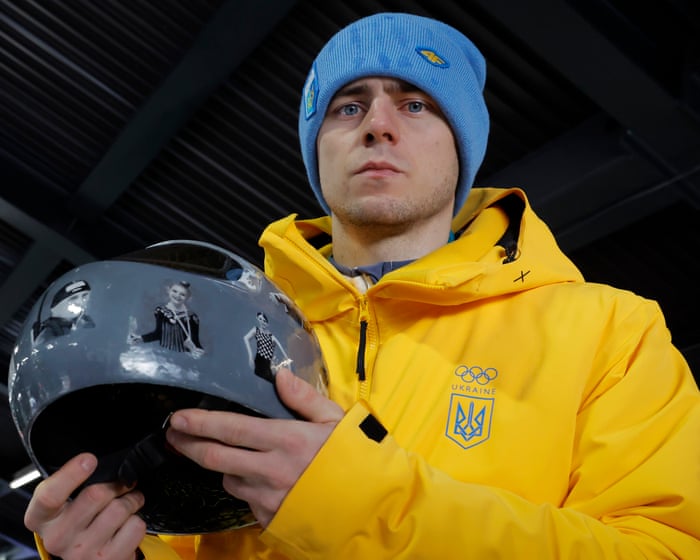
I am deeply saddened by the IOC’s decision to ban skeleton athlete Vladyslav Heraskevych from the Winter Olympics. His helmet, which depicted images of athletes and children who died in Russia’s invasion of Ukraine—some of whom he knew personally—was a heartfelt act of remembrance. The IOC’s response was inappropriate.
The emotional toll was clear just from seeing the photo of Heraskevych’s father upon hearing the news of his son’s disqualification—doubled over with his head in his hands. I cannot imagine what they are going through, but as a former athlete and a fan, I was also moved to tears when Vlad and his father messaged me on social media to thank me for my support.
Heraskevych has appealed to the Court of Arbitration for Sport. At the very least, he will be allowed to stay at the Games to support his teammates after the IOC reinstated his accreditation on Thursday afternoon—a step in the right direction from the initial blanket ban. But the damage is already done. Amid the controversy and broader issues, it’s easy to overlook that sport itself has suffered. Heraskevych was a genuine medal hope for Ukraine and has worked his entire life to reach this point. No one has won here: the IOC is now under intense scrutiny, while Heraskevych has had his Olympic dream taken away.
The IOC seems worried about potential chaos if it didn’t protect the field of play, but its messaging has been confusing. IOC President Kirsty Coventry was in tears after failed negotiations to persuade Heraskevych and his father to change their stance. Then a spokesman, Mark Adams, took a harder line, arguing that with 130 conflicts worldwide, “once you start, as a sporting organisation, taking stands against wars and conflicts there is no end.”
That the IOC allowed Heraskevych to wear his helmet during six practice runs shows it recognizes this isn’t a straightforward case. It even offered a compromise: swapping his “helmet of memory” for a black armband in competition on Thursday. The IOC also gave him ample opportunity to display the helmet in the mixed media zone.
There have been further inconsistencies. Earlier this week, Ukrainian luge athlete Olena Smaha displayed the words “remembrance is not a violation” on her glove and was allowed to compete. Heraskevych also pointed out that Italian snowboarder Roland Fischnaller displayed a Russian flag on his helmet without consequence, despite Russia being banned from competing and the use of its flags supposedly forbidden.
The IOC’s ban centers on Rule 50.2 of the Olympic Charter, which states: “No kind of demonstration or political, religious or racial propaganda is permitted in any Olympic sites, venues or other areas.” A key point is that Heraskevych believes he isn’t breaking any rules, arguing that the images on his helmet were about remembrance, not politics.
We are athletes, but we’re also human beings with passions and things close to our hearts. As athletes, we try to focus on our event and the task at hand, entering the Olympics without distraction or outside noise, but our lives don’t exist in a vacuum.
I don’t think anyone in the sliding community believes Heraskevych was trying to distract or take advantage of the attention. Talking of peace doesn’t feel political. Watching his interviews after his disqualification, you can see the sadness in his eyes—he doesn’t normally look like that. Vlad is a very capable and skilled athlete, and he was a…He also carries the memory of fellow athletes and Olympians who have lost their lives. I deeply admire his courage. After being banned, he posted a picture on social media of his helmet with the caption: “This is the price of our dignity.” I find that a very powerful, well-written, and direct message.
It was wrong for the IOC to revoke Heraskevych’s accreditation. They owe him an apology.
Do you have an opinion on the issues raised in this article? If you would like to submit a response of up to 300 words by email for possible publication in our letters section, please click here.
Frequently Asked Questions
Of course Here is a list of FAQs about the situation involving Olympic officials and Ukrainian skeleton racer Vladyslav Heraskevych
BeginnerLevel Questions
1 Who is Vladyslav Heraskevych
Vladyslav Heraskevych is a Ukrainian skeleton athlete who competed in the 2022 Beijing Winter Olympics He gained international attention for holding up a sign reading No War in Ukraine after his run
2 What happened with the Olympic officials
Following the 2022 Games the International Bobsleigh and Skeleton Federation banned Heraskevych from an event for one year The stated reason was for an unauthorized protest but many believe the ban was politically motivated and a punishment for his peaceful antiwar message
3 Why do people say officials made a mistake
Critics argue that banning an athlete for a peaceful political message during a time of war violates the Olympic spirit of peace and solidarity They see it as punishing a athlete for standing up for his countrys sovereignty rather than for any legitimate sporting infraction
4 What kind of apology is being demanded
Advocates and supporters are demanding that the IBSF andor the International Olympic Committee publicly acknowledge that the ban was unjust formally rescind it and apologize to Heraskevych for attempting to silence his legitimate protest
Advanced Detailed Questions
5 Wasnt the ban technically for breaking a no protest rule
Yes the IBSF cited Rule 63 of its Code of Ethics which forbids demonstrations or political religious or racial propaganda However the application of this rule is highly controversial Many argue that a message against war especially when the athletes homeland is being invaded is a fundamental human right and a defense of Olympic values not propaganda
6 Isnt the Olympics supposed to be apolitical
The IOC often states that the Games are apolitical but this is an ideal not a reality History is filled with political moments at the Olympics The principle is to keep politics out of competition and ceremonies Many believe Heraskevychs silent postrace sign was a personal humanrights statement that fell within acceptable bounds especially given the extraordinary circumstances