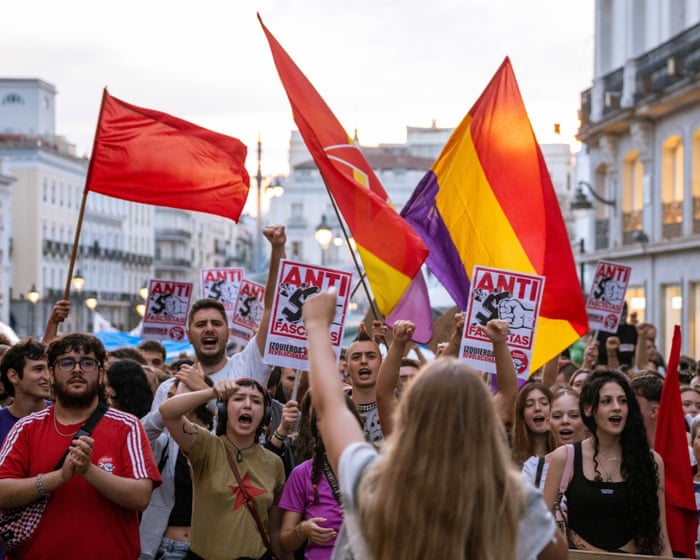
Spain’s socialist prime minister, Pedro Sánchez, has once again staked his political future on a snap general election, announced three days after rightwing parties blocked emergency legislation his minority government had introduced in response to growing public anger over the country’s housing crisis. Sánchez, who has been in office since 2018, used a televised address to announce his decision, which had been widely expected. The next general election had been due before the end of next summer. Announcing on Monday morning that an early general election would be held on 29 November, the prime minister defended his government’s social, environmental and humanitarian record – and admitted it had made mistakes, but said it was time to let the Spanish people have their say. Spain’s Sánchez calls snap election amid national housing crisis – Europe live Read more “It’s up to you now,” he said. “A glance at the horizon shows us that the world is in a very complex era of transformation and transition. It’s a time of great tension, of climate emergency, and of social and technological changes – including highly disruptive advances in artificial intelligence. It is, therefore, a time of great dangers, but also – if we know how to seize the moment – of great opportunities. You, the Spanish people, must decide what role you wish to play in this era, and what role you want Spain to play as well.” Sánchez’s gamble is being seen as a pragmatic move from a seasoned political risk-taker. His minority coalition government with the small, leftwing Sumar alliance has faced a turbulent time in parliament since the prime minister secured his return to office by striking a controversial deal with Catalan pro-independence parties in the aftermath of the inconclusive snap general election he called three years ago. Unable to pass a budget since 2023, with his party and inner circle beset by corruption allegations and his government facing enduring pressure over its handling of the mass crossing into Spain’s north African enclave of Ceuta over the summer, he appears to have decided another snap vote is his best chance of survival. View image in fullscreen Demonstrators gathering in Madrid city centre during a housing rights demonstration on Saturday. Photograph: Enrique Romanos Tardío/NurPhoto/Shutterstock Sánchez repeated his familiar assertion in Monday’s address that the choice was between his progressive government and a Spanish right that would curtail freedoms and turn back the clock on hard-won advances. “You, the men and women of Spain, must decide whether you want to join the far-right wave that rolls back progress wherever it governs, or to ensure that Spain remains a bastion of openness, social justice, and environmental responsibility,” he said. “You must decide whether you want our country to move backwards or continue moving forwards, and whether you prefer a government that works for the interests of the majority of society.” The government’s efforts to tackle the housing crisis were set out in two decrees that contained a range of measures – from a ban on evictions until 2030 to the regulation of temporary lettings and lettings by room – but were voted down in congress on Friday by the conservative People’s party (PP), the far-right Vox party, and the rightwing Catalan pro-independence party Junts. The PP, which is leading the polls but which may need to rely on Vox’s support to form a national government, said it believed construction, and not regulation, was the best way to tackle the crisis. The votes were met with an angry response from the crowds who had gathered outside congress, eliciting boos and cries of “Shame” and “Your profits, our misery”. The PP welcomed news of the snap election. “At last, the Spanish people will decide,” said the party’s leader, Alberto Núñez Feijóo. “This isn’t an election like previous onesThis is about Spain beating Sánchez.” 2:50 How an 87-year-old Spanish woman became the face of the fight for affordable housing – explainer
Vox, which already governs with the PP in four Spanish regions, welcomed the decision. The party’s leader, Santiago Abascal, said Vox would fight to ensure that Spaniards “are not discriminated against in their own homeland” when it came to housing and benefits. He also said his party would focus on “remigration” to reverse what he called “the migrant invasion.”
Long-simmering anger over high rents and insecure tenancies erupted late last month after the eviction of Maricarmen Abascal, an 87-year-old woman who was removed from the Madrid home where she had lived for 70 years. Abascal said she could not possibly afford the 230% rent increase demanded by the investment fund that bought her apartment.
Her situation led tens of thousands of people to protest in the streets and prompted a huge tent camp in Madrid’s central Puerta del Sol square, reminiscent of the 2011 indignados movement.
Over the weekend, large demonstrations were held across the country as protesters increased their demands for urgent action on the housing crisis. Authorities said 70,000 people took part in a protest in Madrid on Saturday, while organizers put the figure at 500,000.
Sánchez will be hoping that the focus on housing, and the right’s rejection of his government’s plans to address the crisis, will mobilize voters.
View image in fullscreen Thousands of people marched through central Madrid on 23 September after the eviction of Maricarmen Abascal. Photograph: David Canales/NurPhoto/Shutterstock
The housing issue has helped divert attention from the government’s much-criticized handling of the ongoing crisis in Ceuta, which was triggered when about 70,000 people crossed into the territory from neighboring Morocco within 48 hours.
Members of Sánchez’s administration, his party and his inner circle have also been dealing with a series of corruption allegations over the past two years.
In July this year, the prime minister’s brother, David Sánchez, was banned from holding public office for nine years after being found guilty of administrative misconduct related to his hiring by a socialist-led council in the southwestern region of Extremadura.
Meanwhile, Sánchez’s wife, Begoña Gómez, is due to face trial after a judge charged her with embezzlement, influence peddling, corruption in business dealings and misappropriation of funds at the end of a two-year investigation.
David Sánchez and Begoña Gómez have both denied any wrongdoing, and the prime minister has previously accused his political and media enemies of launching a “harassment and bullying operation” against his family.
Frequently Asked Questions
FAQs Spains Snap Election After the Housing Law Failure
1 What happened in Spain
Prime Minister Pedro Sánchez called a snap election after Parliament rejected his governments housing law
2 What is a snap election
Its an early election called before the scheduled one The government dissolves Parliament and voters go to the polls sooner than planned
3 Why did Sánchez call the election
The housing law a key part of his agenda failed to pass in Parliament Without enough support to govern effectively he decided to let voters decide
4 What was the housing law about
It aimed to make housing more affordable mainly by limiting rent increases and protecting tenants from eviction
5 Why did the housing law fail
It didnt get enough votes in Parliament Some parties opposed it and Sánchezs coalition lacked the majority needed to pass it
6 What is a housing law in simple terms
Its a set of rules about renting and buying homes like how much landlords can charge and what rights tenants have
7 Why is housing such a big issue in Spain
Rents and home prices have risen sharply especially in cities like Madrid and Barcelona making it hard for young people and lowerincome families to afford a place to live
8 What does dissolving Parliament mean
It means officially ending the current Parliament so a new election can be held and a new one can be formed
9 When will the election take place
It depends on the official decree but snap elections in Spain are usually held within about 50 days of being called
10 Who can vote in the election
Spanish citizens aged 18 and over who are registered to vote
11 What happens to the government between now and the election
Sánchezs government stays in power in a caretaker role it handles daytoday business but avoids major new decisions
12 What is a caretaker government
A temporary government that keeps the country running until a new one is formed after the election
13 Could Sánchez stay in power after the election
Yes if his party wins enough seats and can form a government either alone or with allies
14 What is a coalition government
When two or more parties share power because no single party has a majority