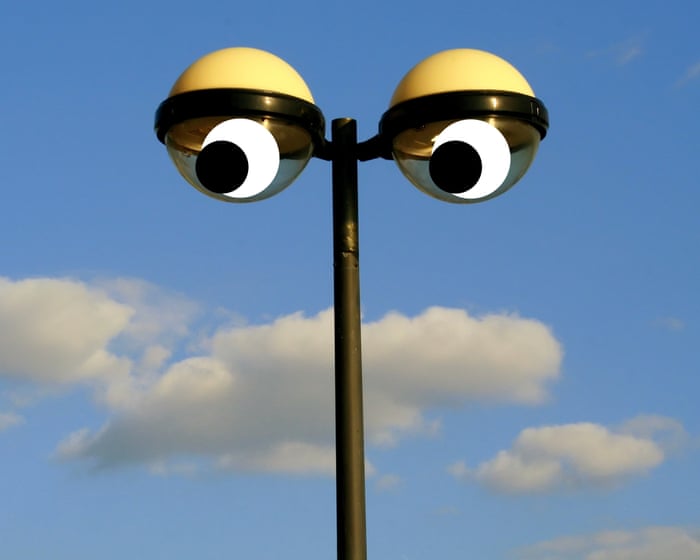
How would you feel if the lamp-posts on your street could recognise your car’s number plate and your face? Maybe you wouldn’t mind, given how long we’ve had automatic number plate recognition and CCTV. But what if that lamp-post could power itself using its own solar panels, and find another use for any extra energy it generates – that would be good, right? That’s what Conflow Power Group (CPG) in Warwickshire claims for its iLamps, the first of their kind in the UK.
What if lamp-posts could also include new AI features you haven’t even heard of yet – like analysing the way you walk or spotting suspicious behaviour? That’s what the organisation Big Brother Watch is worried about. And what if the home secretary had already said she believed in a “panopticon state” – meaning a state that could watch you at all times (as Shabana Mahmood has) – and what if she was still in charge when the lamp-posts got their updates? Or what if the next home secretary was even more keen on hyper-surveillance (hard to imagine), and the street equipment was already in place? And what about all the data this would collect – who would own it?
It’s drizzling in Warwickshire, where I’m hoping to answer at least some of these questions in the hospital car park where some of these new “smart” lamp-posts have been installed. But if it weren’t for me, probably no one would be talking about them, mainly because hardly anyone has heard about them. Not many people know that the iLamp isn’t just solar-powered – it can also “double as a revenue-generating distributed AI datacentre,” according to CPG, let alone understand what that means. And nobody, not even me, knows how much of that potential has actually been built into the UK model – only what CPG has announced: that it has signed an agreement with the government of Katsina state in Nigeria to supply 50,000 of these iLamps, which have extra surveillance capabilities for both vehicles and faces. CPG’s chairman, Edward Fitzpatrick, told the BBC World Service’s Tech Life programme that the lamp-posts could eventually help find missing people or fight crime, but only if developed “with the relevant authority.”
CPG says it has been “extensively covered by worldwide media” and doesn’t take further questions, directing the media to its online materials. As for the Warwickshire lamp-posts, the local council sends all questions to the hospital, and the hospital doesn’t respond. Fair enough – it’s a hospital.
A number of local residents have taken shelter from the rain in a bus stop, most waiting for a partner to pick them up, and many are happy to chat. Karl, 52, who has been in a nearby pub, speaks for almost everyone when he says: “The town centre is already full of cameras, and it’s fine. You don’t mind them being there unless you’re up to no good.” No matter how many loaded questions I ask (What if you were doing something legal today but illegal in a year? What if the surveillance became predictive instead of reactive? What if you didn’t want anyone to know you’d been to the hospital? What if you weren’t supposed to be in a pub? Don’t you think you should at least have been asked whether you wanted it?), I can’t get anyone I speak to to change their view that facial recognition is a tolerable part of life for a law-abiding citizen.
Tejal, 41, also waiting at the hospital bus stop, says: “I think we have to move on and accept that things change.” She’s a radiologist, and seeing AI’s capabilities in her own field makes her very anxious about AI in general. “I have anxieties for my children,” she says. That they won’t find entry-level jobs? “That, and that they’ll lose the ability to celebrate and find joy from the things we used to.” Privacy concerns do seem relatively minor compared to that.Experts are skeptical about some of the claims made for smart lamp-posts. Jasleen Chaggar, senior legal and policy officer at Big Brother Watch, says: “We see this quite often where local councils or other government agencies are … ‘swindled’ is a strong word, but they’re sold these tools as magic wands when there are limits to what they can actually do.”
Prof Rabih Bashroush, director of the Centre for Artificial Intelligence and Data Innovation at the University of East London, is blunt: “AI data centres? There’s absolutely no chance this will work: the technology doesn’t function, there isn’t enough power, and the economics don’t add up …” He says solar power to run the iLamps off-grid might work in Nigeria, but in Britain, the energy generated by the lamp-posts is “negligible”. You might be able to run an app that “wasn’t mission critical, that you didn’t mind shutting down for a few days” – like detecting whether a parking spot was taken – but bigger claims about facial recognition are “just hype. Forget it – this has no future.”
If he sounds impatient, it’s because he is: “It’s getting harder and harder to get an independent opinion on things, because a lot of experts now work in the industry, and their views have to align with their organisation,” he says. So a company might make big claims, throwing in a few AI buzzwords, before a funding round; engineers don’t challenge them, local authorities don’t understand them, and nobody else even realises anything has changed since CCTV was invented.
Chaggar goes to great lengths to explain the conceptual difference between facial recognition and CCTV: “Facial recognition isn’t just passively recording something, like CCTV, which you check after the fact. What facial recognition does is a real-time identity check: it’s much more like a fingerprint or DNA. It’s not like a passport – you can’t get another face.”
Another problem, Chaggar says, is that “a lot of these technologies and infrastructures can add functions later. Hammersmith and Fulham [in London] are updating their CCTV, and it’s possible to embed facial recognition, monitor suspicious shopping behaviour, or add aggression detection. So you can just flip a switch, and it’s all there overnight.” A friend who lives in Fulham happened to send a picture of a camera above a parking restrictions sign – it looks like a cross between Darth Vader and a beetle, and it whirrs as you walk past, as if to show it’s tracking your movements.
This raises all the old privacy concerns, and it’s interesting how many people dismiss CCTV as a fact of modern life, but spontaneously complain about how much they hate being listened to by their phone. Karl says: “I was talking to my mother the other day about dog nail clippers, and the advert came up on my phone that evening. I had my microphone off. I don’t even have a dog!” His friend Bob, 48, has ended up practically off-grid, with no computer and a basic brick phone – a policymaker would probably call him “excluded” – simply because “some people like to be private.”
Another question about facial recognition software is: how good are algorithms at detecting aggression and suspicious behaviour? “A lot of the software is pseudo-scientific,” Chaggar says. “So a company might try to sell emotion-detection, [claiming that] if people are walking through a train station, you can see if they’re angry or about to become aggressive. There’s very little evidence to suggest it’s accurate. If you’re a disabled person who moves differently, you might get flagged and face an intervention.” But the real question for local authorities and any state agents is…Chaggar says people should ask themselves: “Are you comfortable with your political enemies having these capabilities? Because you’re building an infrastructure that’s here to stay.”
You can see this clearly in policing. The Home Office approved the use of facial recognition over a decade ago, and the police have been “essentially using the public as guinea pigs for the past 10 years,” Chaggar says. What happens when the home secretary tells BBC 5 Live, as she did earlier this year, that “you can’t enjoy any of your liberties in any country if you’re not safe”? This heavy-handed logic—where all freedoms come second to the state’s role as your protector—is unsettling coming from a supposedly left-wing government. But the bigger concern is that this doesn’t feel like the right moment in politics to gamble on surveillance technology, basing our acceptance of it on the hope that all future governments will be pro-social and democratic.
View image in fullscreen
‘If you haven’t got anything to hide, I don’t see how it would be a problem.’ Photograph: Justin Paget/Getty Images
Wherever there’s potential to collect data, it raises the question of who owns it. Bashroush used to work with the Internet of Things, the European Commission’s effort to “connect the physical world to a digital environment.” “This was way back, before leaving Europe,” he recalls. “One of the challenges we saw was with a supplier who was basically collecting garbage from homes in the Netherlands, then optimizing truck routes and planning based on your habits. The council running the program was very happy with it and tried to open the bidding a year later to get a more competitive price. The company said, ‘Sure, but the data is ours.’” That issue was never resolved: the contracts were poorly written, and the local authority lost the data.
If you want to see facial recognition go wrong without any authoritarian intent or tech trickery, just look at the retail sector, where it’s already widely used to prevent shoplifting. “We’ve seen misidentification by the police,” Chaggar says, “but in retail, when people are misidentified, it’s Kafkaesque. You’re just blacklisted from the store.”
And again, how much do people really care? If you’re banned from a shop and don’t know why; if a private company has a contract with your NHS trust, promoting technology that isn’t operational yet and might never work, but nobody told you—let alone asked you; if the home secretary thinks it’s fine for the state to watch you at all times—are these the building blocks of a dystopia, or do they just remind us of how we used to describe dystopia before these surveillance capabilities existed?
The New Yorker essayist Ted Chiang wrote some time ago about the habit of projecting onto AI negatives that were actually about economic systems, not technology. He concluded: “Capitalism is the machine that will do whatever it takes to prevent us from turning it off.” Am I projecting onto AI and surveillance tech anxieties that are really about authoritarian politics?
“Well, if you haven’t got anything to hide,” says Sarah, 55, “I can’t see how it would be a problem. I’m presuming they’re actually lamps as well?”
Frequently Asked Questions
Here is a list of FAQs about AIpowered smart lampposts covering beginner to advanced concerns
BeginnerLevel Questions
1 What exactly is an AIpowered smart lamppost
Its a streetlight with builtin sensors cameras and microphones Instead of just turning on at night it can collect data and use AI to analyze that data in realtime
2 Why would cities want to install these
Mainly for efficiency They can dim when no one is around to save energy detect gunshots to alert police faster monitor traffic jams and even find empty parking spots They can also charge electric vehicles and provide public WiFi
3 Can these lampposts actually spy on me in my home
No The cameras and sensors are pointed at the street and public spaces not into private homes They are designed to monitor public areas not private interiors
4 Do they record video of me walking down the street
They can but most systems are designed to process video in realtime without storing the footage However some cities do store footage for a short period The key question is whether the data is saved or just analyzed live
IntermediateLevel Questions
5 How is this different from the CCTV cameras already on every corner
Traditional CCTV just records video that someone has to watch later AI lampposts are smart they can understand what they see For example they can automatically alert authorities if a car is driving the wrong way rather than waiting for a human to spot it on a recording
6 Who owns the data these lampposts collect
It varies Usually the city government owns the raw data However the private tech companies that build the systems often have access to anonymized data or the AI algorithms This is a major point of concern for privacy advocates
7 Can the AI recognize my face
Many advanced models can Some cities use facial recognition to find missing persons or wanted criminals However this is highly controversial and several cities have banned the feature due to privacy and bias concerns
8 Whats to stop a hacker from taking over a whole network of these lampposts
This is a real security risk If a network isnt properly