Picture a vast, empty warehouse spanning 6,000 square metres, intricately designed with multiple levels holding 40 smaller performance spaces. On one side lie the ruins of fallen Troy; on the other, the city of Carthage. At its shadowy heart sits a labyrinth, while overhead reigns the decadent world of the gods, who eagerly meddle in the struggles of the humans below. The aesthetic blends steampunk dystopia with Berlin cabaret.
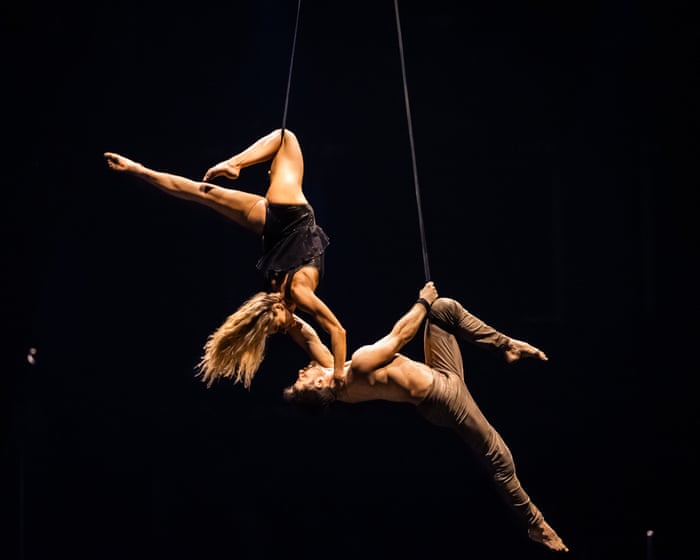
Pass through a black-curtained doorway into a neon-lit bar, where two men twist and whirl on ropes above you. Climb a spiral staircase to find a pool, over which a goddess hangs by her hair, spinning wildly. Somewhere below, a monster drags a woman into the labyrinth’s heart, swallowed by darkness. Above, exiled Trojan soldiers pay tribute to a commanding queen. One of her courtiers breaks away, chased by a soldier—with a few audience members joining the pursuit. There is no safety net, no traditional stage—only viewers and performers side by side.
Now imagine all this and more unfolding at once, with multiple performances happening simultaneously over two hours. This is the experience of Walk My World, which opened in Budapest last year. Part modern circus, part dance, part cabaret, it is immersive theatre on an epic scale—the largest in Europe. Its stories, carried by 26 performers each with their own narrative, draw from the tale of Dido and Aeneas in Virgil’s Aeneid, while weaving in other gods, monsters, lovers, and soldiers from the epic. Audiences roam freely, following characters or exploring the set, often stumbling upon scenes by chance. Some performances last over half an hour, others just minutes; some are solos, others feature jugglers, aerialists, gymnasts, acrobats, and dancers in various combinations.
Walk My World is the creation of Bence Vági, founder and artistic director of the Hungarian contemporary circus company Recirquel. A trained dancer and choreographer, Vági’s life and career have been defined by the same boundary-crossing spirit that marks his company’s work.
Born in the final decade of the Cold War, his first taste of theatre was circus. As he notes, Soviet countries fostered a strong circus culture, seen as a safe form of escapism. His own childhood straddled communist Hungary and the West. His father, an athlete permitted to travel for competitions, moved the family across the border when Bence was five and chose not to return. They lived in West Germany for five years before going back to Hungary after the Berlin Wall fell.
Bence began dance lessons in Germany, discovering a passion that continued after his family’s return. From age 11, he took three or four classes daily, studying classical ballet, jazz, and contemporary dance alongside regular school. How did he manage it all? “I studied on the bus,” he laughs. As a young adult, he returned west to attend Liverpool’s prestigious Institute for Performing Arts, co-founded by Paul McCartney.
It was at the Edinburgh Festival that Vági first saw Cardiff’s pioneering NoFit State Circus, which blends dramatic storytelling with spectacular acrobatics, blurring the line between audience and performers. “Their show wasn’t labeled ‘immersive,’ but inside the tent you were surrounded—it felt like being inside a cabaret,” he says.I went back home and proposed to the Sziget festival, “I want to create a show for you with circus artists.” My idea was to feature performers from Hungary’s national circus institute, but I was told they were too young and inexperienced. I replied, “Give me two months, some funding, and your trust.”
This fusion of cultures gave birth to my company, Recirquel, and a new form of modern circus that blends acrobatics with contemporary and classical dance and physical theatre. I call it “cirque danse.” The abstract nature of dance is a powerful way to tell stories. Circus can sometimes feel limited because performers must focus on dangerous tricks. Dance offers more freedom. Combining that freedom of movement with the superhuman qualities of circus creates something entirely new.
Our debut show, Night Circus, was an instant success and won the support of Hungary’s leading cultural institution, Müpa Budapest, which remains our home base today. Greater public exposure came with The Legend of the Golden Stag in 2017, commissioned for the televised closing ceremony of the World Aquatics Championships. In 2023, the solo show IMA (Pray) won the Seoul Arts award at the Edinburgh Festival and received glowing reviews. The following year’s eight-person show, Paradisum, was similarly praised and is now on an international tour.
My influences extend far beyond circus and cabaret, drawing from the grand theatrical visions of Robert Lepage and Robert Wilson, and the innovative choreography and storytelling of Bob Fosse and Crystal Pite. If the set for my new show feels cinematic in scale, it’s because it was built by a team who worked on Denis Villeneuve’s Dune trilogy.
This level of production isn’t cheap. Half the funding for Walk My World comes from the Hungarian government. There has been widespread concern about the suppression of artistic freedom under Viktor Orbán’s right-wing Fidesz government. A 2022 report found that the regime’s cultural policy promotes a single nationalist narrative, limiting creative expression and diversity in the arts. In 2018, performances of Billy Elliot the Musical were canceled after a media campaign against its alleged promotion of homosexuality. So, am I facing constraints or censorship?
“No, never,” I say. “There has never been a limitation on what type of art we can create or portray.” I point to My Land (2018), a show featuring Ukrainian artists, music, and myths that explored their connection to their homeland. It was on tour when the war broke out, and when it returned to Budapest, the artists displayed a Ukrainian flag on stage and raised money for friends still in Ukraine—all while Orbán remains Putin’s closest ally in the EU.
So, do I have complete artistic freedom? “Does anyone in any country?” I ask, highlighting the universal challenges of funding that shape art everywhere. Yet, Walk My World includes LGBTQ+ characters; a poignant pas de deux between the Trojan soldiers Nisus and Euryalus is a particularly memorable scene. As a gay man myself, I’ve made one promise: “If anyone ever tells me how to do my show, that’s the moment I leave the country.”
While I don’t rule out touring the show eventually, my focus remains on my hometown. “I want Walk My World to be part of Hungarian culture.”I want visitors to Budapest to hear bartenders say, “Have you seen this show? It’s amazing—a unique creation by a Hungarian team from a company famous worldwide.”
What Vági and his company have achieved is astonishingly complex. While each audience member can choose their own path, the performers follow a strict, mapped route across the set, ensuring they’re in position for the next scene. Each wears a discreet smartwatch under their costume, programmed to keep them on cue and in sync with their fellow performers. Imagine a vast Rube Goldberg machine with 26 moving parts, plus individual lighting and music for each performance space, all operating at once.
Somehow, everyone converges for the exhilarating finale. Whooping acrobats launch from a Russian swing—a giant steel-barred contraption with a rotating platform that propels them high into the air in a breathtaking sequence. “There’s a beautiful link between myth and circus,” says Vági. “Both connect us to the superhuman. The impossible.”
Then, the mood shifts: the final tragedy of Dido and Aeneas unfolds above in a heartbreaking aerial dance. Suspended on ropes, they entwine, writhe, and twist. For the first time in two hours, the audience stands still, watching as the performers are lifted higher and farther away, spotlighted as they recede into the vast warehouse. There is no pyre, no dagger—Dido falls from Aeneas’s arms into the labyrinth, while her lover, still airborne, vanishes from sight.
These two sequences showcase Vági’s innovative approach: astonishing physical skill blended with the beauty and emotion of dance, creating drama that unfolds around the audience. “To me, immersive is like Michael Ende’s The Neverending Story, where Bastian reads the book and—whoosh!—he’s inside. Or Narnia,” says Vági. “You step in—because if your mind clicks, you’re inside the story. That’s what I wanted. If we go immersive, let’s do it right.”
Walk My World is booking until 30 April, with new dates to be announced soon. Tickets are available on Recirquel’s website.
Frequently Asked Questions
Of course Here is a list of FAQs about the immersive show Walk My World in Budapest designed to answer questions from firsttime visitors to those curious about its production
General Information Basics
Q What exactly is Walk My World
A Its an awardwinning immersive theatrical experience in Budapest that blends contemporary circus live music dance and interactive storytelling into a nontraditional walkthrough show
Q How is it different from a traditional circus or theatre show
A Theres no seated audience or single stage Instead you walk through a series of beautifully designed rooms and environments with the performance happening all around you Youre not just watching youre inside the story
Q Where is it located in Budapest
A The show is housed in a specially designed venue at Madách Square 5 1075 Budapest easily accessible by public transport
Q Is the show suitable for children
A The show is recommended for ages 12 and up It features intense emotional themes atmospheric music and abstract storytelling that younger children may not fully grasp Its not a traditional familyfriendly circus with clowns and animals
Q How long is the performance
A The entire experience lasts approximately 75 minutes
Ticketing Practical Details
Q Do I need to book tickets in advance
A Yes absolutely Due to its popularity and limited capacity per show advance online booking is essential and often required weeks ahead especially on weekends
Q What language is the show in Is it okay if I dont speak Hungarian
A The show is completely nonverbal It tells its story through movement music and visual spectacle making it universally understandable for any international visitor
Q What should I wear
A Wear comfortable shoes as you will be standing and walking for the duration The venue temperature is normal so dress as you would for any indoor activity
Q Can I take photos or videos during the show
A No The use of phones and cameras is strictly prohibited to preserve the magic and not disturb other guests or the performers You can take photos in the designated areas like the lobby after the show