“I know this bear. He knows me. We’ve met several times.” Our guide for the day points to a damaged sign in Sutjeska National Park, at the start of the trail that leads down into the Perućica forest in southeast Bosnia. The wooden post is covered in scratches from large claws. “Bears are the sharks of the land, because they have the sharpest sense of smell in the mountains. They’re highly intelligent. I’m absolutely convinced they know who’s a friend and who’s a threat. I come to the forest often, so this guy knows my scent. But there was one incident—a hunter who came here to kill, and a bear peeled his face off like an orange.”
The Guardian’s journalism is independent. We may earn a commission if you buy something through an affiliate link. Learn more.
With that image, Dejan Elez has our full attention. A Bosnian Serb who studied law, became a ranger, and now works as a mountain guide, he’s a natural storyteller. My travel companion, Chris, and I are captivated as he describes the famous battle fought nearby, when Yugoslav partisans broke through a German encirclement in 1943, surprising the Wehrmacht under cover of a violent storm—”the wind was picking up and the lightning was like a strobe light.” But after that, Dejan’s story takes us much further back in time, into the depths of one of Europe’s oldest forests.
View image in fullscreen
Bear sightings are more likely in spring, when they come out of hibernation to feast on wild garlic. Photograph: Vince Burton/Alamy
Scientists estimate that Perućica—which spreads across the slopes of a canyon in Republika Srpska, the autonomous Serb-majority region of Bosnia and Herzegovina—has grown without human interference for 20,000 years. Along with Białowieża, which straddles Poland and Belarus, it’s considered the last true remnant of the primeval forest that once covered the continent. But Dejan says Perućica is much better preserved. It has never been inhabited, and its rough terrain and steep slopes have saved its trees from logging. Its 1,434 hectares (3,543 acres) are now strictly protected—no one can enter without a guide—and the site’s importance is recognized by UNESCO.
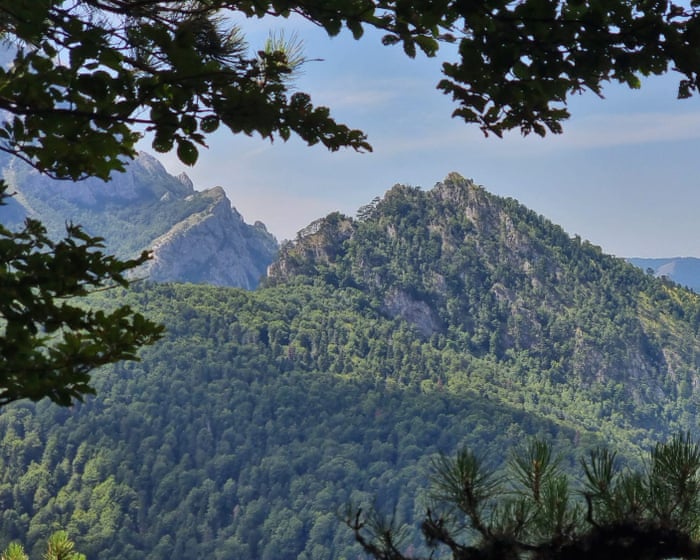
From a viewpoint on a rocky ridge, dense greenery spreads out below, clinging to the sheer canyon walls above a river. The river is fed by Skakavac, a 75-meter waterfall that thunders into a mist of spray, and far above, the white summit of a mountain shines. Originally, Chris and I had hoped to climb Maglić—at 2,386 meters, the highest peak in Bosnia—but it snowed a couple of weeks ago, and we’ve been warned that early spring conditions are dangerous. We’ll save the climb for another time. Today, we’re going down.
View image in fullscreen
The forest has about 170 species of trees and shrubs and more than 1,000 plants. Photograph: Riding Hood/Alamy
Dejan leads the way along the winding trail through groves of mixed beech, fir, spruce, pine, and maple. He admits he doesn’t know the names of all the trees, but he knows the animal tracks intimately. The forest, he says, is “readable,” and he reads it like a book. Circular patches where the soil has been dug up are made by chamois foraging for nutritious roots. Roe deer do the same, but their holes are precise and deep. “Look”—Dejan points to a wet log—”those scratch marks were made by a canine, either a fox or a wolf. But there, on the same log, something even more exciting.” The wider, deeper scratches were made by a passing brown bear. Nearby is a larger hole where a bear has raided a honeybee hive. Of course, sightings are never guaranteed, but they’re always possible at this time of year, when bears come out of hibernation to feast on wild garlic—known in many Balkan languages as “bear’s garlic.” “If I stop, you stop! Now we’re in stealth mode.”
The knowledge that wildcats, lynx, and wolves are hEvery few minutes of descent seems to bring us into a different world, as the temperate rainforest grows taller and more tangled. Deadwood lies everywhere – which, oddly enough, is a sign of health. Lichen, moss, and fungus hang from the branches. The incredible biodiversity protects Perućica from outbreaks like the spruce bark beetle infestation that has destroyed old-growth forests elsewhere. With around 170 species of trees and shrubs and over 1,000 plants, it’s no wonder our guide doesn’t know them all.
During the last ice age, Perućica escaped the freeze and acted as a refuge – an isolated area where many species survived. When the ice melted, trees spread northward from here. Dejan believes the forest’s name is linked to Perun, the pre-Christian and pre-Islamic Slavic god of lightning. It certainly feels like we’re walking through a temple.
He packed sandwiches – cheese and ham in thick white buns – which we eat on a grassy ledge overlooking the waterfall. Chamois clearly eat here too, since their droppings are everywhere. We don’t see the herd, nor do we spot the wildcats, lynx, or wolves that also call this forest home. But knowing they’re here, maybe very close, brings a feeling I can only describe as reverence. We all fall silent in awe. Maglić and the other mountains disappear behind white clouds, and it starts to rain. The wetness doesn’t bother us.
With his legal background, Dejan is clear-eyed about the threats. The ancient forest might be safe, but hunters come into the wider national park, and rangers are sometimes bribed to look the other way. Most visitors to Sutjeska stay in the village of Tjentište, a handful of guesthouses and simple restaurants along the main road, but there’s growing development at the park’s edges. Even our cozy timber cabin near the entrance gate is, in his opinion, too close.
It’s not that people shouldn’t come here, he tells us as we walk back up. What matters is how they come – as respectful guests. We don’t own the forest, or even this trail, which is walked and shared by many others. He bends down to brush aside some leaves and points out bits of bone that have passed through a wolf’s digestive system, and further on, wolf droppings filled with chamois hair. “This was left on the trail on purpose to tell us it’s their territory. They don’t do anything by accident. Everything has meaning.”
After almost five hours, we come out onto the gravel road leading to Tjentište. The absence of so much tangled life is almost shocking. We both feel changed by our glimpse into Europe’s wild past – and maybe we’ve been subtly changed on a biological level too. As we part, Dejan says, “You two gentlemen have been exposed to a universe of microorganisms you’ll never find in England. This forest gets inside you.” Perućica stays with us as we leave the national park and head back to Sarajevo, a two-and-a-half-hour drive north – just as the trees once moved when the ice age ended.
Guided tours of Perućica with Outdoor Bosnia or Wild Balkan Trails from £50 per person. Mountain View, Tjentište, sleeps two, from £44 a night. Alternatively, Apartmani Šarović, also in Tjentište, sleeps two, from £47 a night.
Frequently Asked Questions
Here is a list of FAQs about Were going on a Bosnian bear hunt in Europes oldest forest
BeginnerLevel Questions
1 What exactly is Europes oldest forest
Its the Peruica Forest in Bosnia and Herzegovina Its one of the last remaining primeval forests in Europe meaning it has never been logged or managed by humans
2 Is this a real bear hunt
No Its a playful reference to the childrens book Were Going on a Bear Hunt This is a wildlifewatching and hiking trip to spot brown bears in their natural habitat
3 Do you actually see bears
Yes but its not guaranteed The area has a high density of brown bears so many visitors do see them especially at dusk or dawn near feeding sites or along remote trails
4 Is it safe to go into a forest with bears
Yes when done with a licensed guide Guides know bear behavior keep a safe distance and use special hides for viewing You never approach a bear directly
5 Whats the best time of year to go
Late spring for lush greenery and active bears or early autumn for cooler weather and bears feeding before winter Summer is also good but can be hot
Intermediate Advanced Questions
6 How do the bear hides work
These are camouflaged wooden huts or platforms built at a safe distance from known bear trails or feeding areas You sit quietly inside while bears wander by completely unaware of you
7 Do I need special gear or fitness level
You need moderate fitness hikes can be 36 hours on uneven muddy terrain Essential gear sturdy waterproof boots layered clothing binoculars a headlamp and insect repellent No special climbing gear is needed
8 Can I go without a guide
Absolutely not The forest is remote has no marked trails and is home to wild bears and wolves Guides are mandatory for safety legal access and to avoid disturbing the ecosystem
9 What other animals might I see besides bears
Yes The forest is a biodiversity hotspot You