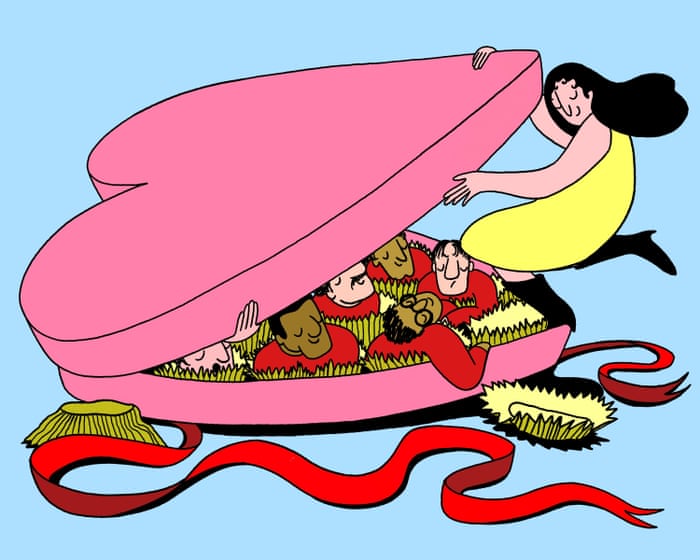
It’s late afternoon, and Lucy texts her husband’s girlfriend. In the living room, cartoons are playing, and she wipes a smear of jam off the counter without really thinking about it.
A few minutes earlier, Lucy’s phone buzzed with a school email about a parent-teacher event on Thursday evening. She usually goes to these things alone, but this time she pauses. She wants her husband, Oliver, to come.
When she checks their shared Google Calendar, she sees Thursday is already taken. Oliver has a date with Cecilia.
Lucy opens WhatsApp. She doesn’t text her husband. She texts Cecilia. Cecilia replies quickly—they can find another night. A few minutes later, the color-coded shared calendar updates.
Later, Cecilia described it simply: “The organizing aspect is very gendered.”
In the group chat between the two couples, she said, the messages usually come from her and Lucy—scheduling, adjusting, confirming. The men, she noted, rarely start these conversations.
When asked about this, Oliver put it more bluntly.
“I’ll be the first to admit that my partner takes on a disproportionate amount of domestic labor,” he reflected. “That is … men being shit,” he said simply.
Oliver, 38, and Lucy, 40, live in London with their two children. For the past several years, Oliver has been in a committed relationship not only with his wife, Lucy, but also with another married woman, Cecilia—whose husband, James, is dating Lucy in return.
Like many couples exploring consensual non-monogamy—a broad term for relationship structures that go beyond sexual exclusivity—they first saw themselves as having an open marriage. That meant allowing physical encounters and casual relationships outside the marriage, but still keeping emotional intimacy and romantic love centered between the two of them.
Over time, though, the boundaries shifted. What started as openness turned into something closer to polyamory: not just having sex with multiple people, but maintaining multiple loving relationships at the same time.
Relationships like these aren’t as rare as they might seem. Recent research suggests that at least 5% of Americans are now in a consensually non-monogamous relationship, and about one in five have tried it at some point. Yet the cultural script remains very narrow.
Open marriage is often seen as something men want—driven by male desire, designed for male freedom, and reluctantly tolerated by women. But that’s not the whole story. Women also want this, and their reasons are rarely simple. They’re shaped by boredom, curiosity, and a desire for autonomy, just as much as by dissatisfaction.
In practice, the shift to non-monogamy—and sometimes into polyamory—can be unsettling for men and, at times, freeing for women, though the emotional and practical realities are rarely that clear-cut.
Lucy had been drawn to non-monogamy for as long as she could remember.
“It was my idea,” she said of opening the marriage. “It’s honestly something I’ve always wanted since I was 18.”
“Because we have this foundation of love between us, we get to go off and experience these things from a place of safety,” Oliver said.
After a few years living in California, Lucy began to see non-monogamy as increasingly “normal.” Their social circle was part of a broader community that questioned traditional relationship scripts—open relationships, polyamory, blurry lines between friendship and romance, and a general spirit of experimentation in spaces like Burning Man. By the time she and Oliver decided to open their relationship, many of their friends already had. “It was in the water of our friendship group,” she said.
Oliver pushes back against the idea that non-monogamy is a last-ditch effort to save something broken, or a”So you’re holding both things at once,” she says.
What she’s describing isn’t just empathy—it’s a kind of redistribution. The imbalance that starts in the dating market doesn’t stay outside. It becomes emotional. Men who have fewer options are often expected to deal with that gap: to manage jealousy, stay open, and do it all while getting less of the external validation that might make those demands bearable.
The couples who tried polyamory – then changed their minds: ‘I never expected my husband to fall in love’
Read more
For James and Lucy, this came up in a moment they hadn’t planned for.
It was early evening, and the four of them were sitting together in the living room. The kids were out with the nannies. At first, it felt like just another check-in—until Oliver and Cecilia told her and James that they were in love.
“That wasn’t in the agreements. But you can’t really control feelings,” Lucy said when asked about that moment.
The agreements, as she described them, were never meant to cover everything. Instead of strict rules, Lucy said they were trying to operate from a place of trust. She wasn’t interested in drawing hard lines around what was allowed. She wanted to protect the relationship’s integrity.
In that setup, falling in love wasn’t explicitly forbidden. It just hadn’t been considered. And once it happened, everything shifted. What had felt open and abundant started to feel, in her words, like “the wild, wild west.”
But that’s not how Oliver describes the dynamic at its best. He talked about something often seen as a cornerstone of polyamory: compersion—the ability to genuinely feel happy for a partner’s connection with someone else.
“I believe compersion is possible because I’ve experienced it,” he said. “Feeling happy that your partner gets to have this connection with someone, and grateful that they’re supporting you to have one too.”
But that version of the arrangement—expansive, mutual, grounded in gratitude—depends on being able to stay in that mindset even when things shift. To absorb moments of jealousy without letting them harden.
Research suggests that while people in non-monogamous relationships often report lower levels of sexual jealousy, they face greater demands when it comes to emotional processing.
“Non-monogamy is an opportunity to disintegrate what you know,” Lucy said.
Over time, the work becomes less about reacting and more about anticipating. Non-monogamy means tracking not just one relationship, but several—and how they overlap.
Thouin describes this as the challenge of rebuilding the relationship’s structure. When exclusivity is removed, couples have to “reinvent what loyalty looks like.” What emerges isn’t a replacement, but an addition. The original imbalances in heterosexual relationships remain: childcare, domestic labor, emotional maintenance—with other layers added on top: more people, more logistics, more feelings to process.
What follows isn’t just an expansion of freedom, but a redistribution of difficulty: the demands of emotional openness, resilience, and relationship management fall unevenly, just like the rewards of the dating market.
Across the women I spoke with, the point wasn’t that open marriage offers an escape from those tensions. It’s that it brings them closer to the surface.
When asked to summarize her open marriage in one sentence, Lucy paused.
“It’s an opportunity to disintegrate what you know,” she said, “as an opportunity for infinitely more integration.”
That integration, though, doesn’t happen automatically. It has to be scheduled, negotiated, spoken aloud, and absorbed—often by the women who first made the freedom imaginable.
So the question isn’t whether open marriage works, but what it reveals—and, once revealed, what women are left to hold.The names of the people interviewed for this article have been changed to protect their privacy.
Frequently Asked Questions
Here is a list of FAQs based on the theme of women choosing nonmonogamy for deeper connection written in a natural tone with clear answers
BeginnerLevel Questions
1 What exactly is nonmonogamy
Its an umbrella term for any relationship style where people have more than one romantic or sexual partner with everyones full knowledge and consent Its different from cheating
2 Isnt nonmonogamy just about having more sex
Not necessarily For many women its about the freedom to form different kinds of deep emotional bonds Its less about quantity and more about the quality of each unique connection
3 How is nonmonogamy different from an open relationship
An open relationship is one type of nonmonogamy usually focused on casual sex outside the primary partnership Nonmonogamy can also include polyamory or relationship anarchy
4 Why would a woman choose this if shes already in a happy relationship
Many women find it allows them to explore different parts of themselves They believe one person cant meet all their needs and that loving more than one person doesnt take away from their primary partnerit can actually deepen their own selfawareness and honesty
5 Doesnt this mean the relationship is failing
For many its the opposite The choice often comes from a place of security not crisis It requires high levels of trust and communication which can actually strengthen a solid foundation
Advanced Practical Questions
6 How do you avoid jealousy
You dont avoid ityou work through it Jealousy is a signal not a stop sign It usually points to an insecurity or a need Nonmonogamy forces you to name that feeling and talk about it which can lead to a deeper connection with your partner
7 Whats the biggest challenge for women in this lifestyle
Social stigma is huge Women often face judgment for being promiscuous or not serious while men in the same situation might be praised Finding a supportive community and unlearning internalized shame is a real struggle
8 How do you find partners who are okay with this
Honesty is key You disclose your relationship structure very