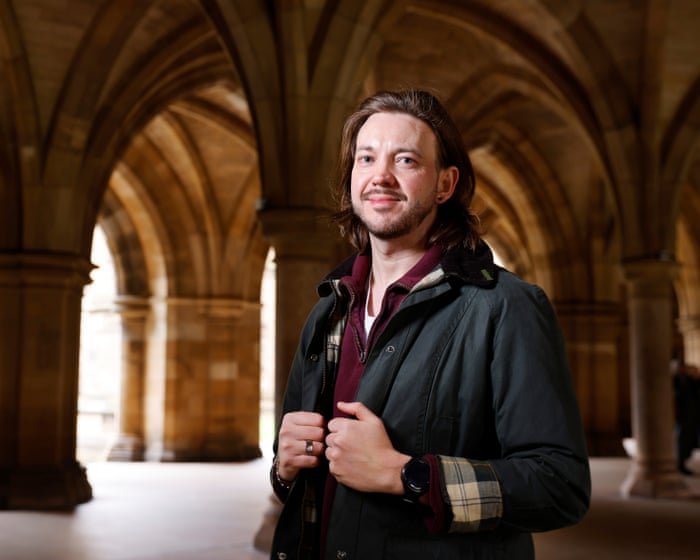
Thomas Delaney never believed he was “good enough to be loved.” Growing up, he absorbed the pain he witnessed at home. “I thought I was useless, I wasn’t a nice person… I even thought that my mum and dad didn’t love each other because of me.”
When I visit him at his home in Glasgow—where he lives with his very affectionate black-and-white cat, Figaro—Delaney, wearing a jumper that says “nicotine is dumb,” is open about how his childhood affected him. “I had suicidal thoughts from a very, very young age because I assumed that if I were dead, maybe my mum and dad wouldn’t be arguing.” Later, he became addicted to ketamine. At his lowest point, he weighed just 38kg (6 stone).
“The reason people use drugs of any kind is because they want to escape,” Delaney says. Now 39, he has been drug-free for seven years and works as a public speaker to raise awareness and prevent substance abuse.
Delaney’s parents are Irish. He lived in Nenagh, County Tipperary, for the first two years of his life before the family moved to Hackney in east London. His parents’ relationship was unstable throughout his childhood, and it ended for good on August 31, 1997—a date he remembers clearly because it was the day Princess Diana died. His mother moved with 11-year-old Thomas and his two younger brothers to Barnsley. But tensions in their new home remained high.
As a teenager, Delaney sought any escape he could find: joining the army cadets and signing up for every weekend trip, staying at friends’ houses as much as possible, taking a job at a call center at 16, and eventually trying to drown everything out with drugs.
He was 17 when he first tried cocaine on a night out “behind a Greggs in Barnsley town center,” he says with a grim smile. He immediately “fell in love with” the feeling of being high, drawn to the sense of connection it gave him—something his life had been missing.
One day, after a weekend of partying, he went to his job at a water filtration company and collapsed. “I had white powder all around my nose,” he says. His boss fired him on the spot. After that, he and a friend moved back to Ireland for a fresh start. For a short while, it seemed to work. “I started looking after myself, rarely took drugs,” he says.
After six months, he returned to England and decided to try living in London. He got another sales job. Although he still took cocaine “if I went out on a date or on a night out… life was a lot more manageable.” However, his job was demanding, living costs kept rising, and after two years, he had “just had enough.” At 21, feeling lonely and directionless, he returned to Barnsley, where the drug scene had “sort of shifted”: ketamine, a dissociative anesthetic, had become the drug of choice for many of his friends. Recent data shows a concerning rise in recreational use of the Class B drug in England and Wales, with Barnsley identified as a hotspot by Alison Downey, a consultant urologist in South Yorkshire.
When he lived in London, Delaney had “despised ketamine.” Back then, he took drugs to socialize and couldn’t see the point of taking something that made you seem like “a zombie.” But after moving in with two friends in Barnsley, one of whom dealt drugs, Delaney started experimenting on nights out. “I would use cocaine to pick me up, I would use ketamine to take me down,” he says.
One day, he was in the bath when a man came to the door with a gun: “That was really traumatizing.”
It makes sense to Delaney.Ketamine has grown in popularity: it’s inexpensive and appeals both to partygoers and to people at home on the sofa looking to escape for a while. When he speaks with young users today, he says, “most of them really struggled through lockdown.” While he doesn’t believe rising ketamine use is a direct result of the pandemic, “it certainly hasn’t helped”: faced with the stress of a global crisis and being stuck at home, many turned to ketamine as an escape.
But that escape comes at a cost, as Delaney knows well. Back in Barnsley, he lost another job after showing up high and swearing at a customer. He started dealing drugs. Though he now sees it as “stupid,” at the time the constantly ringing phone gave him a sense of validation he had always lacked.
With easy access to ketamine and no job, Delaney’s addiction worsened. He was “in and out of hospital,” and chronic use had damaged his bladder so badly that he was “peeing the lining out, peeing blood constantly.” One day, while he was in the bath, a man showed up at the door with a gun looking for Delaney’s housemate and took all the drugs and money in the house. “That was a really traumatizing thing for me,” he says.
After that, he left Barnsley for a while, spending 18 months in Ireland living relatively healthily before returning at age 24. Despite planning to stay clean, “as soon as I came off the boat, I used ketamine,” he admits. He was offered his first “proper corporate job” in the education sector—an opportunity that nearly fell through because of his drug possession convictions. His manager agreed to hire him on the condition that he would undergo random drug tests. “But I realized the test they used didn’t check for ketamine, it tested for everything else,” Delaney says. “So instantly my brain thought: well, you can just use ket and you’ll be fine.”
He worked there for seven years before being laid off in 2018. “I had nothing,” Delaney says. “I didn’t have a job to hide behind. I didn’t have any fancy suits to wear anymore.” Unable to afford his own place, he lived in his car “until I sold it for a drug debt.” He ended up living in a field. After several suicide attempts, he decided to seek help and went to his local clinic. “I’m a drug addict,” he told the doctor. “And that was the first time I’d ever really said that.”
But it was an argument with his mother that finally pushed him to turn his life around. By then, “my relationship with my mum wasn’t great,” he says. His addiction had become so severe that when he visited her, he had to urinate in a bucket because he couldn’t make it to the bathroom in time.
“I knew that if I was ever going to get better, I couldn’t run away to Ireland or to London again and just hide it all,” he says. Through a local recovery service he contacted after seeing the doctor, he was admitted to a rehab center in Glasgow on November 2, 2018, at age 32. He chose Glasgow over other cities because, despite its reputation, he figured it would be harder to find drugs there without local contacts. “But the real and main reason was because it had en suite rooms,” he admits. With his constant bladder issues, he needed his own toilet.
The center didn’t usually treat ketamine addiction. “Even some staff members would tell me that I wasn’t a p“I was a proper junkie,” he says, clarifying that he wasn’t addicted to a Class A drug. His six and a half months in rehab “were one of the hardest parts of my life,” he notes, explaining that rehabilitation centers aren’t always the safe havens people assume. (“I never saw heroin in my entire life until I went to rehab.”)
Ultimately, he found support from staff he describes as “amazing,” and it was during this time that he stopped using drugs for good.
After rehab, Delaney had no idea what to do next. When an article he wrote for his rehabilitation center went viral, he was contacted by the digital publisher LADbible, which wanted to make a video about him. Since then, he has been featured in various publications and invited to speak in Parliament. While volunteering for a youth organization in 2021, he met the late Queen (though he adds he is “not a royalist, obviously”). He now works with organizations including the police, the NHS, and the National Crime Agency, sharing his story and supporting drug users. “I want to normalize that people can get better,” he says.
He plans to continue that mission through more community work and academic research: he graduated with a first-class degree in community education from the University of Glasgow last year and is now studying for a master’s. He also became a father three years ago and says building a life with his partner and son has become the “most important thing” to him. Kirsty, who runs her own cleaning business, “judges me on who she met, not my past,” he says.
Although Delaney hasn’t drunk alcohol or taken an illegal drug since his first day in rehab, he is keen to emphasise that he is “not special.” “Anybody can get better if they want to change their life and they have the strength and courage to do so. I once walked 20 miles to attend a meeting and walked back because I had no money for the bus or a taxi,” he says. “We have this perception that you go to rehab, someone waves a magic wand and you never use drugs again. I wish that was the case.” In the seven years since Delaney left rehab, “I could probably name 20, 30 people who have gone through that same service that are dead.”
Delaney says people need to be lifted out of poverty if drug abuse is to be reduced, pointing out that those in economically deprived areas are more likely to face mental health issues or hardships that can lead to addiction. “We need rehabs. We need support workers. We need all of that,” Delaney says. “But unless the environment is changing, what’s the point?”
More than seven years after leaving rehab, has Delaney finally accepted what he couldn’t as a child: that he is deserving of love? “No,” he admits, welling up slightly. “You need to leave now,” he jokes. But, he says, being a father “gives me purpose.” “If there’s one thing I can teach my son, hopefully it’s that no matter how much you think you’ve messed everything up, no matter how much you think everything’s terrible, you can always change it.”For immediate help in the U.S., call or text 988, or chat online at 988lifeline.org. In Australia, contact Lifeline at 13 11 14. For support in other countries, visit befrienders.org to find a helpline near you.
Frequently Asked Questions
FAQs About I Was Constantly Peeeing Blood Ketamines Bladder Damage
Q What does peeing blood from ketamine mean
A Its a condition called ketamineinduced cystitis The drug causes severe inflammation ulcers and scarring in your bladder lining making it feel like you constantly need to pee causing intense pain and leading to visible blood in your urine
Q Is this bladder damage common with ketamine use
A Yes its a very common and welldocumented physical side effect of regular or heavy ketamine use Its not a rare reaction its a direct toxic effect of the drug and its byproducts on the bladder
Q How much ketamine does it take to cause this
A Theres no safe amount Damage can occur with recreational use and the risk increases significantly with frequency and duration Some people develop symptoms after relatively short periods of use
Q What are the early warning signs
A Early signs include needing to urinate more often a sudden urgent need to go and mild discomfort or a burning sensation when you pee These can easily be mistaken for a urinary tract infection
Q What does it feel like when it gets worse
A It becomes a nightmare Symptoms escalate to constant severe pelvic and bladder pain visibly bloody or cloudy urine passing tiny blood clots severe urgency where you cant hold it and drastically reduced bladder capacity
Q Can the damage be reversed if I stop using ketamine
A Stopping is the single most important step If caught early symptoms can improve and sometimes resolve completely after quitting However with prolonged use the scarring and shrinkage of the bladder can be permanent and irreversible requiring major surgery
Q What kind of treatments are available for this damage
A Treatments focus on managing symptoms and repairing tissue but only work if ketamine use has stopped They can include prescription painkillers bladder instillations physiotherapy and in severe cases surgeries to enlarge the bladder or even complete bladder removal