Not everyone has welcomed the Spanish government’s decision this week to go against European political trends by announcing plans to grant legal status to 500,000 undocumented migrants and asylum seekers, aiming to boost “economic growth and social cohesion.”
Alberto Núñez Feijóo, leader of the conservative People’s Party (PP), called the move a reward for “illegality” that would bring more people into the country and “overwhelm our public services.” Santiago Abascal, who leads the far-right Vox party, attacked the measure as a sinister effort to enable an “invasion” meant to replace Spaniards with foreigners.
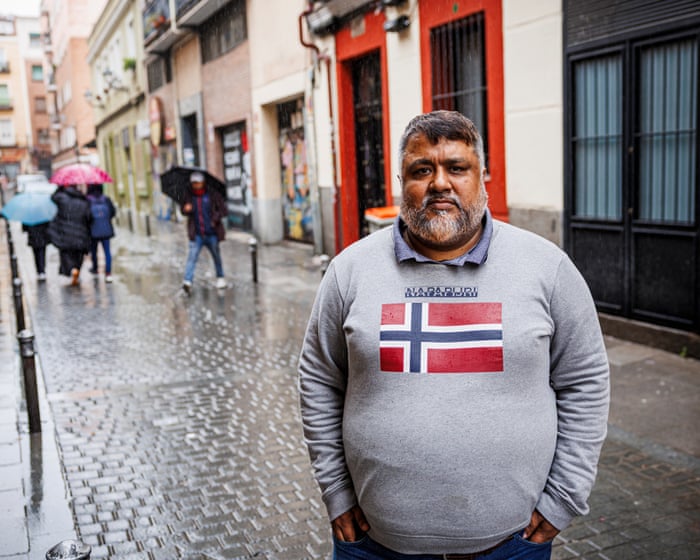
But for a young Bangladeshi man sitting in a cramped NGO office in central Madrid on a rainy Thursday, the announcement felt like a miracle. For him, the decree offers the hope of a future not spent walking the streets in all weather, selling cheap umbrellas to earn between €200 (£173) and €400 a month.
“I don’t have my papers, so I can’t get a proper job,” said the man, who arrived in Spain 14 months ago and asked not to be named. “I really worry about paying my rent, and I’m also trying to support my wife and daughter, who I left behind. I can’t get public housing or go to the doctor. I’m out on the street all day in the rain and the cold and the sun, just trying to earn a living.”
That, he added, was why he was so delighted by Tuesday’s announcement. “I’m so excited,” he said. “It’s like a gift from God that will help keep me going.”
Sitting next to him, Mohammed Elahi Alam Alam, the president of the Valiente Bangla Association, which supports undocumented migrants, also welcomed the decision by the ruling Spanish Socialist Workers’ Party (PSOE), calling it a long-overdue acknowledgment of reality. It was also a necessary response to Vox’s stated goal of deporting 8 million people of foreign origin, including their Spanish-born children.
“There are people who don’t want immigrants here—the fascists—but who’s going to work in the fields?” Alam asked. “Immigrants. Who’s going to work in the restaurants? Immigrants. Who’s going to look after people’s families? Immigrants.”
Signs of Valiente Bangla’s wide-ranging outreach work filled Alam’s office: sacks of potatoes for communal meals, megaphones, children’s toys, and a stack of Spanish language books.
Many of those eligible for regularization, however, won’t need to improve their Spanish. Rosa (not her real name), who came to Spain from Colombia almost two years ago, is one of the many Latin American women working informally as cleaners, cooks, and carers. Many are underpaid, and some are mistreated by their employers.
Rosa said, “A lot of us have sacrificed so much to come here in search of a better life, and yet some days you get up and think: ‘I just can’t do this any longer—I’m going to go back.’ Some people deliberately hire undocumented people because they know they won’t need to pay them properly or cover their social security.”
For Rosa, the regularization program is a chance to get a job paying more than €120 a week and to access the protections and benefits available to legal workers.
Despite the loud political opposition, regularization is far from new in Spain; both PP and socialist governments implemented similar programs between 1986 and 2005. Research suggests such initiatives can bring economic benefits for newly legalized workers.The policy benefits both workers and government finances. Joan Monrás, co-author of a study on Spain’s 2005 regularization of nearly 600,000 non-EU immigrants, noted that tax revenues rose by approximately €4,000 per regularized immigrant annually. He also emphasized that the policy did not create a “magnet effect” by attracting additional migrants.
“The first part of our research examined whether there was a ‘pull effect,’ and we concluded there wasn’t—there was no relative change in migrant flows,” explained the labor economist. “We also clearly observed that the career trajectories of immigrants who entered the social security system improved significantly. A good example is domestic workers who joined the labor market. After starting with family employment, many moved to larger companies within six months and earned higher salaries.”
This decree is not the first time Prime Minister Pedro Sánchez’s administration has made the moral and economic case for immigration, as Spain contends with an aging population and low birthrate.
In October 2024, Sánchez stated, “Throughout history, migration has been a major driver of national development, while hatred and xenophobia have been—and continue to be—the greatest destroyers of nations. The key lies in managing it well.”
However, his government’s stance and policies have angered far-right groups in Spain and abroad, and false stories about the regularization have spread on social media. While the measure grants successful applicants official resident status, it does not provide citizenship or the right to vote in general elections.
This week on X, Elon Musk reposted a claim that Sánchez was using the move for “electoral engineering,” adding, “Wow.” Sánchez responded by reposting Musk’s comment with his own reply: “Mars can wait. Humanity can’t.”
Amid the disputes and political maneuvering, advocates who have long campaigned for regularization urge reflection on the decree’s significance and necessity.
Catholic organizations, including the migration department of the Spanish Bishops’ Conference, view the measure as “an act of social justice and recognition of the many migrants who, through their work, have long contributed to our country’s development, even while being kept in irregular status.”
Edith Espínola, a spokesperson for the Regularisation Now! movement, said the decree would significantly restore rights lost by those who crossed borders seeking safety or better opportunities.
“Regularization makes you feel like a citizen and a person,” she explained. “It stops you from feeling like an object and allows you to fight for your rights. You know those rights are yours, but they aren’t truly yours until you have a plastic card confirming you’re a resident of this country.”
She added that regularization enables people to work, study, and live with dignity. “It means you can break through that invisible border. It means you can feel a little more human from the moment you hold that plastic card.”
Frequently Asked Questions
FAQs Spains Amnesty for Undocumented Migrant Workers
Basic Understanding Definitions
1 What is this amnesty for undocumented migrants in Spain
Its a government program that allows certain undocumented foreign workers to apply for legal residency and work permits effectively regularizing their status
2 Who qualifies for this amnesty
Eligibility typically depends on specific criteria such as proof of longterm residence in Spain a clean criminal record employment history and family ties The exact requirements are set by the government for each program
3 Why is Spain offering this amnesty
Governments use amnesties to address labor shortages integrate longterm residents reduce the shadow economy and manage migration humanely by recognizing people who are already contributing to society
4 What does regularization mean
Its the process of changing from an undocumented status to a legal one granting the right to live and work openly without fear of deportation
Benefits Impact
5 What are the main benefits for someone who gets regularized
They gain legal work rights access to public healthcare social services the ability to open bank accounts sign rental contracts travel freely within the Schengen Area and live without the constant fear of detention or deportation
6 How does this help Spains economy
It brings workers out of the informal economy increasing tax revenues and social security contributions It also fills critical labor gaps in sectors like agriculture hospitality and caregiving with a nowformal workforce
7 Does this mean automatic citizenship
No Regularization grants legal residency usually for one or two years initially and renewable Citizenship is a separate longer process that often requires many more years of legal residence and passing languageculture tests
Process Practical Concerns
8 How do people apply and is it difficult
Applicants must submit a formal application with extensive documentation to the relevant government office The process can be complex lengthy and often requires legal help
9 What are the biggest challenges in applying
Gathering the required documents navigating bureaucracy potential language barriers high demand for legal assistance and the risk of application rejection