Venezuela’s most prominent opposition leader, María Corina Machado, has vowed to continue her struggle to free the country from years of “obscene corruption,” “brutal dictatorship,” and “despair” after being awarded the Nobel Peace Prize at a ceremony in Oslo, Norway.
The 58-year-old conservative has been living in hiding in Venezuela since its authoritarian leader, Nicolás Maduro, was accused of stealing the 2024 presidential election from her political movement. Despite intense speculation that she might make a dramatic appearance at Wednesday’s event after somehow slipping out of Venezuela, Machado was not present, though she was expected to arrive in Oslo soon.
In a lecture delivered by her daughter, Ana Corina Sosa Machado, the former congresswoman and veteran pro-democracy campaigner pledged to continue leading Venezuela on its “long march to freedom.”
“Venezuela will breathe again,” said Machado, who has lived underground since Maduro launched a wave of repression after refusing to accept he had lost last year’s vote, despite compelling evidence.
“We will open prison doors and watch thousands who were unjustly detained step into the warm sun, embraced at last by those who never stopped fighting for them … We will hug again. Fall in love again. Hear our streets fill with laughter and music,” added Machado, who some call Venezuela’s Iron Lady.
Opening Wednesday’s ceremony, the chair of the Norwegian Nobel Committee, Jørgen Watne Frydnes, said Machado was “safe” and “will be here with us in Oslo” after “a journey in a situation of extreme danger,” though not in time for the event.
In an audio message released by her team, the activist thanked those who had “risked their lives” to get her out of Venezuela and confirmed: “I’m on my way … I’ll see you very soon.” It was not immediately clear how Machado had escaped Venezuela, but the Wall Street Journal, citing U.S. officials, reported that she had secretly traveled by boat to the Caribbean island of Curaçao on Tuesday.
Latin American leaders and celebrities, including the right-wing presidents of Argentina, Ecuador, Panama, and Paraguay—Javier Milei, Daniel Noboa, José Raúl Mulino, and Santiago Peña—traveled to Oslo to offer Machado their support as her movement continued its crusade to force Maduro from power.
Also present was Edmundo González, the 76-year-old diplomat who replaced Machado in last year’s election after she was banned from running and is widely believed to have won. González was forced into exile in Spain by Maduro’s post-election crackdown.
The Venezuelan pianist and activist Gabriela Montero flew to Norway to perform at Wednesday’s ceremony inside Oslo’s red-brick city hall.
Montero said Machado had asked her to play “Mi Querencia” (My Haven), a song by Venezuelan composer Simón Díaz that the pianist believed spoke to the exodus of more than eight million people who have fled economic hardship and repression in Venezuela since Maduro took power in 2013.
“The song is about coming home,” Montero said before the ceremony. “That has been [María Corina’s] mantra all these years: that we will all be able to return home and that families will come together and the country will rebuild with that enormous diaspora that has spread through the world for so many years.”
Montero paid tribute to a politician she called “the most courageous, resilient woman that I know.”Corina never gave up the fight, despite her immense personal sacrifices. She always kept her goal in sight: to liberate the country she loves and has dedicated her life to,” the musician said.
Addressing the audience, Frydnes praised Machado’s “tireless work promoting democratic rights for the people of Venezuela and her struggle to achieve a peaceful and just transition from dictatorship to democracy.”
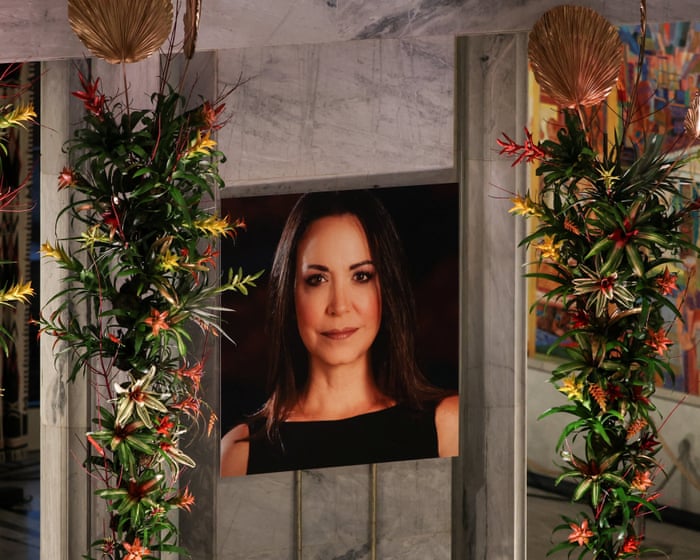
Standing next to a portrait of Machado, Frydnes sent a direct message to Maduro: “You should accept the election results and step down… because that is the will of the Venezuelan people… Let a new age begin.”
The Nobel ceremony comes at one of the most dramatic and uncertain moments in Venezuela’s turbulent recent history. Since August, Donald Trump has ordered a major naval deployment in the Caribbean Sea and a series of deadly strikes on suspected drug boats off Venezuela’s northern coast.
On Tuesday, two U.S. fighter jets flew within less than 80 kilometers of Venezuela’s second-largest city, Maracaibo, in a show of force.
While the official reason for the military buildup is Trump’s “war on drugs,” most analysts and diplomats believe his real goal is to overthrow Maduro by sparking a military uprising. Trump tried—and failed—to remove Maduro during his first term in the White House through a “maximum pressure” campaign of sanctions and military threats.
“His days are numbered,” Trump told Politico this week—although allies, including now-Secretary of State Marco Rubio, made almost identical claims during the 2019 attempt to oust Maduro and were proven wrong.
In an interview with Politico, Trump did not rule out a ground invasion of Venezuela, though given his non-interventionist policy, few expect that to happen. Still, some observers fear bloodshed if Trump escalates his military campaign, possibly by launching strikes against land targets inside Venezuela.
Celso Amorim, the chief foreign policy adviser to Brazil’s left-wing president, Luiz Inácio Lula da Silva, told the Guardian that a U.S. attack could create a Vietnam-style “war zone.”
Other observers recall the chaos caused by the U.S.-led invasion of Iraq in 2003 to overthrow Saddam Hussein or the 2011 NATO airstrikes that helped bring down Muammar Gaddafi.
Montero rejected such comparisons. “They try to compare it to other ‘regime changes’ in history—and it’s nothing like anything else we have ever seen,” the pianist said.
Corina Parisca de Machado, the mother of María Corina Machado, arrives at Oslo City Hall before the award ceremony.
“We have marched, we have voted, we have protested [against Maduro]… We’ve done everything to free ourselves from this terrible, terrible chapter of our history… and it’s very frustrating when we encounter public opinion that doesn’t understand what has happened to us and what we are up against.”
In her lecture, Machado said Venezuela was once “the most stable democracy in Latin America” but was plunged into economic ruin and authoritarian rule in the years after the 1998 election of Maduro’s mentor, Hugo Chávez, as the country’s oil wealth was squandered and stolen. “From 1999 onward, the regime dismantled our democracy,” she said. “We have spent almost three decades… fighting against a brutal dictatorship.”
The Norwegian Nobel Institute’s decision to honor Machado is not without controversy. While the committee praised her determined struggle against Venezuela’s “brutal, authoritarian state,” critics pointed to Machado’s past support for military intervention to overthrow the country’s dictator. Others have criticized her for failing to condemn Trump’s deadly strikes in the Caribbean or his treatment of Venezuelan migrants deported to a notorious prison.In El Salvador, after her Nobel Prize was announced in October, Machado dedicated the award to Trump “for his decisive support of our cause,” calling the U.S. president one of “our main allies to achieve freedom and democracy.”
On the eve of the ceremony, dozens of protesters gathered in the streets of Oslo to condemn the award. Gro Standnes, an activist and member of the Norwegian Peace Council, stated, “A peace prize should be given to those who truly work for peace, dialogue, and justice. Awarding it to a politician who supports military intervention and actions that violate international law undermines the very purpose of the Nobel Peace Prize.”
Frequently Asked Questions
Of course Here is a list of FAQs about the Venezuelan Nobel Peace Prize winner skipping the ceremony written in a natural conversational tone
Beginner Factual Questions
1 Who is the Venezuelan Nobel Peace Prize winner
The winner is María Corina Machado a Venezuelan opposition leader and former legislator She was awarded the 2024 Nobel Peace Prize for her nonviolent struggle for democracy and human rights in Venezuela
2 Why did she skip the Nobel Peace Prize ceremony
She chose to skip the official ceremony in Oslo to remain in Venezuela and continue her work on the ground She stated that her place was with the Venezuelan people during a critical time for the countrys democratic struggle
3 Did she refuse the prize
No she did not refuse the prize She accepted the honor and the award money but did not attend the traditional award ceremony She pledged to use the prize funds to support her prodemocracy work in Venezuela
4 Has this happened before
Yes its rare but not unprecedented Other laureates have missed ceremonies due to imprisonment illness or political pressure For example Chinese dissident Liu Xiaobo was prevented from attending in 2010 and Aung San Suu Kyi was under house arrest when she won in 1991
5 What did she do instead of going to Oslo
She held a parallel event in Caracas Venezuela with supporters and fellow activists symbolizing that the recognition belonged to the Venezuelan peoples struggle
Advanced Analytical Questions
6 What is the political significance of her skipping the ceremony
It is a powerful political statement By staying in Venezuela she highlights that the crisis and fight for democracy are ongoing and immediate It reinforces her commitment to the cause over international accolades and puts a continued spotlight on the situation inside the country
7 How does this affect the Venezuelan governments position internationally
It increases diplomatic pressure on the Maduro government The Nobel Prize brings immense global attention to Machados cause framing the Venezuelan conflict as a clear struggle between authoritarianism and peaceful democratic resistance It complicates the governments efforts to normalize relations on the world stage
8 What are the practical risks and benefits of her decision