Venezuela’s most prominent opposition leader, Nobel Peace Prize winner María Corina Machado, has expressed support for the U.S. seizure of an oil tanker off Venezuela’s coast, describing it as a “very necessary step” to confront Nicolás Maduro’s “criminal” regime.
Speaking in Oslo on Thursday, a day after being honored for her “tireless” struggle for democratic change, Machado praised the U.S. Navy and Coast Guard helicopter raid on the vessel.
She stated that Venezuela’s vast oil wealth—the world’s largest proven reserves—has not been used by Maduro’s dictatorship to fund hospitals, feed impoverished teachers, or improve security. Instead, his regime has used it to buy weapons to repress opponents. “So yes, these criminals have to be stopped, and cutting the resources of illegal activities is a very necessary step,” Machado told reporters.
Earlier that day, Machado said her arrival in Oslo marked a “historic turning point” that shows Venezuelans “the world is with them.”
Machado, who was forced into hiding in Venezuela by Maduro, escaped her authoritarian homeland by boat to travel to Norway and accept her prize. She said on Thursday that Venezuelan authorities “would have done everything they could” to stop her if they had known her whereabouts.
Speaking at the Norwegian parliament, the Storting, hours after making a dramatic 2:30 a.m. appearance on a balcony at Oslo’s Grand Hotel to greet supporters and reunite emotionally with her family, Machado thanked those who had “risked their lives so that I can be here today.”
Standing alongside Norwegian Prime Minister Jonas Gahr Støre, she said, “I don’t think the authorities knew where I was. And it’s quite clear that they would have done everything they could to stop me from coming here.” She added, “I want to thank all those who have risked their lives so that I can be here today.”
“I would say to all citizens of the world in this hour and assure you that I am very hopeful Venezuela will be free, and we will turn a country into a beacon of hope and opportunity, of democracy.”
Machado, who had not seen her children for nearly two years before arriving in Oslo, said she had been unable to sleep while deciding what to do in the “first instant that I saw my children.”
“For many weeks I had been thinking of that possibility, which one of them I would hug first… I hugged the three of them at the same time. It’s been one of the most extraordinary spiritual moments of my life, and it happened in Oslo, so I’m very grateful to this city. Something I will never forget.”
She described herself as one of millions of mothers “longing to embrace our children,” adding, “That brings us together.”
Machado said she would have liked to visit several countries in Europe but plans to return directly to Venezuela, where she will remain in hiding. “When I return, the regime will not know where I am. We have people to take care of me and the places I stay,” she said.
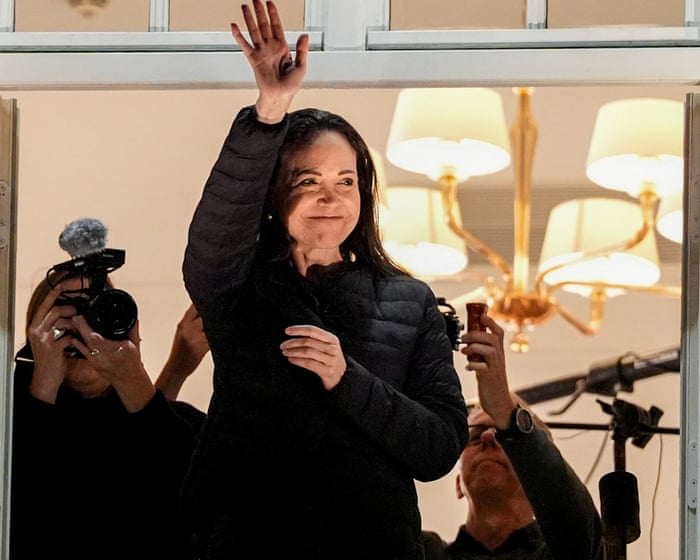
Hours earlier, the politician and pro-democracy activist marked her arrival in Oslo by stepping onto the Grand Hotel balcony just before 2:30 a.m. local time. Dozens of supporters chanted “Courageous!” and “Freedom!” in front of the hotel and sang the Venezuelan national anthem as she appeared. “Glory to the brave nation, which shook off the yoke!” they cried out.
It was Machado’s first public appearance in almost a year, following the July 2024 presidential election, which Maduro won.Accused of stealing, the 58-year-old conservative appeared on the balcony outside the hotel’s historic Nobel suite. Minutes later, she came down to the street, climbed over metal barricades, and embraced supporters gathered outside the 19th-century building’s gleaming facade.
At a press conference on Thursday, she stated, “Peace is a declaration of love. And that’s what brought me here.” When asked if she supports U.S. military intervention in Venezuela, she replied that the country has already been invaded. “We have Iranian agents, and terrorist groups like Hezbollah and Hamas, who operate together with the regime.” She added that drug cartels have “made Venezuela a criminal center.”
In a 4 a.m. interview with Norwegian broadcaster NRK, Machado—who does not have a passport—said she had been traveling for nearly two days. “It is very, very difficult and very dangerous to leave Venezuela if you are persecuted by the regime,” she explained. Reuniting with her family was “very emotional.” “I haven’t seen my children for almost two years. My mother had to leave too, so I haven’t seen her for 16 months. Or my husband, or my sisters, or my friends, or my colleagues.”
Hours earlier on Wednesday, the Nobel laureate’s 34-year-old daughter, Ana Corina Sosa Machado, accepted the Nobel Peace Prize on her mother’s behalf after Machado failed to arrive in Oslo in time for the ceremony.
Speaking at the event, the chair of the Norwegian Nobel Committee, Jørgen Watne Frydnes, urged Maduro to step down, having lost last year’s presidential election to Machado’s ally, Edmundo González. “Let a new age dawn,” Frydnes said, praising Machado’s “struggle to achieve a peaceful and just transition from dictatorship to democracy” in Venezuela.
Numerous past Nobel laureates have been unable to collect their awards in Oslo due to political situations in their home countries, including Chinese dissident Liu Xiaobo, Burmese politician and activist Aung San Suu Kyi, and Polish union leader and future president Lech Wałęsa.
Members of Maduro’s regime denounced Machado’s award. Vice President Delcy Rodríguez described the Nobel ceremony as “a total failure” that her adversary missed. “They say she was scared,” Rodríguez added, claiming the 2025 Nobel Prize was “stained with blood.”
Maduro, speaking at a rally in Caracas, urged the Trump administration—which has spent recent months trying to topple his government—to cease its “illegal and brutal interventionism.” He said citizens should be ready “to smash the teeth of the North American empire if necessary.”
Machado appears well positioned to lead Venezuela if Trump succeeds in forcing Maduro from power. However, Maduro’s downfall is far from certain—he survived the U.S. president’s 2019 “maximum pressure” campaign, which combined sanctions and threats to topple him. Some observers believe the Venezuelan leader will withstand Trump’s latest intervention.
Frequently Asked Questions
Of course Here is a list of FAQs about the Venezuelan Nobel laureate supporting the US seizure of an oil tanker framed in a natural tone
BeginnerLevel Questions
1 Who is the Venezuelan Nobel laureate in this story
Answer Its Marta Lucía Ramírez She is a Colombian politician and lawyer not Venezuelan She was awarded the Nobel Peace Prize in 2016 as part of the Colombian Peace Negotiating Team that ended the conflict with the FARC guerrillas
2 Wait shes Colombian Why is she commenting on a Venezuelan oil tanker
Answer Yes she is Colombian She made the comments in her role as a former Vice President and Foreign Minister of Colombia a neighboring country deeply affected by Venezuelas political and economic crisis She views the Maduro government as a threat to regional stability
3 What oil tanker was seized and why did the US seize it
Answer The tanker was the Empire Navigation ship the Suez Rajan The US seized its cargo of crude oil because it was accused of violating international sanctions The oil was owned by a company tied to the Venezuelan state oil company PDVSA and was allegedly being illicitly sold to benefit the Maduro government
4 So what exactly did Marta Lucía Ramírez say
Answer She publicly supported the US action framing it as a legitimate move against dictatorship and corruption She argued that the proceeds from such illicit oil sales fund repression in Venezuela and exacerbate the regional migration and humanitarian crisis
Advanced Contextual Questions
5 Why is her support significant
Answer Her voice carries moral weight due to her Nobel Peace Prize Her support helps legitimize the sanctions policy internationally especially in Latin America where US interventions are often viewed with suspicion It frames the issue not as US aggression but as part of a broader fight against authoritarianism
6 Isnt seizing another countrys oil an act of war