In some corners of the internet, the Bulgarian mystic Baba Vanga has reached mythical status. Social media and tabloids worldwide claim she predicted the 9/11 attacks, the Covid-19 pandemic, and the war in Ukraine.
Recently, some headlines went even further, asking if she foresaw the Israel-Iran conflict, U.S. involvement, missile strikes, and airspace closures. An earlier article speculated about her “predictions for 2026,” which supposedly included the outbreak of World War III and humanity’s first contact with aliens.
While such claims attract clicks, many voices from Bulgaria and elsewhere warn that numerous prophecies credited to Vanga were likely never spoken by her. Instead, they argue, the so-called “Nostradamus of the Balkans” has become a powerful symbol, used for everything from sensational clickbait to promoting pro-Russian narratives.
“It’s absurd,” said Ivan Dramov of the Bulgaria-based Baba Vanga Foundation, listing false claims—spread on TikTok, YouTube, and outlets ranging from UK tabloids to Albanian state media—about Vanga foreseeing nuclear disasters or world wars.
“Absolute lies have been told about this holy woman,” said Dramov, whose organization was founded by Vanga’s followers and was chaired by Vanga herself in the years before her death. “Vanga dealt mainly with people’s health problems, not with upcoming global catastrophes.”
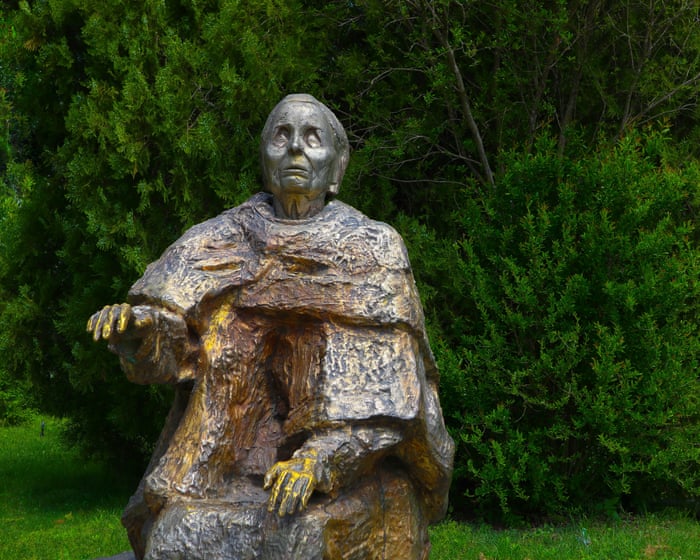
Known internationally as Baba Vanga, Vangeliya Pandeva Gushterova was born in 1911 in what was then the Ottoman Empire. As a teenager, she was reportedly swept into a field by a tornado, which gradually led to her losing her eyesight.
She gained local prominence during World War II as people visited her to learn whether their loved ones would return from the front, Dramov explained.
By the 1960s, she had become a regional phenomenon, drawing crowds to Petrich, the southwestern Bulgarian town where she lived with her husband. As her reputation spread beyond Bulgaria, visitors began arriving from countries like Russia, Romania, and Greece.
Vanga’s advice was often narrowly focused on the personal lives of those who sought her guidance and their relatives, said Dramov. “She told people which doctor to see, what steps to take, but nothing more.”
Her fame soon grew internationally, with TV series, books, and talk shows exploring her life and prophecies.
Among her most enthusiastic followers were Russians, with the Bulgarian mystic becoming “one of the most noteworthy mediums of ‘truth’ in 20th- and 21st-century Russian imagination,” as noted by researchers at the University of Texas at Austin in 2024.
Later, with the rise of social media, references to Vanga multiplied. Her influence on Russian culture was so significant that it inspired the verb vangovat, meaning “to predict,” as well as an expression roughly translating to: “How should I know? Do I look like Baba Vanga to you?”
Today, her name and alleged prophecies are frequently cited in Russia, sometimes to support narratives aligned with the Kremlin.
This combination has had a far-reaching impact: a 2024 disinformation report by the media organization BIRN Albania, which surveyed 36 Albanian publications over a year, found at least a dozen articles—most citing Russian media—where Vanga’s predictions were “often used by conspiracy and disinformation outlets to reinforce certain narratives against NATO and the EU.”
Russians’ eager embrace of Vanga overlooks the fact that she likely said very little—at least explicitly—about Russia, according to Viktoria Vitanova-Kerber, a PhD student and research assistant at the Chair for Global Christianity and Interreligious Theology at the University.Many predictions linked to Baba Vanga, such as the collapse of the Soviet Union or a glorious future for Russia, actually originate from the Russian writer Valentin Sidorov, who said he met Vanga in the 1970s.
“There are no recordings of these meetings, which gave Sidorov freedom to interpret—or possibly even construct—what Vanga did or didn’t say about Russia,” explained Vitanova-Kerber. “Some of his writings from the early 1990s suggest Vanga predicted Russia would surpass the United States, a narrative that resonates in today’s Russia.”
Sidorov’s work inspired a new wave of Russian “Vanga experts,” many of whom have risen to prominence over the past decade. According to Vitanova-Kerber, they often invent details or twist the limited historical records to align with their political views or interests.
These commentators “exaggerated, added to, and reinterpreted the information until it matched the dominant themes of modern Russian identity politics: national greatness, anti-Western sentiment, and the preservation of ‘traditional values’ tied to Eastern Orthodox Christianity, in contrast to what they call the ‘rotten’ liberal values of the West,” she said.
As a result, one popular narrative about Vanga in Russia today stands out for its conspiratorial, anti-Western tone and is used to justify events like Russia’s invasion of Ukraine. “The lack of clear historical facts, combined with the spiritual authority Vanga still holds in Russia and beyond, makes her a convenient tool for political propaganda,” Vitanova-Kerber added.
Researchers at the University of Texas at Austin echoed this view, noting that Vanga’s appeal goes beyond her supposed abilities as a medium or seer. “Her power lies in being a flexible symbol—her name and voice can be used for many different purposes,” they said.
The steady flow of prophecies credited to Vanga is surprising given that she was never recorded while alive and left no written records, said Bulgarian author Zheni Kostadinova, whose books on Vanga have been translated into multiple languages.
“Everyone puts words in her mouth that she never said,” Kostadinova remarked. “But because her authority as a prophet is on par with someone like Nostradamus, hundreds of people are tempted to speak for her.”
In one of her books, Kostadinova described Vanga’s prophecies as lying between “truth and myth,” usually retold and interpreted to some degree.
Still, many seem eager to spread sensational false claims about what Vanga said during her lifetime. “Who hasn’t used Vanga’s name for their own purposes?” Kostadinova asked. “Every propaganda machine uses it to push its own messages—the ones that suit them—to reach the masses.”
In a way, this misuse of her name was something Vanga herself anticipated, according to Dramov of the Vanga Foundation. In 1989, as Bulgaria’s communist regime fell apart, Vanga saw her image and name being used to sell everything from clothes to handkerchiefs.
While Vanga never specifically mentioned disinformation or propaganda, “she did say that her name would be misused,” Dramov noted. “She said many times that people would use her name during her life and after her death.”
Frequently Asked Questions
FAQs The Baba Vanga Legend Online Propaganda
BeginnerLevel Questions
Who was Baba Vanga
Baba Vanga was a blind Bulgarian mystic and herbalist who lived from 1911 to 1996 She gained fame locally for her spiritual advice and supposed clairvoyant abilities often speaking in vague symbolic terms
What are Baba Vanga prophecies
These are predictions attributed to her after her death covering topics like world events technological advances and natural disasters Most were not documented in her lifetime and have been created or heavily distorted since
Why are they so popular online
The prophecies are often dramatic emotionally charged and relate to current fears This makes them highly shareable on social media where algorithms favor engaging sensational content
How can a simple prediction become propaganda
When a vague old prediction is falsely linked to a modern event it can be used to justify a specific political viewpoint create a sense of inevitable doom or undermine trust in science and official narratives
Whats a clear example of this
A common claim is that Vanga predicted the exact year of a specific leaders death or a pandemic These are usually retroactive fitsher vague statements are reinterpreted after the event to seem accurate then used to lend false credibility to the person sharing the claim
Advanced Critical Thinking Questions
What are the common hallmarks of a fabricated Vanga prophecy used for propaganda
They are often 1 Retroactively specific 2 Geopolitically charged 3 Shared in meme format with bold text and no credible source and 4 Used to foster fatalism
How do these myths spread so effectively
They exploit cognitive biases confirmation bias illusory truth effect and appeal to mystery Propagandists leverage these to make ideologies more palatable