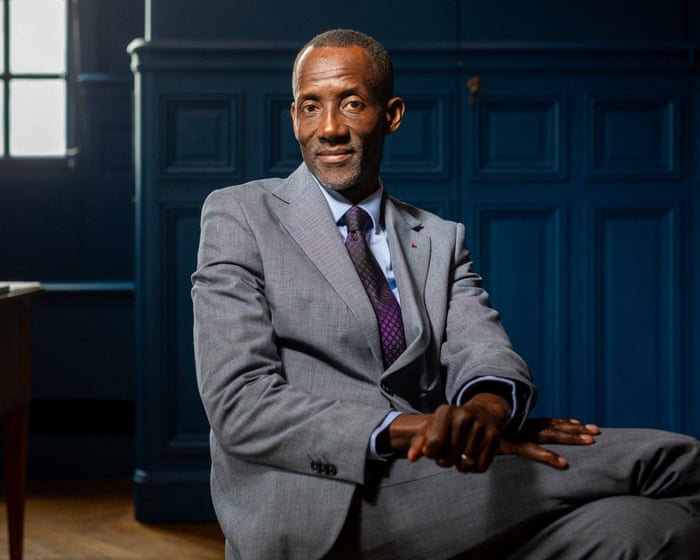
A French mayor who has been targeted with racist insults, now under police investigation, is urging France to urgently address racial hatred and curb the rise of far-right ideologies ahead of next year’s presidential election.
“It has become much easier for racist views to be expressed… and unfortunately, racist comments are becoming trivialized,” said 52-year-old Bally Bagayoko in his office at the Saint-Denis town hall outside Paris, where he was recently elected mayor for the radical left.
Thousands are expected to attend an anti-racism rally in support of Bagayoko on Saturday, after Prime Minister Sébastien Lecornu stated that the abuse directed at him reflects the “normalization of racism and evil” in France.
Following Bagayoko’s strong first-round election victory last month, guests on a debate show on CNews—the TV station owned by Catholic conservative industrialist Vincent Bolloré, which was France’s most-watched news channel last year—discussed him with references to apes and tribal chiefs.
The Paris prosecutor’s office announced that an investigation is underway into the TV comments, along with a separate police inquiry into online hate targeting Bagayoko. Anti-racism groups have filed complaints with the broadcast regulator. CNews has denied any racism.
At the Saint-Denis town hall, switchboard staff have also received racist phone calls since Bagayoko’s election, while a file of racist letters sent to the town hall is being compiled to hand over to police. One such letter, also sent to several Black elected officials across France, claimed they had “escaped from a zoo.”
Bagayoko said Saturday’s demonstration aims to unite all citizens against racism and those who oppose the rise of the far right in France: “Those who think the time has come to stand up together and propose an alternative. It’s not just about deploring what happened; it’s about taking action to ensure this doesn’t happen again.”
Bagayoko was born in France to Malian parents and grew up in a housing estate in Saint-Denis. He has received messages of support from local rabbis and other religious leaders, emphasizing that Saturday’s rally is against racism, antisemitism, and all forms of discrimination and hatred in France.
With Emmanuel Macron’s two terms ending in 2027, uncertainty looms over who will lead France. The far-right, anti-immigration National Rally party, led by Marine Le Pen and Jordan Bardella, is polling strongly ahead of next spring’s presidential election.
Bagayoko, a senior manager at the Paris region transport company RATP, was elected with a large majority for Jean-Luc Mélenchon’s radical left party, La France Insoumise (LFI), with support from communists who have had a presence in Saint-Denis for decades. He previously served as a local councillor for 19 years and coached basketball. He now leads LFI’s largest town, with a population of 150,000.
Saint-Denis is a diverse, deindustrialized town bordering northern Paris and hosted a significant part of the Paris 2024 Olympics. It lies at the heart of Seine-Saint-Denis, a département outside Paris that remains one of France’s poorest, with a young, multi-ethnic population facing discrimination and higher-than-average unemployment.
As the first mayor from a local French family with a history of African immigration, Bagayoko believes he has broken a “glass ceiling” in town politics. He feels this immediately sparked a backlash on TV and social media, where racist stereotypes were hurled at him—including claims that “drug dealers” voted for him. He was also misquoted when referencing a poem about Saint-Denis, where French kings are buried in the cathedral.The mayor referred to the town as the city of kings. It was mistakenly claimed on social media that he had said “city of Blacks” instead. He stated that the insults directed at him were dangerous racist stereotypes.
Bagayoko argued that successive governments under Macron’s presidency have failed to tackle the economic inequality fueling division and racism, allowing the far right to grow. “The far right—and racist ideology—takes root where there are austerity policies,” he said. “When you have policies that divide the population, it enables the far right to establish itself and deepen those divisions by scapegoating others.”
He pointed out that low-income towns near Paris remain isolated and lack state investment. “We’re so close to Paris, yet there’s a kind of segregation.” He attributed inequality and unemployment to insufficient investment in education and housing, issues he aims to address.
Saint-Denis, which saw new development during the Olympics, has been central to debates over gentrification and rising housing costs, even as many low-income families struggle.
Bagayoko remarked, “I’m not one of those who say the middle classes—which I belong to myself—don’t have the right to move to Saint-Denis. Of course, they’re welcome. But there must be balance.”
He is also looking into gradually restricting the use of certain weapons by municipal police.
Bagayoko described the French motto of liberty, equality, fraternity as “a precious ideal that must be preserved,” noting that some parts of France do not fully benefit from it.
He pledged to continue speaking out against racism, recognizing his privilege of having a platform. “But how many people in France suffer racist insults and are unfortunately silenced? Far too many.”
Frequently Asked Questions
FAQs Racist Ideology Austerity Politics
BeginnerLevel Questions
What does racist ideology takes root in austerity politics mean
It means that during times of government budget cuts and economic hardship ideas that blame or target racial ethnic or immigrant groups for economic problems can become more common and politically accepted
Who is the French mayor mentioned and what is their perspective
The reference is to a mayor who is speaking from experience in local government Their perspective is that farright racist ideas gain traction when public services are cut and communities feel abandoned and that local leaders must directly address these issues
What is austerity politics
Austerity politics refers to government policies that sharply reduce public spending often through cuts to social services welfare education and healthcare usually with the goal of reducing debt or deficits during economic downturns
What is the far right in this context
In a European political context the far right typically refers to political movements and parties that combine nationalist antiimmigrant and often racist or xenophobic ideologies sometimes alongside populist critiques of the political establishment
How can austerity make racism worse
When people lose jobs services and a sense of security due to austerity cuts they may look for simple explanations Farright groups often provide a scapegoat blaming immigrants or minorities for taking resources or jobs redirecting anger from economic policy toward specific groups
Intermediate Advanced Questions
Whats the connection between economic policy and racist ideology
The connection is often scapegoating Austerity creates real hardship and anxiety Instead of analyzing complex economic systems racist ideology offers a simpler emotionally charged narrative that others are the cause of the problem Politicians can exploit this to gain support without addressing the root economic causes
Can you give a realworld example of this link
Yes Following the 2008 financial crisis and subsequent austerity measures in Europe many countries saw a rise in votes for farright parties These parties often campaigned on platforms linking economic insecurity to strict antiimmigration policies arguing that protecting national welfare required excluding outsiders
What does confronting the far right mean for a local mayor
For a local mayor it