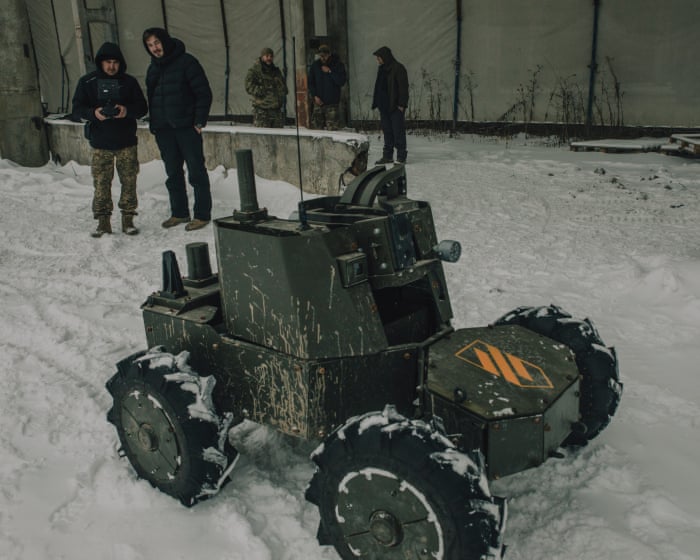
Victor Pavlov showcased Ukraine’s newest and most versatile weapon: a battery-powered land robot.
These unmanned ground vehicles come in various shapes and sizes. One runs on caterpillar tracks and looks like a roofless milk float. Another has wheels and antennas. A third carries anti-tank mines. Since spring 2024, their use has grown dramatically.
“This is what modern warfare looks like. Armies everywhere will have to robotize,” said Pavlov, a lieutenant with Ukraine’s 3rd Army Corps.
Russia’s full-scale invasion of Ukraine is now in its fifth year, and this conflict—Europe’s largest since 1945—has seen a remarkable transformation in battlefield weapons and tactics. The war has become a technological contest, fought not with expensive tanks but with cheap, expendable drones that can deliver bombs with deadly accuracy.
Ukraine’s drone expertise is now highly sought after, including in the context of the US-Israeli conflict with Iran. Last week, Volodymyr Zelenskyy signed 10-year defense agreements with several Gulf states, such as Saudi Arabia and Qatar, to supply them with low-cost Ukrainian interceptors. These can shoot down long-range kamikaze Shahed drones, which Tehran uses in attacks on its neighbors and which Moscow also employs.
The Kremlin’s war has turned Kyiv into a hub for developing modern unmanned weapons. A unique ecosystem has emerged where engineers design new products and frontline soldiers provide instant feedback. Manufacturers then scale up production, building ground vehicles, anti-Shahed interceptors, and pioneering sea drones.
Land robots now handle 90% of Ukrainian army logistics. “It’s very difficult to move around because of enemy first-person-view drones. So we use robotic systems,” said Pavlov. In January, Ukraine’s armed forces carried out a record 7,000 operations using ground vehicles, or UGVs.
Robots are increasingly taking on key combat roles and replacing human infantry. They have been equipped with remote-controlled machine guns and grenade launchers. One system—a DevDroid TW 12.7—defended a position for 45 days. Last summer, a kamikaze robot carrying 200kg of explosives traveled 12 miles (20km) to a school building occupied by Russian troops and destroyed it.
“It’s not Star Wars, with lots of lasers. The frontline is more like Terminator. A land robot arrives at your position and there is nothing you can do about it,” said Bambi, a drone operator with the 25th Airborne Brigade. He added, “You can shoot a person in the chest and they stop firing. If you shoot a ground robot, it doesn’t feel pain. There’s a guy looking at a screen who is going to fire back.”
Land drones also deliver food, ammunition, and materials like logs, which soldiers use to build underground shelters. They can evacuate up to three wounded soldiers from the frontline. Typically, a robot can operate for eight hours. They are smaller and less visible than armored vehicles, which can be easily spotted and destroyed by Russian spy drones.
Since December 2023, these robots have delivered supplies to Ukrainian soldiers stationed around the ruined eastern city of Pokrovsk, the scene of intense fighting. “One rolled up to the entrance of our dugout. I felt like a caveman gazing at alien technology,” Bambi said. “It looked so futuristic. I couldn’t have imagined this two years ago.”
In addition, UGVs perform vital engineering tasks. The latest models can lay and clear mines, deploy barbed wire, and tow or retrieve damaged and burned-out vehicles. Pavlov said his unit loses about three robots a day to Russian aerial attacks—an attrition rate of 25%. “This is a small price to pay when you consider that we are saving the lives of our infantry,” he said.Ukraine’s defense minister, Mykhailo Fedorov, praised the swift growth of remote military operations. “Just six months ago, using ground robots for casualty evacuation was rare. Now, robots regularly enter high-risk areas—delivering ammunition, maintaining supply lines, and evacuating the wounded in situations where sending personnel would pose extra danger,” he said.
Last summer, in a historic first, Russian soldiers even surrendered to an armed ground robot. The soldiers—one of them bloodied—emerged from a damaged building after their position had come under prolonged Ukrainian fire. The 3rd Army Corps reported deploying robots to retake the area in what it called a “well-planned offensive action.”
Based in northeastern Ukraine, the 3rd Corps has led the development of unmanned ground systems. Its training center, the KillHouse Academy, instructs UGV pilots. Last month, trainees practiced driving vehicles over a snow-covered track using remote consoles. The droid-like machine navigated between fir trees and headed toward a course made of black tires.
Upstairs, a soldier tested a computer simulator with forest and swamp terrains, while others attended a classroom lecture.
Oleksandr, an instructor with the call sign “Barman,” said robots now handle many tasks that until recently were done by humans. “War has reached a new level. With so many drones in the sky, it’s become very hard to reach positions or evacuate people,” he noted. “Former gamers adapt to this technology very quickly. They’re more effective than the average soldier.”
Russia also employs ground systems extensively, including an electric vehicle called “Courier” that can carry 250kg of cargo to frontline troops and conduct electronic warfare. According to Pavlov, Ukraine currently holds an advantage in ground robot technology. “We have more systems than Russia. The priority now is to scale them up,” he said.
Russia occupies about 20% of Ukraine, including Crimea. Since 2022, despite suffering an estimated 1.2 million soldiers killed or wounded, it has failed to make major advances in the east and south. Marking the fourth anniversary of the invasion, Volodymyr Zelenskyy stated, “Putin has not won this war.” He highlighted that Ukrainian forces have reclaimed roughly 116 square miles (300 square kilometers) in the southern Zaporizhzhia region.
Andriy Biletsky, commander of the 3rd Corps, said new tactical approaches will ultimately decide which side prevails. He described Ukraine as being on the “verge of another revolution,” alongside the ongoing revolution in aerial drones, and predicted: “Ground-based robotic systems will radically change the battlefield and replace a significant share of soldiers, both in logistics and combat roles.”
Frequently Asked Questions
Of course Here is a list of FAQs about the use of robotic combat units in Ukraine framed around the Terminator analogy
BeginnerLevel Questions
What does it mean that the frontline is like Terminator
Its an analogy comparing modern unmanned robotic weapons on the battlefield to the relentless advanced robots from the Terminator movies It highlights how Ukraine is using remotecontrolled or autonomous machines to fight without always risking a soldiers life
What exactly are these robotic combat units
They are unmanned ground vehicles and unmanned aerial vehicles They range from small commercialstyle drones that drop grenades to larger armored vehicles that can transport supplies evacuate wounded or even directly engage enemy positions with mounted weapons
Whats the main benefit of using these robots
The biggest benefit is force protection They keep soldiers out of the direct line of fire for dangerous tasks like reconnaissance logistics under fire and attacking fortified positions This saves lives and preserves experienced personnel
Arent these just fancy drones
Yes but the term robotic combat unit often refers to more advanced purposebuilt military machines While consumer drones are widely used newer units include armored kamikaze UGVs that drive into enemy trenches to explode or robotic mules that autonomously follow troops with their gear
Is this like having fully autonomous killer robots
Not currently Most systems in use in Ukraine are remotely operated by a human soldier The human makes the final decision to engage a target The autonomy is often in navigation or following a preset route not in independent target selection
Advanced Practical Questions
What are the biggest limitations or problems with these robots
Key challenges include
Electronic Warfare Russian jamming can break communication links causing drones to be lost or missions to fail
Cost Scale Advanced models are expensive and not yet produced in the massive numbers needed to replace traditional forces
Durability They must withstand harsh battlefield conditions mud and rough terrain
Logistics They require reliable power sources maintenance and trained operators
Can you give a real example from the Ukraine war
A prime example is the