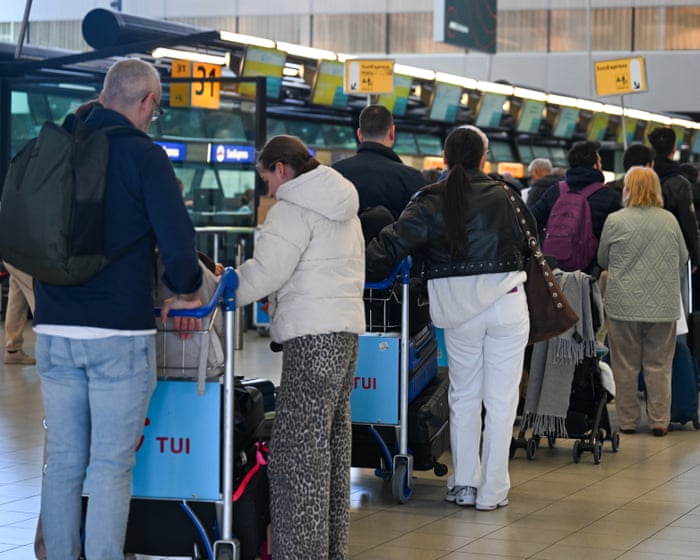
Some travelers passing through the new EU entry-exit system (EES) have faced major delays at border checks, with some waiting up to three hours, according to airports. The new rules have been gradually introduced in Europe since October 2025 and took effect on Friday in the Schengen countries – 25 of the EU’s 27 member states, plus Iceland, Norway, Liechtenstein, and Switzerland.
Hundreds of people responded to a Guardian online callout to share their experiences of traveling to Europe since the rules came into effect. While some said their journey went smoothly, many reported severe delays that caused some to miss their flights. Travelers described problems with fingerprints not being accepted and extra delays when traveling with children. Many said there was little guidance on using the kiosks. Some also mentioned having to repeat the registration process at each stage of their trip, even though they had already completed it, with no explanations from staff – or no staff available to ask.
Dave Giles, 47, an IT manager from Raunds in Northamptonshire, missed his flight home on April 12 from Copenhagen, where he had been to a music festival with his family, after getting stuck in long queues at passport control despite arriving hours early.
“When they called the gate and we went down to passport control, there was a queue of probably 80 to 100 people in front of us and only three kiosks checking passports,” he said. “Before long, one of those closed.” Staff seemed aware of the problem but couldn’t fix it in time. “A supervisor was making calls asking them to hold the gate open,” he said, but by the time he reached the front, “the gate had been closed a few seconds before we arrived.”
The disruption cost him a lot of money, forcing him to buy new flights for the next day, find accommodation for that night, and pay extra parking fees at Stansted. He also had to rent a car and drive from Heathrow to Stansted, since the only available flight landed there. “We’ve got receipts for about £1,800 – it’s probably over £2,000 in total. It’s extremely frustrating.” Giles said he didn’t expect to get that money back. “Insurance won’t cover it. The airline said it wasn’t their fault,” he added, noting that he had emailed the airport. “I’d be surprised to get a reply from anyone.”
Georgia, from London, experienced a four-hour delay when she arrived at Pisa airport on April 10. “There were no staff in sight to advise on waiting times,” she said. For Georgia, who is five months pregnant, it was a tough wait. “There were people with infants but no special assistance available, or any seating. People at the back of the queue became very hot, stuck in a windowless corridor for hours. I sat on the floor and had to tell the people around me I was pregnant and to give me some space because I was almost fainting. They were handing out water, but only when you got to the very front of the queue, which was about four hours in.”
She said she now feels anxious about traveling in Europe again. “I was meant to fly to Paris this weekend with my husband, but I’ve canceled the trip just because I couldn’t face it again. I have a trip to Greece coming up, but I saw that they’re now not following the new system, which was amazing news.”
Stuart MacLennan, 49, from Oban in Scotland, found traveling with children especially difficult. He flew from Glasgow to Málaga on April 11, where he faced long queues because several flights had arrived at the same time. This delay was a “nightmare,” Stuart says. He and his wife had to wait with their children, aged one and seven. “There was no real direction as to where to go,” he said. “After aboutAfter half an hour, we were moved to a different line because we had children under 12. Then we waited in line for two and a half hours before finally reaching passport control.
His return trip from Málaga four days later was even worse, with a three-and-a-half-hour queue for those with kids under 12. Like Georgia, he wants to avoid this system in the future. “It would make me think twice about traveling to busier European airports,” he said.
Other travelers said the self-service kiosks meant to process their registrations were either not in use or not working.
Dylan Thomas, 23, an HR associate from Lincolnshire, faced delays with the system on two recent trips. He said there was a two-hour wait when he arrived in Madeira on March 15, and another delay on his return from a solo trip to Brussels via the Eurostar on April 6.
“It was ridiculous,” he said. “There must have been about 20 machines, but they were all covered in plastic and couldn’t be used… Only one person was checking everyone manually.”
Paul Coleman, a retired volunteer from Southend-on-Sea, said staff at Kraków airport in early February had to use their own mobile phones. He and his wife, Nicolette, waited three hours at passport control.
“The cameras on the machines weren’t working, so they took out their phones and took pictures of us. It was just crazy,” he said. “There was no explanation for the delay, no apology.”
David, 75, from Durham, said delays could be especially hard on elderly people. On a trip to Gran Canaria in February, he was kept on the plane for 30 minutes because of queues at Fuerteventura airport. “The first single queue was huge, and everyone had to join it, even those who had already given their biometrics. They should be separate. Better signs, shown earlier, would speed things up.
“They have a system where they herd non-EU passport holders into an area with glass partition walls. There aren’t enough seats. A lot of elderly people are left standing, with no toilets. If you need to use a toilet in another area, you get searched again. It’s really a mess.”
He added: “The airlines seem to have given up any responsibility. They just said, ‘It’s your job to get to the gate.'”
“I think the main issue is that it’s inconsistent. You have no idea what will happen when you get to these airports.”
Frequently Asked Questions
Here is a list of FAQs about the rocky start of the EUs new EntryExit System written in a natural helpful tone
BeginnerLevel Questions
Q What is the EUs new EntryExit System
A Its a new digital system that will replace the old passport stamping process When you enter or leave most European countries the system will record your name travel document and biometrics electronically
Q Why did it cause long queues and missed flights at the start
A The system was launched at a very busy time and airports and borders werent fully ready Staff needed training and the new computer systems were slow This created huge bottlenecks especially at ports and Eurotunnel terminals causing some people to miss their flights or ferries
Q Do I need to do anything before I travel to prepare for EES
A Not yet For now you just need your valid passport However its a good idea to arrive at the airport or port much earlier than usual until the system is running smoothly You cannot preregister your data
Q Is this the same as ETIAS
A No they are different EES is a checkin system that records your entry and exit ETIAS is a visawaiver that youll need to apply for online before you travel ETIAS is expected to launch later in 2024 or 2025
AdvancedLevel Questions
Q How long will the initial chaos last Will it get better
A Most experts expect the first few weeks to be the worst As border staff get used to the system and technical glitches are fixed queues should shorten However major holiday periods could still see delays
Q What happens if my fingerprints dont scan properly