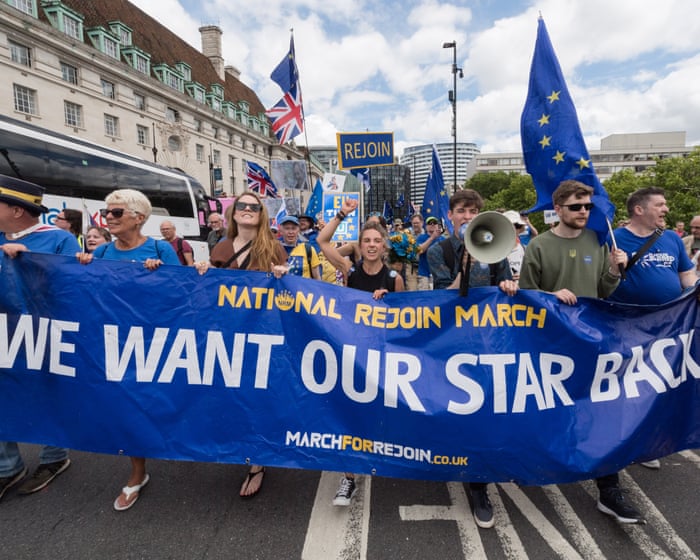
Exclusive polling shows that a generation of young Britons, who were too young to vote in the 2016 EU referendum, now believe Brexit has failed. A majority of them are calling for a new vote to rejoin the EU.
According to new polling of 18- to 28-year-olds by the thinktank More in Common, shared with the Guardian, Gen Z Britons are deeply unhappy with the UK’s departure from the EU.
The UK marks 10 years since the Brexit referendum – Europe live
Read more
The data reveals that 60% of this age group would vote to rejoin the EU if given the chance, compared to 9% who would vote to stay out.
When the results are narrowed to only those likely to vote in a hypothetical second referendum, the margin becomes a landslide. The pro-EU Remain/Rejoin camp would capture 81% of the vote, while just 19% would choose to stay out.
The More in Common study, which surveyed 440 young people across Britain, shows that 50% of Gen Z Britons consider Brexit a failure. In contrast, only 16% see it as a success, while 34% are still undecided.
Graph of gen Z responses
Luke Tryl, the executive director of More In Common, said: “For many Gen Z Britons, the Brexit referendum was a key moment in their political coming of age. In focus groups, many in this age group say Brexit was the first political event they were vividly aware of – too young to vote, but with clear memories of that campaign and the years of debate that followed.
“Ten years on, our polling of Britons aged 18 to 28 reveals how they feel about Brexit: they tend to think it has failed, and three in five want a fresh referendum on rejoining. But interestingly, few think the idea of Brexit was doomed from the start – like the rest of the public, they tend to say it could have worked well, but that politicians ruined it.
“And while young Britons mostly support rejoining in principle, focus group conversations with Gen Z voters suggest they’re hesitant about returning to the endless Brexit debates they remember from their youth. They worry this could distract from the issues they care most about – the cost of living, affordable housing, jobs, and climate change.”
Hostility toward the UK’s exit from the EU is strongest among the youngest adults. Among those aged 18 to 21 – who were children aged six to nine in 2016 – 53% say Brexit is a failure, while only 12% see it as a success. This sentiment softens slightly among older Gen Zers aged 25 to 28, though the outlook remains negative, with 48% calling it a failure and 20% a success.
While there is agreement that the current situation isn’t working, young Britons are split on whether the project was flawed from the start or mishandled by politicians. About 37% believe Brexit could have worked well but was “ruined by politicians” who handled it badly, while 29% argue that the project was “never going to work” from the very beginning.
Only 11% maintain that Brexit has worked well so far, and 23% expressed no opinion.
The polling comes amid a broader national conversation about the changing makeup of the UK electorate. The narrow 2016 referendum result – won by Leave with 51.9% to Remain’s 48.1% – was heavily driven by older generations.
However, time has significantly changed the voter rolls. Pollster Peter Kellner has argued that the pro-Brexit majority from 2016 has disappeared. Writing on Substack, he noted that more than 6 million Britons have died since the 2016 referendum, and because older demographics voted overwhelmingly to leave the EU – 64% of those over 65 voted to leave – mortality has disproportionately affected the Leave coalition.
According to calculations based on Office for National Statistics data and published by the Financial Times, roughly 15% of original Leave voters have died, compared with 10% of Remain voters.
Meanwhile, about 6 million young people who were ineligible in 2016 have now reached voting age. This generational shift has led analysts to argue that the pro-Brexit majority has effectively vanished.Through natural population changes, there is now an active “anti-Brexit” majority of several million living voters. According to polling by More in Common, three in five young Britons – 62% – said there should be a referendum on rejoining the EU within the next five years. Only 11% of people under 29 oppose holding another vote, while 27% are unsure. The desire for a second referendum is strongest among those who want to return to the European Union, with 88% of potential Rejoin voters supporting a new ballot.
Frequently Asked Questions
Here is a list of FAQs based on the poll showing that three out of five Gen Z Britons want another vote on rejoining the EU
BeginnerLevel Questions
Q What does three out of five mean in this poll
A It means 60 of the Gen Z respondents said they would support a new referendum on whether the UK should rejoin the European Union
Q Who are Gen Z Britons
A They are people born roughly between 1997 and 2012 making them the youngest adult generation in the UK right now
Q Does this poll mean the UK will definitely rejoin the EU
A No This is just a snapshot of opinion among one age group A national vote or a change in government policy would be needed for that to happen
Q Why might young people feel differently about the EU than older people
A Many Gen Z Britons were too young to vote in the 2016 Brexit referendum They have grown up with the effects of Brexit and often feel more connected to other European countries
IntermediateLevel Questions
Q Was this a national poll or just a small online survey
A The poll was conducted by a reputable research company and included a representative sample of Gen Z adults While its not a vote its considered a reliable indicator of current opinion
Q How does this Gen Z opinion compare to the general UK population
A Older generations particularly those over 50 are generally more supportive of Brexit and less keen to rejoin The overall UK opinion on rejoining is split but Gen Z is clearly the most proEU generation
Q Are these young people just saying they want to rejoin or would they actually vote for it
A The poll asked about supporting another vote not just wanting to rejoin Pollsters usually find that stated support is close to actual voting intention but peoples views can change when a real election or referendum is called
Q What practical changes would happen if the UK rejoined the EU
A The UK would likely reenter the single market and customs union meaning free trade no border checks for