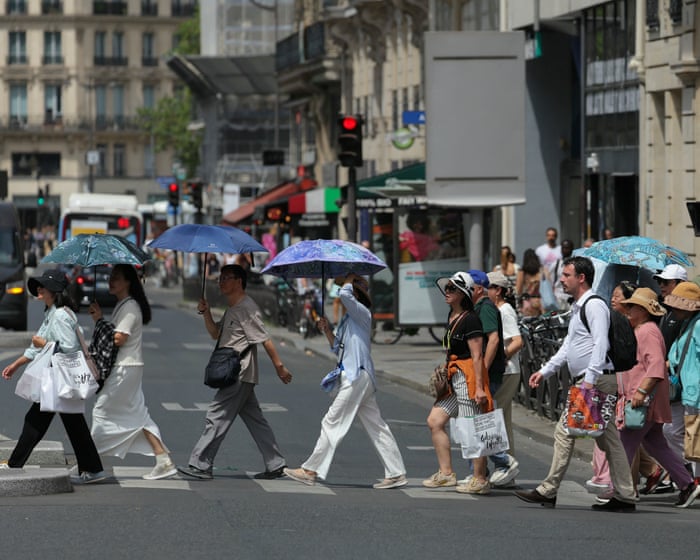
Forty people have drowned while swimming in unsupervised areas across France in recent days, the prime minister has said, as people across the country tried to escape the record-breaking heatwave sweeping much of Europe.
“There is a tragic wave of drownings,” Sébastien Lecornu said on Tuesday. “The latest figures we have show 40 deaths since June 18. Most of the victims are young people.”
Lecornu was about to chair a crisis meeting with ministers to address the intense early-summer heatwave, which has pushed parts of western France to prepare for temperatures as high as 43°C (109°F).
“We are experiencing an exceptionally intense event,” Lecornu said. “Every day and night, local and national temperature records are being broken.”
The national weather service, Météo-France, said 54 departments were under a red heatwave alert as “oppressive and exhausting” heat covered about half the country. It said overnight temperatures were the hottest since records began in 1947.
Early on Tuesday, France’s national heat index—an average of daytime and nighttime highs from 30 weather stations across the country—reached a record 21.6°C, according to early figures. The previous record of 21.4°C was set on July 25, 2019.
Officials in the greater Paris region advised people to work from home as much as possible and avoid train travel. “The transport network is under severe strain during extreme heat… railways cannot handle temperatures above 50 degrees,” Valérie Pécresse, head of the Île-de-France region, told reporters.
The heat, which forced about 1,350 schools to close on Monday and is believed to be linked to the deaths of two young children in their family car, is expected to last until the end of the week.
“More record-breaking temperatures are expected, including some that could beat all previous records, no matter the time of year,” Météo-France said.
The scorching temperatures across large parts of Europe are caused by what Clair Barnes, a climate scientist at Imperial College London, described as a bulge of hot air.
“It’s pulling warm air up from North Africa, from the Sahara, and that’s why we have this intense heat,” Barnes told Reuters. “It’s moving very slowly, so there’s no wind, no breeze for relief.”
In England, some schools closed early on Tuesday as the UK braced for the heatwave to set new records. With temperatures expected to reach 40°C, the Met Office issued its second-ever red heat warning.
UN Secretary General António Guterres said in a speech at a London Climate Action Week event on Tuesday: “London isn’t just calling. It’s cooking.”
He urged the world to work toward limiting global warming. “A climate crisis is pushing us deeper into higher temperatures and closer to catastrophic tipping points, and an energy crisis is exposing the foolishness of a world hooked on hydrocarbons,” he said. “On the surface, these crises may seem separate, but they share the same destructive source: fossil fuels.”
In Italy, the health minister declared a red heatwave alert in 15 cities, including Milan and Rome. In Germany, officials said swimming accidents had spiked over the weekend, leading to five deaths.
Nearly all of Spain was under a heat alert on Tuesday, with red warnings of “extraordinary danger” issued for areas around the southern city of Córdoba, the northern city of Bilbao, and parts of the country.In the northern region of Cantabria, on Monday, 101 out of 828 weather stations across Spain recorded temperatures of 40°C or higher. At around 30 stations, temperatures stayed above 25°C overnight into Tuesday, highlighting the intensity of the heatwave.
The situation was even worse in the southeastern province of Almería, where temperatures didn’t drop below 30°C overnight for three nights in a row.
The extreme heat dominated local news. “More than 72 hours above 30 degrees Celsius,” reported La Voz de Almería. In another article, the newspaper pointed out the impact: “Almería doesn’t sleep: a hellish night with temperatures above 30°C and highs exceeding 40°C.”
Frequently Asked Questions
Here is a list of FAQs based on the news about the heatwave in France and Spain written in a natural clear tone
General Safety Questions
Q I heard that 40 people drowned in France during the heatwave Why would a heatwave cause drownings
A Many people go to lakes rivers and the sea to cool off Unfortunately the combination of strong heat alcohol consumption and unfamiliar swimming spots often leads to fatal accidents especially among people who arent strong swimmers
Q Are the drownings directly caused by the heat or is it something else
A Its indirect The extreme heat drives people to swim in unsupervised or dangerous areas to escape the heat The drownings are a tragic side effect of people trying to cool down
Q What does nighttime temperatures above 30C mean for people in Spain
A It means the air doesnt cool down at night This is dangerous because the body needs a break from the heat to recover Without cooler nights the risk of heatstroke and other health problems rises sharply
Health Practical Tips
Q How can I stay safe if I go swimming during a heatwave
A Only swim in designated supervised areas Never swim alone dont drink alcohol before swimming and be aware of strong currents or sudden depth changes
Q What is the biggest danger of nighttime temperatures staying above 30C
A Heat exhaustion and heatstroke When your body cant cool down at night it leads to sleep deprivation dehydration and puts extreme strain on your heart and other organs
Q What are some practical tips to cool down at night without air conditioning
A Take a cool shower before bed Use thin cotton sheets Place a damp towel or ice pack on your neck or wrists Keep curtains closed during the day to block heat and open windows at night if its safe
Advanced Contextual Questions
Q Is it normal for Spain to have nighttime temperatures above 30C