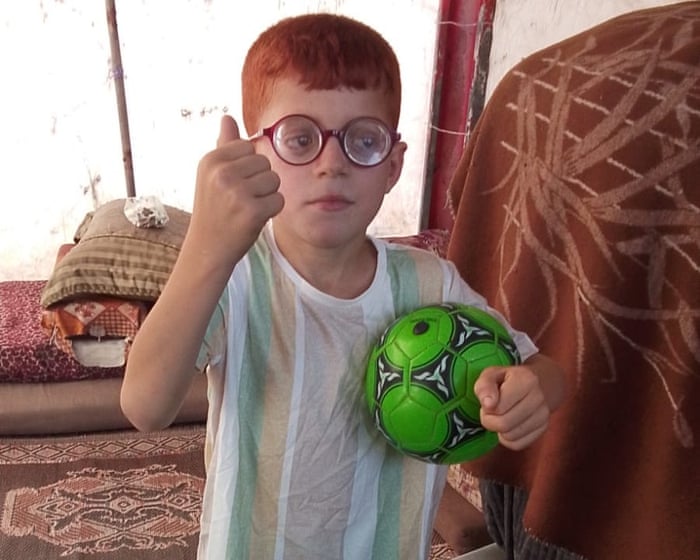
A video of a seven-year-old Palestinian boy in Gaza, who has a severe vision problem, crying over his broken glasses has gone viral on social and international media.
The footage of Ayoub Junaid has highlighted the struggles of many visually impaired children in Gaza. Because of Israel’s blockade and the destruction caused by the war, they can’t get eye exams, glasses, or specialist eye surgery.
After the clip was seen by tens of millions of people, Ayoub got a new pair of glasses. But this good news doesn’t fix the real issue—he urgently needs surgery.
Ayoub’s mother, Eman Junaid, 30, who is displaced in the Gaza City port area, told the Guardian that her son’s problems started when he was two.
“Ayoub has very severe nearsightedness after having a fever illness,” she said. A doctor told her that Ayoub’s vision would slowly get better as he grew older, but the opposite happened. His prescription got stronger, and the lenses he now needs aren’t available in Gaza.
“We were getting ready to travel for treatment, but the war started and everything stopped,” she added.
Ayoub rarely leaves his tent, Junaid said. When he wants to play with his siblings or other kids, he holds his glasses tightly and moves very carefully. He doesn’t run, jump, or move freely. Doctors warned the family not to let him do anything too active, because a fall or hit could hurt his retinas even more.
Ayoub used to ask his mother why he was different from other children. He often asks her: “Why don’t the other kids wear glasses like me? Why can’t I move like them? Why can’t I go to school like them?”
“At the end of April, while walking with a family member along a road full of rubble, he fell and hit his face on the ground, breaking the glasses,” his mother said. “He burst into tears, rolled on the ground, and desperately tried to put them back together. For Ayoub, those glasses were everything. Even with them, he can’t see clearly and often has to hold things just inches from his face. But without them, he can barely move around at all.”
His family said the time Ayoub spent without glasses was especially hard. For three or four days, he rarely left a corner of the tent and couldn’t move around without help. When he tried to walk on his own, he would crouch close to the ground, bringing his eyes near the floor to try to see his surroundings.
Relatives said they tried to fix his glasses several times, but the damaged lenses couldn’t be repaired.
“The video I shared was filmed after we got to the tent,” his mother said. “In the street, he was crying even more and saying he wanted to fix his glasses because he couldn’t see without them. After the video spread, donors helped us, and we were able to get a new pair of glasses, but it’s still not the right prescription he needs.”
According to his family, Ayoub’s mood has shown some improvement. In recent days, he seems more willing to talk to visitors and those offering support. The change is small, but his family says it has brought them some relief and hope.
Health officials in Gaza say the war has destroyed eye care services, leaving thousands of visually impaired patients without treatment due to severe shortages of medical equipment and surgical supplies.
Hospitals are missing key items like surgical microscopes and phaco machines. Officials say more than 2,800 patients are currently waiting just for cataract surgery, while the total backlog for eye procedures—including corneal transplants, glaucoma operations, and reconstructive surgery—is over 4,000 cases.
On top of that, Israeli bombing near medical facilities has forced theGaza City’s Government Eye Hospital, the only public eye care center in the territory, has temporarily shut down. “The current situation clearly shows a shortage in all medical consumables and surgical tools,” says Dr. Hussam Dawoud, a senior consultant in ophthalmology and eye surgery and the hospital’s director. “Right now, we’re providing services at about 60% of what we offered before the war. The main reason is that Israel is preventing the entry of medical equipment and surgical instruments.”
Doctors have also reported a sharp increase in severe corneal infections, which they blame on overcrowded living conditions, poor sanitation, and limited access to medication. Some patients have suffered permanent vision loss.
Their situation is part of a larger humanitarian crisis affecting Gaza’s children. The territory has more child amputees per person than anywhere else in the world. Tens of thousands of sick or injured young people still need urgent medical treatment, and many who require specialized care outside Gaza have not yet been evacuated.
According to the latest figures from Gaza health officials, an estimated 4,000 children urgently need medical evacuation. “A child who breaks their glasses may remain effectively blind for a long time because replacement glasses are impossible to find,” says Dr. Irdi Memaj, a surgeon working in Gaza with the humanitarian organization Emergency. “About 40% of the patients treated at our clinic in al-Qarara are children under 14. One of the most recent concerns has been infestations of parasites and rats, with numerous reports of children being bitten by rodents while they sleep.”
When reached by the Guardian, the Israeli Defense Ministry’s Coordinator of Government Activities in the Territories rejected accusations about restrictions on Gaza. “Israel is working to allow and facilitate the entry of all required medical equipment and continues to facilitate the entry into Gaza of trucks carrying medical supplies without any quantitative restrictions,” it said.
Frequently Asked Questions
Here is a list of FAQs based on the video of the blind Palestinian boy crying over his broken glasses
BeginnerLevel Questions
1 What is this video about
It shows a young blind Palestinian boy crying because his glasses were broken The video has been shared widely online because it highlights the difficult living conditions for children with disabilities in conflict zones
2 Why is the boy crying if he is blind
Even though he cant see the glasses are important for him They likely help protect his eyes from bright light dust and debris and they may also provide some light perception or comfort Losing them makes him feel more vulnerable
3 Where did this happen
The video was filmed in the Gaza Strip a region that has been under heavy conflict and siege
4 Who filmed the video
The video appears to have been filmed by a family member or a journalist on the scene The exact source varies but it was widely shared by news outlets and human rights organizations
5 Why did this video go viral
It shows a simple heartbreaking moment that many people can relate tolosing something preciouswhile also highlighting the extreme hardships faced by children with disabilities in war zones
AdvancedLevel Questions
6 What specific challenges do people with visual impairments face in Gaza
Beyond the general dangers of war they face a lack of accessible medical care shortages of assistive devices and difficulty navigating destroyed infrastructure The constant noise and explosions can also be disorienting without visual cues
7 How does this video relate to the broader humanitarian crisis in Gaza
The broken glasses are a symbol of the broader collapse of essential services including healthcare education and aid supplies It shows how even basic necessities for people with disabilities are destroyed or unavailable
8 What are the practical issues with getting new glasses for the boy
Getting new glasses requires an eye exam a prescription and the availability of the correct lenses In Gaza most optical shops are destroyed or closed and importing new glasses is nearly impossible due to the blockade and ongoing conflict
9 Are there organizations helping children like this boy
Yes groups like the Palestine Red Crescent Society UNRWA and international NGOs eg Doctors Without