Uzbekistan made history in June by qualifying for the World Cup for the first time in the country’s 34 years of independence, having lost just once in 15 qualifiers. But then they faced a problem: Timur Kapadze stepped down, and they needed a head coach for next year’s tournament.
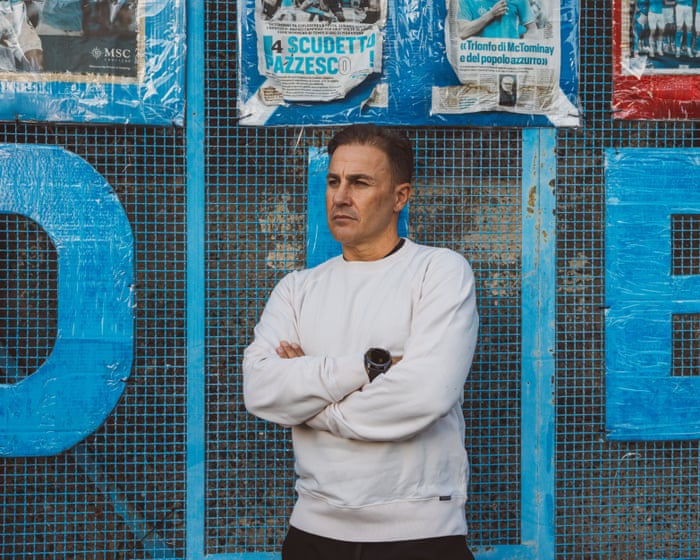
They turned to Fabio Cannavaro, Italy’s 2006 World Cup-winning captain and Ballon d’Or winner. With a rich and varied coaching career behind him, he was ready to take on the challenge of leading a nation still finding its feet in international football.
We meet on an early November afternoon in Naples, outside the gates of the Centro Paradiso in the Soccavo district. The former Napoli, Juventus, and Real Madrid defender arrives on his scooter and welcomes us inside what was once the training ground of Maradona’s Napoli. Here, he oversees a project to build student accommodation and, as part of it, restore a football pitch that had become unrecognizable after being looted following the club’s bankruptcy.
You recently became head coach of Uzbekistan. How did this opportunity come about?
My coaching career has been very different from others. One day, Marcello Lippi called me and said, “Do you want to come and coach my team in China [Guangzhou]? I’d like to be the sporting director.” I was working as an assistant coach in Dubai, and he convinced me to go. But I told him, “I know you, and you know me. You handle the sporting director role, and I’ll be the coach.”
After three months, though, he had a disagreement with the club and left. They thought I was just his assistant and sacked me too. We were top of the league and had reached the last 16 of the Asian Champions League. That same team went on to win the league and the Asian Champions League. Imagine my frustration.
After that, I went to the Chinese second division, won the league, and then returned to Guangzhou. After three years, COVID hit and everything changed. I came back to Italy thinking I’d find something quickly, but my experience in Asia wasn’t really valued back home. Maybe they don’t see it as “real” experience.
What happened next?
A sporting director friend convinced me to take over at Benevento in Serie B. I didn’t know the league well, but I trusted him. The team had too many problems, though. I remember a match against Ternana: we played brilliantly in the first half, but in the second half, we could barely stand. Later, I found out four players had COVID, and no one had told me. There were strange injuries and difficult situations. The president ended up sacking me.
Then Udinese came calling, and I thought it was the right move—a fantastic club with great management. We kept them up, but somehow a positive situation turned negative. It was the same story at Dinamo Zagreb: the sporting director who brought me in was fired, and I told them, “After my first defeat, you’ll fire me too.” They said no, but of course, after one loss, they sacked me.
I found myself in this negative cycle and felt strange, discouraged. I thought, “How is this possible? Everyone else can coach, and I can’t find anything?” I wanted to stay in Italy, but then this World Cup opportunity came along. That is priceless. I had other national team offers from Asia but never considered them. This one I did because it’s a young national team with many talented players. The federation is heavily investing in academies across Uzbekistan, and they’re producing good players. The Under-17, Under-19, and Under-23 teams are consistently successful in Asia. That was important to me.
What kind of welcome did you receive?
They really appreciated that we watched one or two matches a day for a month. They weren’t used to that—many foreign coaches would watch a few games and then leave. We stayed for 40 days, traveling to different places.We wanted to get started with the project immediately. There’s still a lot to do because the intensity of the Uzbek league is very different from what we’ll face at the World Cup. We need to close that gap. We’ll have extra training camps for local players and monitor them not just in matches, but in training as well.
What are my impressions of the country? We live in Tashkent, an international city that’s growing, with an old part and a new one. The people are nice and very friendly. We’ve settled in well. We also visited Samarkand, which is beautiful. Like anywhere, there are positives and negatives. The main negative right now is pollution—it’s very high. But we’re very happy with the working conditions. The federation has provided us with a great new sports centre.
What goals have we set for the national team? The World Cup will be a tournament for learning. Then, six months later, we have the Asian Cup, and that’s where we’ll see what we can achieve. I don’t want to overlook the work done so far—they got the team to the World Cup. I want to build on that with a slightly more European football culture.
Are there players who could emerge at the World Cup? Yes, a few. They have many good young players. Ours will be quite a young team. They need to improve because physically they can’t be compared with Europeans, but Uzbeks are tough—they fight and never give up. Playing against them is a pain. We played Uruguay: we had nine injured players who weren’t at their best, but my players are tough. It’s not easy to play against them, and we only lost 2-1.
What do I think about the expanded World Cup? Everything is expanding these days. I like it because it gives countries like Uzbekistan a chance to qualify, which was unthinkable 30 years ago. Maybe at the start there will be some boring matches or one-sided games with too many goals, but it’s an opportunity for everyone.
What language do I speak with the players? I try to communicate in English. They understand me, and I also have an interpreter. That’s necessary in football nowadays. For me to learn Uzbek? That’s tough. I need to improve my English first.
I have a special connection with Asia: Dubai, China, and now Uzbekistan. Why? They were opportunities, and I struggle to wait. I can’t sit still. I would have liked a more “normal” career path, but I didn’t have one. I always think, “If I don’t take this chance, maybe I’ll end up at home.” Udinese was key for me—a fantastic place and an exceptional club. Those moments are crossroads: you either take them or go elsewhere. For now, I’m elsewhere, building experience, but I’m still an Italian coach and I hope to return one day to prove my qualities in Italy.
What will my life be like in the coming months? I’ll spend a lot of time in Uzbekistan. The league is stopping soon, then we’ll follow the players based in Europe. From March onward, we’ll be here full-time.
What’s the level of the local league? It needs improvement. There aren’t big investments, and the infrastructure can grow. It’s a league that must improve in many aspects.
Could Uzbekistan be a surprise at the World Cup? I hope so, but it has to come through work, sacrifice, knowledge, and confidence. Surprises don’t just happen.
What about my other passion—how did the idea to buy and restore the Centro Paradiso come about? It came from seeing that, after Napoli went bankrupt, this facility was constantly vandalized. They took everything, and over the years it became an open-air dump, a disaster. I saw some reports and photos online, and it hurt to look at them. It’s right in the heart of several popular neighbourhoods, and it carries the memories of generations who used to come watch Napoli train.My idea was to create a pitch where people could play sports, especially football, which is what I’ve always done. It’s part of Napoli’s history, Maradona’s history, but it’s also my own story: I arrived there when I was 10, I played in youth competitions there, going through all the steps with Napoli. We played with the Primavera team, I moved up to the first team, and we even slept there during training camps. It was my home.
So I decided to take it over and I’m trying to restore it. It’s not easy because it’s a sports facility with just one pitch, and everyone knows how challenging it is to buy, renovate, and especially manage a place like this—to make people understand it needs to be self-sustaining.
Now the rooms will be turned into student housing, and we’ll try to start a football school, bring young people in, and make it come alive again. It couldn’t stay the way it was. It has to live again, and also give something back to the city of Naples. It holds the memories of generations who used to come watch Napoli train. It deserved to be brought back to life.
Frequently Asked Questions
Of course Here is a list of FAQs about Fabio Cannavaros quote on Uzbekistan designed to cover different levels of interest
FAQs About Fabio Cannavaros Quote on Uzbekistan
Beginner General Questions
1 Who is Fabio Cannavaro
Fabio Cannavaro is an Italian football legend a former defender who captained Italy to win the 2006 FIFA World Cup He also won the FIFA World Player of the Year award in 2006 After retiring he became a manager
2 What is he talking about Why did he say this
He said this while he was the head coach of the Chinese national team He was discussing an upcoming match or reflecting on past games against the Uzbekistan national team highlighting how difficult and persistent they are as opponents
3 What does a real pain mean in this context
In sports talk calling a team a real pain means they are extremely frustrating and difficult to play against Its a backhanded complimentit doesnt mean they play dirty but that they are so stubborn hardworking and resilient that they make the game very uncomfortable for their opponents
4 Is this an insult to Uzbekistan
Not at all In the world of competitive sports this is considered high praise from an opponent It acknowledges their toughness spirit and ability to challenge even more favored teams Coaches often use this kind of language to show respect for a difficult adversary
Advanced Tactical Questions
5 What specific qualities of Uzbekistans team is he likely referring to
He is likely praising their organization physicality work rate and mental resilience Teams like this are hard to break down and can punish mistakes
6 Is this a common perception of Central Asian football teams
Yes teams from this region have built a strong reputation for being physically strong disciplined and incredibly tough to beat at home They often excel in defensive organization and set pieces
7 How should a team prepare to face a side described this way
A team needs