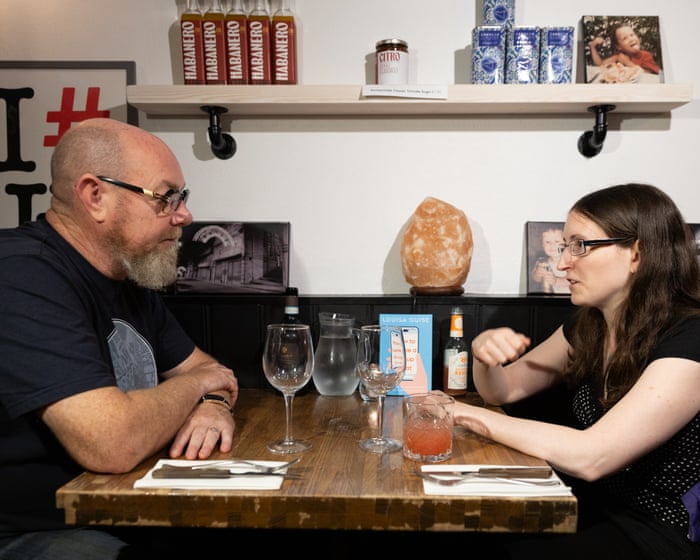
Andy, 62, Stevenage
Occupation: Agile coach in technology
Voting record: Generally Labour
Amuse bouche: He’s just released his first single under the band name MeMe.
Louisa, 39, Reading
Occupation: Author and marketing and communications professional
Voting record: She has voted Labour, Green and Lib Dem, but doesn’t feel loyal to any one party
Amuse bouche: Last year, she published a book about how to use your phone less.
For starters
Louisa: I was quite excited. I thought somebody who would sign up for this would be open to intelligent discussion. We got on well.
Andy: I wondered what would happen if I straight away threw out a contentious thing, so I asked, “What do you think of Brexit?” We agreed that we both lost out.
Louisa: I had a really delicious cheese soufflé, then a mushroom pasta with truffle oil, and a nice little tiramisu at the end. It was lovely. We also shared a bottle of red.
Andy: I had clams on celeriac – wow, it was fabulous – and seafood spaghetti. I didn’t have a pudding – I like to think because I’m sweet enough, but really it’s because I’m too fat.
The big beef
Andy: We discussed whether we should increase immigration, and I said no. Louisa’s side was that she comes from an immigrant background. But I think immigration is used as a political tool, because there is contention and emotion wrapped around it. I wish we could just look at the real numbers, the pros and the values of it, then look at how it would be managed.
Louisa: One of my grandfathers was an eastern European refugee who came to Britain to fill the labour shortage after spending four years in a Nazi work camp. We’re always told there are too many people, but what I’ve never seen is somebody saying, “The number of immigrants that we can maximally fit in this country is X.”
Andy: It’s not that I don’t see value in immigration, but I don’t believe we’re managing it very well. Why would you increase something you’re bad at?
Louisa: I think the numbers of people coming in is something governments like to pretend is in their control, but it isn’t. Climate change and wars are going to displace people. If you increase aid to other countries and try to solve conflicts, people would be more likely to stay.
Sharing plate
Louisa: I think businesses can do more about loudcasting – people having their phones on loud in public spaces. Eighty per cent of people don’t like it, but most are too scared to speak up. There are railway bylaws that prohibit noise disturbing others. I see nothing wrong with enforcing fines if it’s particularly disturbing. And instead of trains having a quiet carriage, there should be one loud carriage.
Andy: I agree it’s extremely irritating, but I’d just ask people, “Would you mind turning that down?” I wouldn’t mind a public service advert, like “Be respectful of others regarding your phone”, but I’m not sure we need anything stricter.
For afters
Louisa: I think we’re overreliant on cars, and heavier vehicles that cause more wear and tear and potholes. A lot more could be done to encourage other modes of transport and make people more mobile without always relying on cars. Andy feels it’s down to the councils to maintain the roads better.
Andy: It doesn’t make me happy to see cars with one person in them. But what options do we have? They’ve cut public transport, they’ve moved shopping centres out of town. What do you do? Fight against the machine all the time to your own detriment? Or do you try not to go out in your car if you can avoid it? I feel there should be a sense of self-management.
Takeaways
Andy: She was an extremely nice person and I had a really enjoyable evening.It’s nice to talk to someone and find you have different opinions. If you approach a conversation with the right mindset, those differences can be healthy.
There are so many assumptions that come with certain sensitive topics—like, “If you believe this, you must be that kind of person.” People need to start listening to each other instead of jumping to conclusions and dismissing others without hearing them out.
Additional reporting: Kitty Drake. Andy and Louisa ate at Citro in London N6.
Want to meet someone from across the divide? Find out how to take part.
Frequently Asked Questions
FAQs Dining Across the Divide Immigration Discussion
BeginnerLevel Questions
What does Dining Across the Divide mean
It refers to a conversation or event where people with opposing political or social views come together to talk respectfully over a meal aiming to understand each other better rather than to win an argument
What is the core topic of this specific conversation
The core topic is immigration policy specifically whether a country should allow more immigrants One participant stated a clear position against increasing immigration levels
Why is talking about immigration so difficult
Its difficult because immigration touches on deeply held values about national identity economic security fairness and compassion People often have strong personal experiences or fears tied to the issue
Whats the goal of having this kind of difficult conversation
The primary goal is mutual understanding not necessarily agreement Its about hearing why someone holds their view learning the human story behind their position and finding common ground where it exists
Advanced Practical Questions
How can I start a productive conversation if I strongly disagree with someone on immigration
Start with curiosity not confrontation Use questions like What experiences or information led you to that view or What are your biggest concerns about the current system Focus on listening to understand their reasoning
What are common arguments for allowing more immigration
Common arguments include addressing labor shortages and an aging population bringing in new skills and innovation fulfilling humanitarian obligations to refugees and enriching cultural diversity
What are common arguments against allowing more immigration
Common arguments include concerns about strain on public services downward pressure on wages in some sectors challenges with cultural integration and maintaining national security and border control
What are some trip wires or phrases to avoid in this discussion
Avoid labeling generalizations and dismissive language Dont make it personal stick to discussing policies and principles
Can you really change someones mind in one conversation
Its very rare A more realistic goal is to soften a stance introduce a new perspective or correct a specific piece of misinformation The most significant change often happens later upon reflection