The tower’s peak vanished into the mist, yet its bells rang out clear and true, their tolling carrying beyond the abbey gates, over the frost-edged trees, and down to the town in the valley below—the final call for morning mass. I took a seat at the back of the modern church, built when the Abbey of Saint Maurice and Saint Maurus moved to this hill in Clervaux, northern Luxembourg, in 1910. Then the monks entered, sweeping away a thousand years with their presence. Their Gregorian chants, sung in Latin, filled the nave: simple, calming, timeless. I’m not religious and didn’t understand a word, yet in a way, I understood it completely.
Although mass is held here daily at 10 a.m. year-round, the monks’ ethereal incantations felt perfectly suited to the season. Leaving the church, I picked up a waymarked hiking trail and walked deeper into the forest—and the mood lingered. There was no one else around, no wind to dislodge the last clinging beech leaves or sway the towering spruce. A jay screeched, and plumes of hair ice feathered fallen logs. Just as in the church, all was stillness, a touch of magic.
I’d come to Luxembourg by train, hoping to find a frozen fairytale. This tiny grand duchy, about the size of Dorset, boasts a ridiculous number of castles—as many as 130, depending on your definition. It’s a legacy of its location at the heart of western Europe, enduring centuries of incursions. Some castles have been restored for visitors; others offer places to stay, with lower rates off-season. Add in frosty forests, chanting monks, and the fact that all public transport is free—perhaps the most magical thing of all—and my hopes for an atmospheric winter break in Luxembourg were being fulfilled.
My walk ended at Clervaux Castle, which dates from the 12th century but was destroyed during the desperate Battle of the Bulge in World War II, fought in these cold forests in December 1944. Rebuilt since, it now houses the UNESCO-listed 1950s photo exhibition The Family of Man. It was nearly empty as I wandered among the 503 images by the era’s most prestigious photographers, depicting ordinary people at every stage of life—the everyday made extraordinary. Without captions or locations, each photograph told its own complete story, containing multitudes. It was incredibly uplifting.
You can’t stay overnight at Clervaux Castle, but just a 10-minute free bus ride away is Chateau d’Urspelt, where you can. When I arrived, the castle looked Disney-cute, with fairy lights dripping from its whitewashed turrets. Eighty years ago, it was quite different: the U.S. 1st Battalion 110th Infantry had its headquarters here in December 1944 before being overwhelmed by German forces. After the war, Urspelt fell further into ruin until 2005, when a local entrepreneur restored it into a smart hotel. I skipped the snazzy spa and the ice rink sparkling in the courtyard but enjoyed a fruity Luxembourgish Pinot Noir in the low-lit bar, hidden like a speakeasy in the castle’s historic cellars.
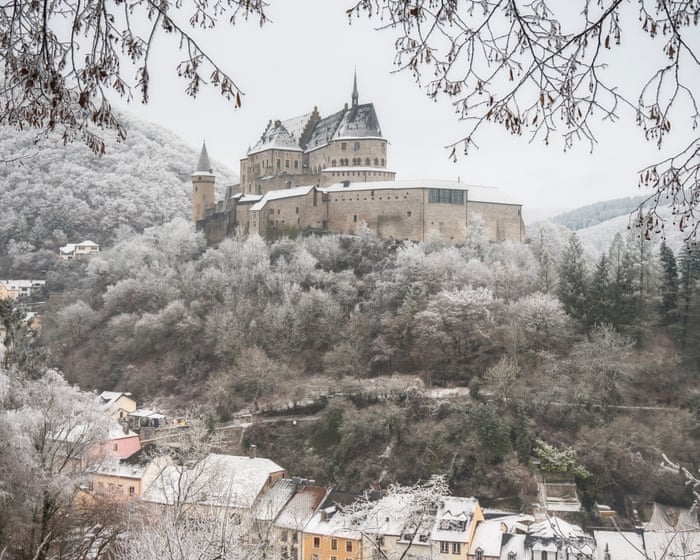
One of the country’s most impressive castles is Vianden (less than an hour from Clervaux by free bus), a beast of a bastion looming over the River Our on the German border. Built between the 11th and 14th centuries on Roman foundations, it was altered many times, left to decay, then painstakingly restored to its medieval grandeur from the 1970s onward. On a pale winter’s day, it was crowd-free. I wandered through its vast state rooms and marveled at the layered history on display in the visitor center, built around past excavations.
It’s not just the castle that gives Vianden its charm.The village has a fairytale feel, with its winding river, densely wooded hills, remnants of 13th-century walls, and a charming cobbled main street. I fully escaped reality at the Ancien Cinéma café, a former movie theater where you can enjoy a coffee on a couch while watching whatever is playing on the big screen, surrounded by film memorabilia.
My final stop was a truly unique castle. Château de Clémency, near the Belgian border, is a five-room guesthouse and the 2025 winner of Luxembourg Tourism’s Best Host award. Built in 1635, it was always a small residential retreat, never a military fortress. When Pascal Zimmer—a former judoka, self-taught tailor, architect, and historic building restorer—bought it 20 years ago, it was in such disrepair it needed either demolition or a complete renovation. He saw its true value and was particularly drawn to the staircase. “You could say I spent €400,000 on some stairs…” he admitted, pointing out the stone steps worn smooth by 400 years of footsteps.
“When you think of castles, you think of Windsor or Versailles. But this is a Luxembourgish castle—not so grand, not so perfectly finished; you can’t restore it in the same way,” he explained.
As a result, Clémency reflects Pascal’s own artistic vision. Each room has a different theme, from the belle époque “Peggy’s” to the “Roaring 20s.” The “Tribute” room honors the local steel industry, the foundation of Luxembourg’s wealth. “My father was a miner,” Pascal said. “He was a humble man; he’d say all he wanted was a small, clean room. This is a small, clean room.” A patchwork blanket covers the bed, and the bathroom features black polished concrete, a nod to life underground. I stayed in “Sherlock,” a Holmesian fantasy suite where the lounge felt like a steampunk curiosity shop, filled with moody portraits, scientific instruments, and even stuffed cats.
There isn’t much to do in the town of Clémency itself, but that hardly mattered. It was just 40 minutes by public transport (all free!) to Luxembourg City, a storybook capital perched on a steep rock. An even shorter trip took me to Bascharage, where I cozied up in D’Braustuff, a gemütlich brewery-brasserie serving Luxembourgish classics—I enjoyed a hearty wäinzoossiss (traditional sausage). When darkness fell, I was happy to stay in my castle with a book—the shelves were full of Agatha Christie and Conan Doyle—enjoying my own alternative winter’s tale.
The trip was provided by the Luxembourg tourism board and Byway, which can arrange bespoke itineraries including Eurostar tickets, Interrail passes, and accommodation. Château de Clémency offers doubles from €99. Château d’Urspelt offers doubles from €174.
Frequently Asked Questions
Frequently Asked Questions Winter Castle Tours via Luxembourgs Free Bus Network
Planning Basics
Q Is it really free to travel between castles by bus in Luxembourg
A Yes Luxembourgs national public transport network is completely free for everyone You can hop on and off without buying a ticket
Q Which castles are best to visit in winter and are they all open
A Not all castles are open yearround or have full winter hours Top winteraccessible options often include Vianden Castle Bourscheid Castle and the Castle of Clervaux Always check the official website of the specific castle for exact winter opening times before you go
Q How do I plan a route using the free buses
A Use the official mobiliteitlu website or app Enter your starting point and your destination castle It will give you the exact bus numbers stops and timetables
Q What should I wear and bring for a winter castle visit
A Dress warmly in layers with waterproof boots as castle grounds can be snowy icy and windy Bring a phonecamera a portable charger and have the mobiliteitlu app downloaded for realtime bus info
Using the Transport System
Q How do I find the correct bus stop especially in rural areas
A Stops are clearly marked with signs and schedules In the mobiliteitlu app your route will show the specific stop name Dont hesitate to ask the bus driver For please let me know when to get off Many are helpful
Q How frequent are the buses to the castles especially on weekends
A Service is less frequent on weekends and in rural areas You might wait 12 hours between buses Plan your departure and return times carefully using the app to avoid long waits in the cold
Q Can I use the free buses to get from the airport directly to a castle
A Yes From Luxembourg Airport take the regular public bus to the central station or other hubs then transfer to a regional bus