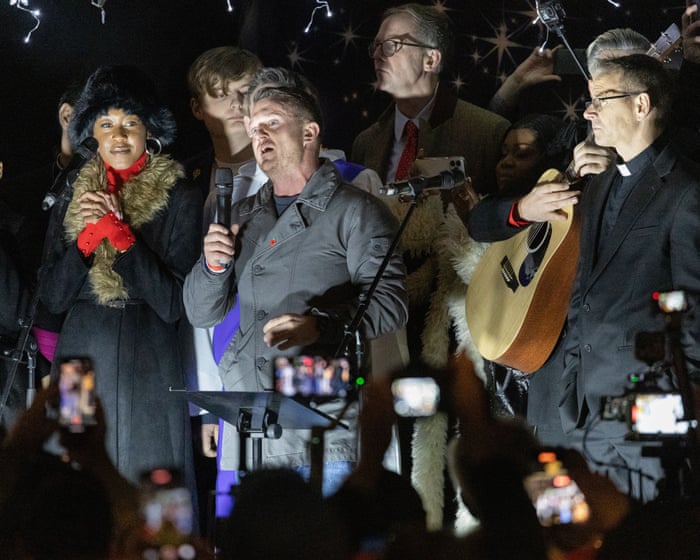
Gary arrived early at Whitehall to secure a good spot for the “Unite the Kingdom” (UTK) outdoor carol service in the lead-up to Christmas. After around 150,000 people attended the last rally organized by Tommy Robinson, the leader of the anti-migrant far-right movement, in September, Gary wanted to make sure he had a prime viewing location.
But he needn’t have worried. Only about 1,500 people—roughly 1% of September’s turnout—gathered on Whitehall in the mid-December twilight to sing carols and listen to preachers. Robinson had publicly framed the event as a non-political Christmas celebration, which may have kept some of the movement’s more ardent activists away.
Crosses and flags were visible, but there was little open discussion—from either the preachers or the crowd—of Robinson’s usual political themes. One attendee did complain loudly that her grandchildren were “banned from celebrating Christmas” at school, while a group of women handed out leaflets calling for communities to be “protected from illegal immigration.”
Standing under a “Jesus saves” sign, Gary said he was a believer but didn’t go to church. “That’s not for me, I can’t be bothered with all that,” he explained. Others at the service also identified as Christians but not regular churchgoers.
Since Robinson—whose real name is Stephen Yaxley-Lennon—was released from prison last May, appearing bearded and wearing a wooden cross, churches have been unsure how to respond to the emerging Christian nationalism on the far right of British politics. Some church members have wanted to firmly reject racism and xenophobia, stating they have no place in Christianity, while others warn that any direct response risks amplifying the far right’s message.
According to Rikki Doolan, a minister at the Spirit Embassy church in Tottenham—which has many worshippers of West African heritage—Robinson was “led to Christ” while in prison. Doolan, a former UKIP local election candidate, visited him three weeks before his release. “We spoke about the gospel, and he received Jesus Christ as his personal lord and saviour, right there in the prison,” Doolan said later.
After his release, Robinson told the far-right media platform Visegrad 24 that he had “looked deeply over the past few years about what we are fighting for and what made Britain, and it is Christianity. We are a Christian culture.”
Over Christmas, Robinson posted several messages on X positioning himself as an advocate for Christian revival. On Boxing Day, he shared a tweet from a right-wing account claiming a “MASSIVE surge in attendance across all denominations,” adding the comment, “It’s happening,” along with a cross emoji. The account also shared a clip from a Sky News interview with an Anglican vicar discussing “huge growth” in church attendance, especially since the pandemic.
At the large UTK march in central London in September, overt Christian symbolism was on display, including large crosses and placards reading “Christ is King.” Hymns were sung and prayers were said.
Some suggest the far right’s newfound Christianity is more cultural than deeply faithful, or simply a respectable cover for anti-migrant and Islamophobic views, while also appealing to potential supporters beyond Robinson’s largely white base. Others point to the entrenched, influential, and well-funded Christian nationalism in the U.S., arguing he is trying to emulate that movement.
According to Chris Wickland, a senior pastor at the evangelical Living World Church Network in Hampshire and an associate of Robinson, the rise of Christian nationalism is a “continuation of much older debates about identity, sovereignty, and culture.”He said: “Many people currently attending our churches are disillusioned with the country’s political situation and see faith as a stabilizing force in family life, local communities, and society more broadly. People are drawn by a shared concern about the role of faith in public life, and many are also exploring or deepening their personal commitment to Christianity.”
Online footage has shown Wickland trying to recruit new members from men attaching flags to lamp-posts as part of the right-wing “Raise the Colours” movement.
A few supporters of the group UTK have started appearing in churches, creating a dilemma for clergy and fellow worshippers who do not share their views. “People are showing up after these rallies, and local church leaders are wondering: ‘What do we do with this?’ It’s something we have to think very hard about,” said someone who attended a December meeting of church, charity, and civil society leaders in Westminster to discuss their response to Christian nationalism.
Arun Arora, the Bishop of Kirkstall and a co-lead in the Church of England on racial justice, said he “rejoiced” that Robinson had found faith, but that the far-right leader needed to hear Christianity’s key messages: love thy neighbor, compassion, and justice for the weak and vulnerable.
Within the Church of England, Arora has led the argument that the church must firmly oppose Robinson’s Islamophobia and anti-migrant stance—while being careful not to demonize everyone associated with him. “Not everyone who goes on a UTK march is racist. No one is in favor of uncontrolled immigration. But that doesn’t mean you stay neutral in the face of Robinson’s message,” Arora said. He and other clergy in Leeds have engaged with protesters outside asylum hotels in the city, offering cake and a vision of “positive patriotism” to create space for discussion. He said the next few years would see a “battle over what Christianity is.”
In the lead-up to the UTK carols service, several clergy publicly called for a strong response from the Church of England. Their case was strengthened when the Baptist Union, Methodists, and United Reformed Church criticized the event. Churches Together in England shared an opinion piece questioning “why so many churches were slow to challenge [Robinson’s] insidious rhetoric.”
The day before the UTK carols event, the Church of England’s national office released a 43-second video reminding people that “Christmas belongs to all of us.” It did not mention Robinson or the UTK event, but Church officials indicated they were happy for it to be seen as a response to both. Some who had argued for pushback felt it was a “safe” way to avoid a more radical response.
Differences in views on how to respond to Robinson, UTK, and the Reform UK party are believed to exist at the highest levels of the Church of England, between Stephen Cottrell, the Archbishop of York—who has a long record on racial justice issues—and the incoming Archbishop of Canterbury, Sarah Mullally. In a pre-Christmas interview with the Sunday Times, Mullally condemned the use of “Christian symbols to oppress,” but she is thought to be cautious about the potential pitfalls of a political battle with hard-right politicians and activists.
In January, Church of England bishops will discuss the church’s response to Christian nationalism and the far right at one of their regular meetings. Nick Spencer, a senior fellow at the Christian thinktank Theos who is beginning a two-year study of Christian nationalism, said the Church of England faces a genuine dilemma. If it embraces right-wing activists proclaiming newfound Christianity, it…If the church were to engage with them, it would face harsh backlash; if it rejected them outright, it would be a catastrophic failure of its mission. As he put it, the church is in a no-win situation. “I don’t believe it can stay silent, but by responding, it risks reinforcing the idea that the Church of England only serves the comfortable middle class.”
Baptist minister Steve Chalke, founder of the Oasis Charitable Trust, warned that ignoring Christian nationalism is “really unwise—you wouldn’t ignore a cancer in your body.” Having worked for decades against poverty and injustice, Chalke added, “We need to build community, belonging, and hope. Britain is no longer just post-Christian; it’s now post-secular. People are searching for meaning and purpose.”
According to Spencer, what comes next hinges on whether Robinson reflects on the low turnout for the UTK carol service and chooses to “quietly abandon” his Christian nationalist rhetoric. “Or will he persist? How genuine is his Christian faith?”
A possible hint emerged the week before Christmas, when Robinson and UTK announced the “largest demonstration for national unity and strength this country has ever witnessed,” set for 16 May in central London. Promoted as a “celebration of our culture, our identity, and our shared destiny,” the event made no mention of Christianity.
Frequently Asked Questions
FAQs Tommy Robinsons Prison Conversion Church Responses
BeginnerLevel Questions
Who is Tommy Robinson
Tommy Robinson is a British political activist and former leader of the English Defence League a farright group He is a controversial figure known for his antiIslam activism and has served prison sentences for various offenses including contempt of court
What does it mean that he found Jesus in prison
It means that Robinson has publicly stated he underwent a religious conversion to Christianity while incarcerated claiming he now has a personal faith in Jesus Christ
Why are churches divided about this
Churches are divided because some see his conversion as a genuine example of redemption and the transformative power of faith Others are skeptical due to his past actions and rhetoric concerned it might be insincere or used to rehabilitate his public image without demonstrating true repentance
Is it common for people to find religion in prison
Yes it is relatively common Prison can be a time of introspection and crisis leading some individuals to explore spirituality or religion as a source of hope structure and purpose
Advanced Practical Questions
What are the main arguments from churches that support him
Supportive voices often cite Christian teachings on forgiveness grace and the belief that no one is beyond redemption They argue that the churchs role is to welcome repentant sinners and that doubting a conversion is not their place
What are the main concerns from churches that are skeptical or critical
Critics point to the need for fruits of repentancevisible changes in behavior and attitude that demonstrate a sincere turn away from past harmful actions They worry about the optics of embracing a figure associated with division and whether it could alienate minority communities or be seen as endorsing his previous views
Does the Bible offer guidance on how to handle controversial conversions
Yes broadly Passages discuss testing spirits looking for the fruit of a changed life and the principle of welcoming the repentant However interpretations on applying these to highprofile cases vary widely
Whats the difference between forgiveness and endorsement
This is a key point of tension