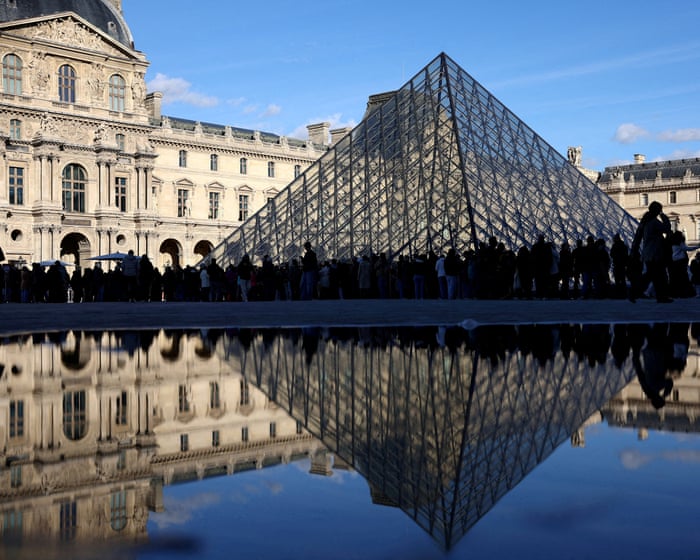
Long before Versailles captivated the world, the Louvre stood as a royal residence along the banks of the Seine. Charles V housed his famous library here; Henri IV established his collections of paintings, fine art, and weapons, turning the palace into a thriving artists’ enclave where cabinetmakers, tapestry weavers, painters, and armorers lived and worked. Under Louis XIII, coins, medals, and the Louvre’s printing press were added; Louis XIV later contributed casts, antiquities, and the academies of architecture, arts, and sciences.
The Enlightenment called for art masterpieces to be made public, and the Revolution answered. On November 8, 1793, ordinary citizens were admitted to the Louvre’s Salon Carré and Grande Galerie for the first time, transforming the royal palace into a national museum. Continuously reshaped through redesign, reconstruction, and reinvention, it has endured revolutions, arson, and Nazi occupation. Within its labyrinthine galleries, bold thefts have unfolded in broad daylight, while secret acts of bravery left barely a trace in history. The Louvre remains a place of enduring mystery and imagination, belonging both to France’s collective memory and the world’s dreams. Yet this year, a series of thefts, leaks, and infrastructure failures has forced France to reconsider what the Louvre has become—and what it stands to lose.
More than a century before this October’s spectacular heist, another daylight robbery caused an international sensation. On August 21, 1911, Vincenzo Peruggia, an Italian handyman who had worked at the museum, removed the Mona Lisa from the wall, slipped it out of its frame, and walked out with it hidden under his coat. Believing he was righting a historical wrong, Peruggia thought he was repatriating an Italian treasure stolen by France—though in fact, Leonardo da Vinci had brought the painting with him when invited by François I. It took the Louvre over 24 hours to notice the Mona Lisa was missing, and another two years to recover it. In the meantime, crowds lined up simply to gaze at the empty space on the wall.
Twenty-eight years later, Jacques Jaujard, the museum’s deputy director, saved the Mona Lisa and the entire collection from the Nazis through a daring and highly secret operation, just ten days before World War II began. With the help of hundreds of curators, loyal employees, and art students, Jaujard oversaw the packing and transport of 1,862 crates of treasures to remote castles deep in the French countryside. When the Nazis arrived in Paris in June 1940, they found the Louvre empty—with Jaujard waiting at his desk.
The Louvre is woven from such extraordinary tales. Scandalous thefts, mysteries, and acts of heroism have helped make it the world’s most visited museum today, with recent annual averages of nearly 9 million visitors (and close to 10 million in 2019). Yet over time, this popularity has become both a blessing and a burden, and daring jewel heists are only the most visible of the museum’s problems: it is bursting at the seams, sometimes literally.
In recent months, the Campana gallery, home to nine rooms of ancient Greek ceramics, closed over fears of a collapsing ceiling. Water pipes have burst, damaging the Egyptian antiquities library and around 400 historic documents, including records from the first archaeological excavations in Egypt in the early 19th century. Laurence des Cars, the Louvre’s current director, had warned of the urgent need to modernize the museum but seemed to wait for others to act. Some speculate that a state of emergency may be needed to prevent further damage to both the collection and the Louvre’s reputation. Staff represented by trade unions have been on rolling strikes since December 15 to pressure management and the government into swift action.
The grand redesign of the Louvre—the “renaissance” announced earlier this year by President Macron—cannot comeSoon enough, a major renovation plan for the Louvre is set to begin. Estimated to cost €1.15 billion—partly funded by taxpayers—the project includes a dedicated room for the Mona Lisa with its own entrance, new galleries, updated facilities, and a spectacular eastern entrance to complement I.M. Pei’s glass pyramid. Upgrading security, water, heating, and electronic systems with state-of-the-art technology is also a top priority.
Meanwhile, we French have grown accustomed to rolling our eyes in despair and embarrassment at each new Louvre “misadventure.” Oh no, what now? Has someone flown off with the Winged Victory of Samothrace using a drone? At this point, nothing would surprise us.
A parliamentary committee investigating the theft of the crown jewels last October has now delivered damning conclusions. Over the past decade, internal reports repeatedly warned about the Louvre’s inadequate IT and security infrastructure—one highly secure password, laughably, was simply “Louvre.” Yet these warnings went unread, buried in drawers. Many have questioned the priorities of the last two directors since 2018: was it wise to spend €105 million on new acquisitions while allocating only €27 million for maintenance?
Finally, it seems the urgency of the Louvre’s situation has been understood. In the coming weeks, the winning architect for the grand redesign should be announced. President Macron has stipulated that work must begin no later than 2027 and be finished by 2031. Part of the funding will come from visitors: starting in January, non-EU nationals will pay €32 for entry, while EU residents will pay €22 (under-18s and EU students will still enter free). Through French eyes, mass tourism has contributed to the Louvre’s challenges, so it is only natural that it should help fund the solution.
The Louvre, both iconic and vulnerable, revered and imperfect, carries the weight of history while grappling with modern pressures. It embodies the contradictions of France itself: proud yet self-critical, global yet intensely local, eternal yet in urgent need of care. With enough will, funding, and a bit of luck, the Louvre will survive the present chaos—and French pride will remain intact.
Agnès Poirier is a political commentator, writer, and critic for the British, American, and European press.
Frequently Asked Questions
FAQs About The Louvre is Frances Prideand Its on the Brink of Collapse
BeginnerLevel Questions
1 What is the main problem with the Louvre discussed in the article
The article explains that the Louvres physical structure is deteriorating Its foundations drainage systems and overall infrastructure are aging and failing putting the building and its priceless art at serious risk
2 Why is the Louvre so important
The Louvre is not just a museum its a historic palace and a global symbol of art and culture It houses masterpieces like the Mona Lisa and the Venus de Milo making it a cornerstone of Frances national identity and a top destination for millions of visitors each year
3 Whats causing the Louvre to collapse
A combination of factors its age the immense weight and visitor traffic outdated systems and years of deferred maintenance have created a critical situation
4 Cant they just fix it like a regular building
No its far more complex The Louvre is a massive historic monument Restoration requires specialized techniques to preserve its original features is extremely expensive and must be done while the museum remains open to the public
5 Who is responsible for saving the Louvre
Primarily the French state as the Louvre is a national museum Its director and administrators must secure funding and manage the restoration but its seen as a national duty requiring public and potentially private support
Advanced Practical Questions
6 What are the specific risks if the Louvre isnt repaired
Risks include structural damage to the building flooding from failed drainage climate control failures harming delicate artworks and potential safety issues for visitors and staff In the worst case sections could become unstable and close
7 How much will the restoration cost and who will pay for it
The needed repairs are estimated to cost hundreds of millions of euros Funding is a major challenge It will likely come from a mix of the French governments budget international fundraising campaigns and possibly private donations from philanthropists and corporations
8 What is the time factor mentioned in the articles title
The title suggests the situation is urgent The longer repairs are delayed the more extensive and expensive the damage becomes increasing the risk of an irreversible catastrophe It