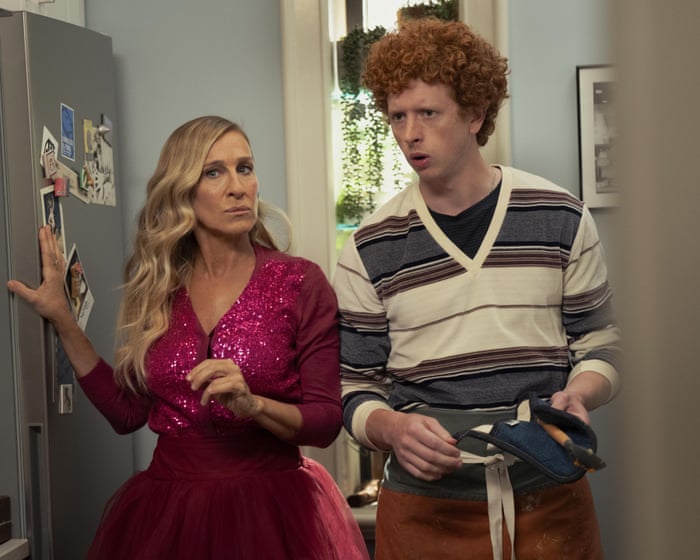
Where to even start with the love-hate Sex and the City spin-off, And Just Like That? The show was plagued by terrible writing, cringe-inducing character development (justice for Miranda!), and a mere 71 seconds of fan-favorite Samantha. For a moment, as the third season began, it seemed like the series had finally found its footing. Then came an entire episode focused on Seema’s natural deodorant. No wonder creator Michael Patrick King announced this would be the final season. It ended on a low note—the close-up of Miranda’s toilet overflowing with poop was just too symbolic. Still, there’s no denying fans have had a blast picking apart every single “WTF?” moment. And as Carrie—single once again—danced around her palatial townhouse to Barry White’s “You’re The First, The Last, My Everything,” who didn’t let out a little sob?
All’s Fair
Can Kim Kardashian act? Of course she can’t. But that was almost the least of All’s Fair’s problems. The show received a rare zero-star review in the Guardian—and rightly so. It’s hard to know where to begin listing the issues with this Ryan Murphy misfire. The hilariously clumsy writing? The tedious celebration of wealth and consumption? The parade of clichés that felt almost intentional? Performances so bad they seemed spiteful? Let’s just say “all of the above” and never speak of this show again. Except a second season has been commissioned, so we probably will have to.
AKA Charlie Sheen
Given the restraining orders, domestic violence allegations, and parental failures, it’s fair to say Charlie Sheen has been a bad boy. Not that you’d really know it from this three-part documentary, which chuckled along at Sheen’s various bouts of self-destructive hedonism while struggling to tell us anything new about the Hollywood hell-raiser. Instead, it felt like this loose cannon was being indulged, so any sympathy this series might evoke should be reserved for those who’ve had to endure close contact with this charming but flippant egotist.
The Iris Affair
Of course, we knew it was preposterous from the start: a drama about a supercomputer named Charlie Big Potatoes that could either save the world or destroy all of humanity. We stuck with it out of sheer love for Niamh Algar and Tom Hollander… but by the end, it felt like even they had stopped trying. Hollander barely reacted when his character died, and Algar ended up hacking Charlie with an axe… in super slow-motion. Talk about giving up the ghost.
Mob Land
Shady characters meeting in deserted boxing gyms? The Prodigy’s “Firestarter” blaring in club scenes? The late ’90s called and wants its gangland drama back. Actually, that’s unfair to the gangland dramas of the late ’90s. Many may seem dated now, but at least they didn’t suffer the indignity of indulging Pierce Brosnan and Helen Mirren’s baffling Irish accents. But Mob Land had many other problems, mainly that it was just really dull—a dispute over drug-selling territory between various cockney rogues that Nick Love would probably dismiss as a bit basic.
With Love, Meghan
Given how much she grinds the gears of the nation’s performatively outraged, right-wing culture warriors, it’s almost tempting to admire the Duchess of Sussex’s various televised ventures into…I initially dismissed these homemaking shows as deliberate provocations. But after watching, I’m forced to admit they might have a point in this one instance. It’s like watching the Liberty catalogue come to life before your horrified eyes—a “wine o’clock” poster with delusions of grandeur, a parade of snoozing dogs, humming beehives, Hallmark platitudes, and pointless crafting “hacks” you’ll instantly forget. All of it is underpinned by vast, largely unearned wealth. Ugh.
Victoria Beckham
There are clearly interesting things to be said about Victoria Beckham and her struggles with vocation, self-image, and self-acceptance. But for whatever reason, this three-part series chose not to say them. Instead, the experience was like consuming a sales catalogue. Victoria clearly has good reason to bristle at what she describes as her “miserable cow” image, but sadly, she didn’t do herself any favours with this cagey non-event of a series.
The Inheritance
It should have been the next Traitors—only camper, with Liz Hurley playing dead and executor Robert Rinder overseeing her inheritance. What more could you ask for? As 13 ordinary contestants battled it out, there was plenty of backstabbing and squabbling. But the rules quickly became bewildering; it’s still too confusing to explain what exactly was happening in the weekly division ceremonies. Even more disappointingly, we only saw glimpses of Hurley via videos recorded for the contestants. The Inheritance ended up reeking of a show trying way too hard to live up to something way beyond it.
Too Much
How do you follow a show that defined a generation like Girls did? The pressure on Lena Dunham was immense when she released this starry romcom about Jessica, a rosy-eyed New Yorker who lands in London with a broken heart. Meg Stalter took her biggest role to date by the horns and was joyous to watch as she revelled in Austen-level romantic ideals, all while falling for indie guy Felix (Will Sharpe). But it was all very glossy and, ironically, not enough. Plus, the sheer number of celebrity friends involved felt icky.
Mitchell & Webb Are Not Helping
David Mitchell and Robert Webb’s previous sketch series, the largely excellent That Mitchell and Webb Look, had a skit pondering the innate patchiness of sketch shows. We only wish this return to the format rose to the status of “patchy.” Given the shrewd recruitment of talented younger comics Stevie Martin, Krystal Evans, Kiell Smith-Bynoe, and Lara Ricote, expectations were high. But sadly, most of it didn’t land. “Sweary Aussie Drama” was a single joke milked dry but repeated in every episode. Mitchell seemed too willing to slip into his Would I Lie to You? auto-rant mode. The writing room sketches, meanwhile, simply provoked the thought that they should probably have stayed in there a while longer.
The Twisted Tale of Amanda Knox
This dramatisation of the Amanda Knox story was executive produced by Amanda Knox and pretty much exclusively showcased her perspective. So, while there probably is an interesting drama to be made about the 2007 murder in Perugia of British student Meredith Kercher, this isn’t it. Of course, the story of Knox’s wrongful conviction and eventual exoneration is interesting in itself, but the material needed to be handled sensitively. Instead, the series struggled painfully to find the right tone, lurching awkwardly from an oddly jaunty, slightly mannered farce to…Inevitably, real-life horror. Twisted? Arguably. A total mess? Absolutely.
Prime Target
We love Leo Woodall, but did we buy him as the greatest math genius since Euclid, a man so brilliant he’s on the verge of a prime number discovery that could unravel society? Not at all. This globe-trotting thriller about the NSA spying on—and eliminating—intellectuals, and the man with the formula they’re after, became more farcical by the second. It was pure silliness-by-numbers.
1000 Men and Me: The Bonnie Blue Story
This glowing portrait followed the OnlyFans star, infamous for sexual exploits like proudly sleeping with men who look “barely legal,” as she prepared for her biggest stunt yet: having sex with 1,000 men (or 1,057, as it turned out) in 12 hours. What on earth would drive her? What we wanted was a much deeper look into Bonnie Blue’s actual psyche, as well as the minds of the men lining up to have sex with her—some wearing balaclavas and, interestingly, many not. They could have at least spoken to the legendary mother who showed up to drag her son out of the queue. Instead, we got horrific shots of Bonnie making snow angels on a floor covered in used condoms and absolutely no examination of her notoriety. And to think, the documentary-maker has a teenage daughter.
Frequently Asked Questions
Of course Here is a list of FAQs about the floating poop scene framed as questions a viewer might genuinely ask
Beginner General Questions
Q What is everyone talking about with floating poop on TV
A People are referring to a controversial scene from the finale of the TV show Shgun A characters feces is shown floating in a stream which many viewers felt was a heavyhanded and disappointing symbolic moment
Q Why was that scene such a big deal
A The show Shgun was critically acclaimed for its sophisticated storytelling complex characters and historical depth For many this crude literal symbol felt like a jarring and silly misstep in an otherwise brilliant series finale undermining the emotional weight of the moment
Q What was the poop supposed to symbolize
A Within the story it was meant to symbolize the character Toranagas final absolute victory and cunning The idea is that even his waste is part of a grand deceptive strategy showing his enemy that he is weak and sick when he is actually at the peak of his power
Q Was this in the original book
A Yes the scene is directly from James Clavells novel However in a book internal monologue can make a symbolic idea feel more nuanced On screen presented visually without that internal context it can come across as very literal and odd
Advanced Critical Analysis Questions
Q Why did this specific symbol feel like a letdown to so many people
A Its seen as a letdown because it reduced a master strategists decadeslong intricate plot to a juvenile bathroom joke It felt unsubtle and tonally inconsistent with the shows otherwise refined and respectful approach to its subject matter It told the audience what to think instead of trusting them to understand the subtext
Q Could the scene have been done better
A Many critics and viewers think so Suggestions include
More implication less depiction Showing Toranaga looking at the stream thoughtfully or a reaction shot from his scribe without explicitly showing the feces