On May 30 last year, Kim Sajet was in her office at the grand, porticoed National Portrait Gallery in Washington, D.C. The gallery is one of the most important parts of the Smithsonian Institution, the group of national museums that has told America’s story for nearly 200 years. The director’s suite, spacious enough for a small gathering, carries a dignity that matches the museum’s role as the home of portraits of the nation’s most significant historical figures. As she worked, Sajet was surrounded by pieces from the collection—including a striking 1952 painting of Mary Mills, an African American nurse in military uniform, and a bronze head of jazz and blues singer Ethel Waters.
It felt like an ordinary Friday—until an anxious colleague came in to tell Sajet that the president of the United States had personally denounced her on social media. “Upon the request and recommendation of many people I am herby [sic] terminating the employment of Kim Sajet as Director of the National Portrait Gallery,” Donald Trump had posted on Truth Social. In the post, he called Sajet “a highly partisan person” and a “strong supporter” of diversity and inclusion programs, which he claimed to have eliminated from federal agencies through an executive order on his inauguration day, January 20. “Her replacement will be named shortly,” the message continued. “Thank you for your attention to this matter!”
Sajet is a Dutch art historian, raised in Australia, now in her early sixties. She has platinum blond hair, wears brightly colored trouser suits and bold glasses, and comes across as warm and open, yet professionally composed. When we met in the autumn of 2025, she seemed so careful to avoid saying anything controversial that I found it hard to believe anyone could see her as radical. She recalled that after taking in Trump’s post, she looked at her shaken colleague and asked, “Are you OK?”
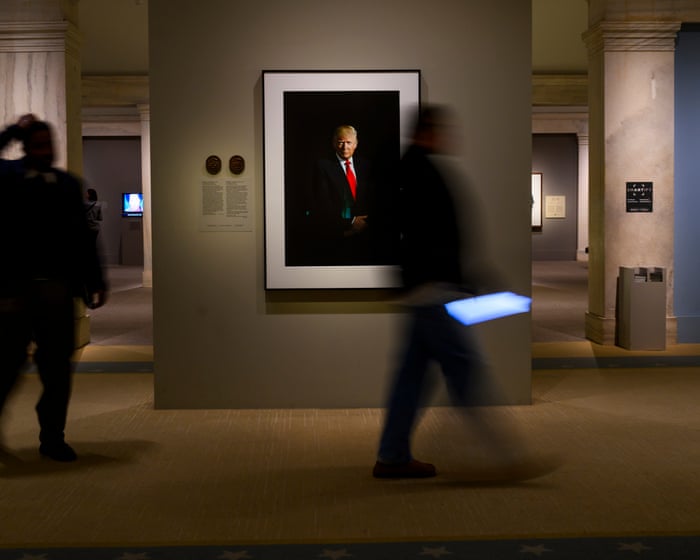
“It honestly was another day in the office,” Sajet told me. “Truly, I don’t think people realize that as soon as you become a director at the Smithsonian, you are a public figure.” In her twelve years leading the museum, she said, members of Congress had constantly questioned exhibits. A disgruntled painter, whose portrait of Trump she had declined to display—citing insufficient quality—had pursued legal action against her for years.
But surely, I asked, being personally fired by the president on social media was different? She shrugged, her composure unbroken. “I think we can all agree we live in unusual times,” she replied.
Perhaps it was only a matter of time before Trump targeted a senior figure from the Smithsonian. In February, he had declared himself—without any authority—chair of the Kennedy Center, the U.S. national performing arts center, and vowed to end “woke” programming. That turned out to be a prelude to renaming the institution after himself: this Christmas, workers added his name in slightly mismatched lettering above Kennedy’s on the building’s facade. At the national museums, some had hoped his focus on the arts might stop there. After all, the Smithsonian and the separate National Gallery of Art had preemptively shut down their diversity offices soon after Trump’s executive order, even though they are not federal agencies.
But on March 27, an executive order was published, claiming the Smithsonian had “come under the influence of a divisive, race-centered ideology” that “promoted narratives that portray American and Western values as inherently harmful and oppressive.” Tasked with removing this “improper ideology,” alongside Vice President JD Vance, was Lindsey Halligan, a Trump aide in her mid-thirties who had previously worked as aAn insurance attorney with no background in the arts, she was targeted by an executive order called “Restoring Truth and Sanity to American History.” On May 30, as soon as she learned of the Truth Social post, Sajet spoke with her supervisor, Lonnie Bunch III, the secretary of the Smithsonian Institution and former founding director of the National Museum of African American History and Culture. “We quickly agreed that the president of the United States does not have the authority to fire a Smithsonian director,” Sajet recalled. That power rested with Bunch, overseen by the Smithsonian’s board of regents—a traditionally non-partisan group made up of members of Congress, private citizens, the vice president, and the chief justice. “I just kept on working,” Sajet said.
The following workday, Monday, June 2, the Smithsonian’s board of regents held an emergency meeting. By the end, Sajet still had her position. A week later, on June 9, a second board meeting took place. Afterward, the Smithsonian issued a statement affirming that hiring and firing decisions belonged to Bunch. This was despite reports from those familiar with the meetings that Vice President Vance had personally called for Sajet’s removal. As a concession to the administration, the Smithsonian announced that Bunch would also take steps to ensure “unbiased content” in the museums and report back to the board on any necessary personnel changes.
Sajet avoided social media, steering clear of the threatening messages from Trump’s supporters that friends warned were piling up. She held on until Thursday, June 12. Ultimately, she decided to step down, hoping to defuse what she feared could become a larger, more determined attack on the museum. “It just became fairly obvious that the story wasn’t going to change,” she told me. “So I thought, ‘I’m just going to take control of this and step outside of the maelstrom.'”
In short, the president ended up getting what he wanted without any real authority to do so. As for Sajet’s alleged partisan stance or her commitment to diversity and inclusion—an ideology some despise—her mission, she explained, was simply to ensure Americans could see portraits of people like themselves. Gradually, she worked to include more women, minorities, and Black individuals on the museum’s walls. “It was just recognizing that people had been left out of the national story, so let’s put them back in,” she said. “It wasn’t terribly revolutionary.”
In a smoothly functioning liberal democracy, it might be easy to dismiss the arts and culture as distractions unworthy of serious political attention. But as culture wars have intensified over the past decade and global politics have grown less stable, that view has become harder to maintain. It is certainly not a view shared by Trump and his circle. On August 19, the president offered his most detailed articulation of his position yet. “The Museums throughout Washington, but all over the Country are,” he declared on social media, “the last remaining segment of ‘WOKE.'”
He continued: “The Smithsonian is OUT OF CONTROL, where everything discussed is how horrible our Country is, how bad Slavery was, and how unaccomplished the downtrodden have been—Nothing about Success, nothing about Brightness, nothing about the Future.” He added: “I have instructed my attorneys to go through the Museums, and start the exact same process that has been done with Colleges and Universities where tremendous progress has been made.”
In other words, Trump wanted museums to reflect a MAGA vision of American history—one that is nationalist, triumphalist, and downplays reflection on its darker aspects.His views on America’s past, particularly its history of slavery, aligned with his other, smaller cultural interventions—like his desire to build a triumphal arch in Washington or his personal role in vetoing artists considered “woke” from receiving Kennedy Center honors.
While the first Trump administration largely avoided cultural issues, his second term has made them a priority. Through lawsuits, executive orders, threats, and intimidation, the administration is pushing the country to the right. This marks a sharp and extreme escalation in the long-running battle between the right and left over the narrative of American history. To achieve this, he is targeting universities and museums—institutions that shape people’s minds, imaginations, and sense of identity. As one senior Smithsonian employee told me, “The goal is to reframe the entire culture of the United States from the foundation up.”
“In Trump 1.0, the systems that held everything together were still working,” said Gus Casely-Hayford, former director of the Smithsonian’s National Museum of African Art, now at the V&A East in London. “But those systems were held together only by culture, practice, and belief. No one thought anyone would unravel that, yet so much of what the Smithsonian does relates to what it means to be American.” And what it means to be American now seems more contested than ever.
The Smithsonian Institution is especially vulnerable to Trump’s focus. As a collection of national museums with members of Congress and the vice-president on its board, it is physically close to the centers of power in Washington, D.C. It also holds a unique status among U.S. museums, with about 60% of its funding coming from the federal government. While its aim is to be politically unbiased—though impartiality, as BBC followers know, is a moving target—this special status sets it apart from other major museums like the Metropolitan Museum of Art in New York, the Art Institute of Chicago, or the Getty in Los Angeles, which are privately funded through philanthropy and endowments and thus more removed from government influence. Intimidation is one tool the administration can use against the Smithsonian; funding is another. Already, the Smithsonian is anticipating a budget cut of $131.2 million in 2026.
However, there is one potential weapon the Trump administration might use against private museums. Many, along with charitable foundations and universities, have tax-exempt status, which Trump could threaten to revoke. Glenn D. Lowry, who recently retired after 30 years as director of the Museum of Modern Art in New York, believes this may happen. “Theoretically they can’t do it,” Lowry told me. “But the mere threat acts as a form of pressure. Institutions might start to self-censor, and that is a very real risk.”
The Baltimore Museum of Art is an elegant Greek temple-like building overlooking its deeply segregated, majority-Black city. It stands near a park that, until 2017, held a statue of Confederate generals—now an empty plinth. On a weekday morning in November, the museum was bustling. While a few visitors were drawn to its stellar collection of Matisses, more were there to see an exhibition by Amy Sherald, the artist who gained fame in 2018 for her painting of Michelle Obama in a sweeping, geometrically patterned gown, commissioned for Washington’s National Portrait Gallery. The show attracted crowds clustering around Sherald’s striking, larger-than-life paintings of Black subjects, whom she portrays with the grandeur of heroic figures.Amy Sherald, who studied art in Baltimore, found her exhibition “American Sublime” taking on the feeling of a homecoming. However, this was not the original plan. Just two months before its scheduled opening, Sherald abruptly withdrew the show from its intended venue, the National Portrait Gallery in Washington, D.C. She acted over concerns that her work was being censored—not by the Trump administration, but by the Smithsonian Institution itself.
By the time Sherald’s decision became public on July 24, the gallery’s director, Kim Sajet, had already been gone for over a month. In a statement, Sherald explained she pulled the exhibition after learning of troubling discussions at the Smithsonian’s central headquarters, known as “the castle,” regarding one specific painting. The work, titled Trans Forming Liberty, portrays a transgender woman in the triumphant pose of the Statue of Liberty. Sherald told the New York Times she discovered an internal debate about either replacing the painting with, or contextualizing it using, a video of people reacting to the artwork. She understood this discussion was driven by fears that the portrait might attract negative attention, as transgender people are frequent targets for figures in Trump’s circle. “The video would have opened up for debate the value of trans visibility,” Sherald said, “and I was opposed to that being a part of the American Sublime narrative.”
Tracking self-censorship in museums is challenging, as it often operates subtly—a word removed from a label here, a display quietly taken down there. One D.C. museum professional mentioned being told that “anything relating to trans life, or even acknowledging trans life, is going to need extra layers of review.” Another said their institution had removed the phrase “social justice” from a wall text to soften the presentation of an artist who was a socialist and anti-racist figure. In a different case, references to the Dutch empire’s involvement in slavery were discouraged in labels for an exhibition of Dutch landscapes.
“People are acquiescing in advance as a way to stay under the radar,” said Steven Nelson, who recently stepped down from a senior role at the National Gallery of Art. “Very quickly, things that would not have been considered DEI [diversity, equity, and inclusion] began being considered DEI, which was almost anything not white.” No current staff at the Smithsonian or the National Gallery of Art agreed to speak on the record about these issues, fearing for their jobs and their colleagues’. The prevailing sentiment is to avoid drawing attention from the White House. “Don’t poke at it,” was how one museum director put it.
Some Smithsonian staff believe the institution is being overly cautious. One person described a proposed label for a recent exhibition that referred to the “unjust” incarceration of Japanese Americans during World War II. Central Smithsonian administrators requested the word be changed, arguing it could appear partisan. “America hardly ever apologizes for anything, and it almost never gives reparations,” the individual said, “except for this event, this example in our history where we said sorry, and that apology came with money.” While it seemed obvious that “unjust” was an accurate description, the review process demanded a more wordy alternative. The accumulation of such small adjustments, they noted, creates a sense of “small moral injuries”—changing language or omitting references for the sake of caution.
At times, this self-censorship borders on dark comedy. One Smithsonian employee recounted removing the word “diversity” from texts and replacing it with…They replaced it with the synonym “variety.” After all, “diversity” was a word sure to anger Trump’s circle because of its link to DEI programs. But here, “diversity” was being used in a purely scientific sense: the “diversity” of astronomical objects. Still, the employee worried the word might catch the attention of any search tools the administration used to scan museum texts. It seemed safer, overall, to avoid drawing notice.
For some, this self-censorship—what might be called anticipatory obedience—is growing increasingly frustrating. “I think courage is contagious,” one curator told me. “If a major institution like the Smithsonian, with all its influence and power, were seen taking a stand, others would follow. But the message to staff is more like, ‘Well, if the CIA and FBI can’t stand up to Trump, what can we do?'” Nelson put it even more bluntly: “The administration doesn’t really have to do anything, because institutions are doing it all for them.”
In Washington, D.C., that autumn, life often appeared normal. Restaurants and bars were busy, streets filled with purposeful-looking people on official business. But every so often, you’d catch a glimpse of something very different: soldiers gathered on street corners, in metro stations, even inside shops. These were National Guard troops deployed to support Immigration and Customs Enforcement (ICE). From January through July, ICE arrested 88 people in D.C. But from August 1 through October, that number jumped to 1,147. “You could be walking your dog,” one Smithsonian employee said. “Suddenly, black cars pull up and people grab some kid on a moped delivering dinner. They pummel him or her to the ground, put a foot on their neck, shove them into a black SUV, drive off, leave the moped there, leave the food on the sidewalk, and neighbors come out to see what they can do. It happens in other countries. Now it’s happening here.”
That feeling of life carrying on while, on another level, becoming disordered and frightening, was also true at the Smithsonian. On the surface, an employee told me, not much had actually “happened.” Those with long memories recalled past Smithsonian scandals, like a 1990s exhibit about the Enola Gay, the plane that dropped the atomic bomb on Hiroshima. After loud accusations of anti-American bias, the exhibit was heavily changed, and the director of the National Air and Space Museum resigned. Optimists pointed out that nothing on that scale had happened yet.
This winter, the museums were still busy with visitors—at least after the lengthy government shutdown in the fall ended. The National Museum of African American History and Culture, which Lonnie Bunch had helped create, drew crowds, many of them Black Americans making a pilgrimage to confront the unvarnished cruelty and racism central to their country’s history. One of its most moving artifacts is a chunk of iron ballast from an 18th-century slave ship, used to counterbalance the human cargo.
Behind the scenes, though, a tense standoff continued between the Trump administration and the “castle.” In his 2019 memoir, Bunch was frank about his awkward encounters with the president. He recounts giving Trump a tour of the National Museum of African American History and Culture, which opened during Trump’s first term. Before the president arrived, aides warned Bunch that Trump was “in a foul mood and that he did not want to see anything ‘difficult.’” Bunch decided to start with the slavery section anyway, believing “it was not my job to make the rough edges of history smooth, even for the president.” In a section on how nations like Portugal, Britain, and…The Netherlands benefited from the slave trade. Trump paused to examine a label. “I thought perhaps he was engaging with the museum’s work,” Bunch writes. “He quickly proved me wrong. Turning from the display, he said to me, ‘You know, they love me in the Netherlands.’ All I could say was, let’s keep walking.”
On August 12, three weeks after Amy Sherald withdrew her exhibition in Washington D.C., Lindsey Halligan and two other Trump aides wrote to Bunch. The letter started politely, thanking him for a tour of some museums, but then announced they would be leading a review of the institution. Initially focused on eight museums—including the Museum of American History, the Museum of African American History, the National Portrait Gallery, and the American Art Museum—those most involved with the nation’s identity and self-image.
Institutions were required to provide a vast amount of information within 75 days: exhibition outlines, label texts, catalogs, budgets, staff manuals, organizational charts, inventory lists, educational resources, and grant applications. Within 120 days, museums were to begin making “content corrections,” replacing “divisive or ideologically driven language.” A “revitalized” curatorial vision should be grounded in the “strength, breadth, and achievements of the American story.” In short, the institution would start focusing on what it termed “Americanism.”
A week later, Trump published a lengthy post describing museums as the “last remaining segment of woke.” Two days after that, the White House released an article titled “President Trump Is Right About the Smithsonian,” highlighting exhibits and texts deemed objectionable. These included a painting of a refugee family crossing the Mexican border wall, an animation about Dr. Anthony Fauci’s career, and a wall text describing America’s founding as “a profound unsettling of the continent.”
Then, on August 28, Bunch was called to the White House for lunch with Trump and Halligan. Afterwards, Bunch assured staff in a letter that the review would actually be conducted by the Smithsonian’s own team—a reassertion of its independence—though information would be shared with the White House. He also addressed a concerned all-staff meeting at the Museum of African American History auditorium. According to a staff member present, the message was: carry on with your work; keep doing what you do.
These days, Kim Sajet is in Wisconsin. Shortly after resigning from the National Portrait Gallery, she was approached by the Milwaukee Art Museum to become its new director. Located on the shores of Lake Michigan, the museum is a striking collection of buildings: some designed by Finnish architect Eero Saarinen in modernist concrete, and others by Spanish architect Santiago Calatrava in the fantastical shape of a giant bird, whose sweeping wings have become a city symbol.
We met a few weeks after Sajet started her new role, in an office noticeably less grand than her previous one in D.C. “I’m still getting familiar with the collection,” she said of the museum’s diverse holdings, which range from paintings by Georgia O’Keeffe and Agnes Martin to an Egyptian mummy and one of the most significant collections of Haitian art in the U.S.
Sajet told me she loves Milwaukee, with its green spaces and lakeside walks, and is excited to lead an institution that can be at the heart of its local community. Privately funded, the museum is far removed from Trump’s watchful eye.When I asked if she still felt she could be targeted, she replied, “I don’t know. It could happen, right? I’m still a pretty visible symbol, after all. Who knows what’s around the corner. But you just can’t live like that.”
About ninety miles down the lake coast, in the Democratic stronghold of Chicago, Trump’s shadow fell much less darkly over its museums than in Washington. During my visit, protesters were gathering in force against ICE and its raids. The Museum of Contemporary Art was hosting an exhibition on the history of queer culture in the city, and a featured image on its website was a sculpture by African American artist Arthur Jafa, based on a famous 1863 photograph of an enslaved man with horrific scars on his back. (The Trump administration had reportedly ordered reproductions of this photograph removed from national parks.) At the Art Institute of Chicago, one of America’s great museums, curator Sarah Kelly Oehler showed me the recently rehung galleries of 20th-century American art. “I think of myself as part of a 150-year trajectory of curators,” she said. Her vision of modernism was pluralistic, featuring more work by female artists and artists of color than in the past—an interpretation that would have seemed alien to visitors fifty years ago. “My job is to offer historical information,” she explained. “We have a very diverse audience in Chicago, and we have a responsibility to them. If we want to offer a place of respite and inspiration, we have to think about who these people are.”
Back in Washington, D.C., one museum director told me they were feeling calm—more prepared than in the spring for potential attacks from the administration. They knew what they would do if hauled before a hostile congressional hearing, as the presidents of Columbia and Harvard had been the previous year. They had scenarios mapped out, “like a crime board.” Meanwhile, Lonnie Bunch is walking a delicate line. On December 18, a new letter arrived from the White House. It stated that the Smithsonian had fallen short in providing the information requested the previous August. “We wish to be assured,” it continued, “that none of the leadership of the Smithsonian museums is confused about the fact that the United States has been among the greatest forces for good in the history of the world. The American people will have no patience for any museum that is diffident about America’s founding or otherwise uncomfortable conveying a positive view of American history.” Then came the threat: “As you may know, funds apportioned for the Smithsonian Institution are only available for use in a manner consistent with Executive Order 14253, ‘Restoring Truth and Sanity to American History,’ and the fulfilment of the requests set forth in our August 12, 2025 letter.”
The following day, Bunch wrote a note to all staff, quietly reaffirming the institution’s autonomy. “For nearly 180 years, the Smithsonian has served our country as an independent and nonpartisan institution committed to its mission—the increase and diffusion of knowledge—for all Americans. As we all know, all content, programming, and curatorial decisions are made by the Smithsonian.”
With JD Vance on the board of regents, along with Republican members of Congress, the question lingers: how long will 73-year-old Bunch survive in his position? “Lonnie knows his time is short,” one D.C. museum director told me. “It’s a question of how he decides to go, and which hill he chooses to die on.”
Frequently Asked Questions
Of course Here is a list of FAQs about the topic framed in a natural tone with direct answers
BeginnerLevel Questions
1 What is this about What did Trump say about the Smithsonian
During his presidency and in subsequent statements Donald Trump and his allies have criticized the Smithsonian Institution for exhibits they view as promoting a negative leftwing narrative about American history They have framed this as an effort to reshape Americas cultural landscape by challenging traditional patriotic narratives
2 What is the cultural landscape hes talking about
The cultural landscape refers to the shared set of stories symbols heroes and historical interpretations that define national identity Its what is taught in schools displayed in museums and celebrated in public life The debate is over whether this landscape should primarily highlight Americas ideals and triumphs or also critically examine its failures and complexities
3 What specific things did the Smithsonian do that were criticized
Key criticisms were aimed at
The 1619 Project educational resources that centered slavery in American history
Exhibits on systemic racism and the legacy of slavery
Discussions about racial inequality and social justice which critics labeled as critical race theory or antiAmerican
4 What was Trumps main goal in attacking the Smithsonian
His stated goal was to promote patriotic education and defend a more traditional celebratory view of American history He issued an executive order to establish the 1776 Commission as a direct response aiming to counter narratives he believed were divisive and unpatriotic
Advanced Impact Questions
5 Is this just about museums or is it part of a bigger trend
Its part of a much larger ongoing culture war battle over history education and public memory Similar debates are happening at local school board meetings over curriculum in state legislatures passing laws restricting how topics like race can be taught and in discussions about monument removal
6 Whats the difference between patriotic education and what critics call revisionist history