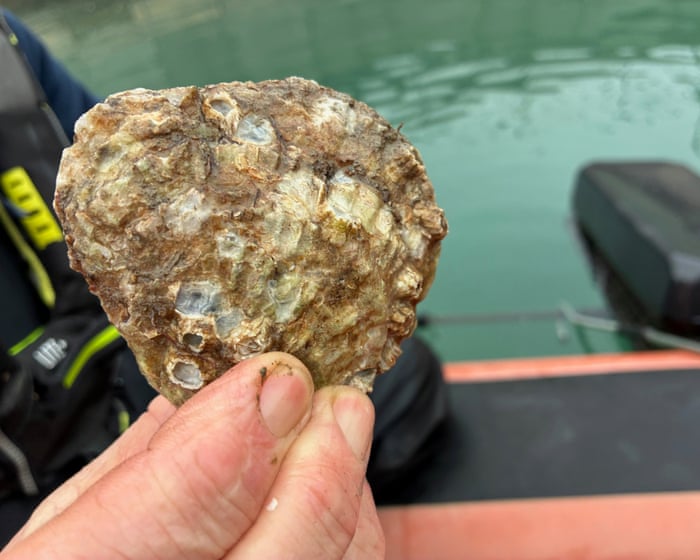
The dinghy slowed to a stop alongside a long line of black, bobbing baskets. David Lawlor reached out to inspect the first one. Inside lay sixty oysters, their shells tightly closed, protecting the life within. “They look great,” Lawlor said with a smile. So did their neighbors in the next basket, and the ones after that, all along the line of three hundred baskets holding eighteen thousand oysters in total.
These oysters, however, will never be eaten. Their mission is to reproduce and restore oyster reefs to Dublin Bay, more than two centuries after the reefs were wiped out. “We want them to live long and happy lives,” said Lawlor.
This pioneering project in Dún Laoghaire harbour is betting that a species which thrived here for millennia—before the waters became an oyster graveyard—can do so again. Similar restoration efforts are underway across Europe, where sprawling reefs of the European flat oyster were once common until overfishing, dredging, and pollution destroyed them.
Oyster reefs create rich ecosystems, providing habitat for nearly two hundred species of fish and crustaceans. They also play a vital role in stabilizing shorelines, cycling nutrients, and filtering water. “These oysters are amazing climate heroes,” said Lawlor, co-founder of the nonprofit Green Ocean Foundation, which is leading the Dublin effort. “They are natural filter feeders. Each oyster filters about 190 liters of seawater a day.”
By feeding on plankton and nitrates, the oysters clear algae and allow sunlight to reach the seafloor. This encourages the growth of seagrass—a carbon sink—which in turn supports other species and improves coastal biodiversity and marine habitats.
Ireland’s inhabitants cultivated oysters in the Middle Ages, but industrialization and overfishing in the 1800s killed off the Dublin Bay reefs, a pattern repeated from Scandinavia to the Mediterranean. Inspired in part by New York’s Billion Oyster Project, Lawlor enlisted volunteers and business sponsors for pilot projects that moved oysters from Tralee Bay in County Kerry to sites around Dublin Bay, including Malahide, Howth, Poolbeg, and Dún Laoghaire, as well as Greystones in County Wicklow.
“You’re building your understanding of why things work well or don’t work well,” Lawlor explained. “You want to make sure they survived, to see what the growth was like, and to see if they spawn.”
The transplanted oysters did especially well in Dún Laoghaire, so it was chosen for the next phase. Last November, volunteers placed three hundred baskets containing eighteen thousand adult oysters in a sheltered part of the harbour. The hope is that they will become broodstock—spawning baby oysters in the summer that will settle around the harbour and, over time, create a reef.
Scientists from Dublin City University’s Water Institute analyzed the water last year to establish baseline indicators and will monitor the oysters’ impact using sensors, along with chemical and biological assessments.
The baskets are connected along a hundred-meter line and are flipped by hand every few weeks. This allows Arctic terns, gulls, and other birds to peck away fouling that might otherwise restrict water flow through the baskets.
In Northern Ireland, the charity Ulster Wildlife recently used a different technique, placing two thousand adult oysters and thirty thousand juveniles, sourced from Scotland, on the seabed of Belfast Lough. Meanwhile, the Luna Oyster Project—a collaboration between Norfolk Seaweed and Oyster Heaven—aims to restore four million oysters to the North Sea by deploying clay structures called mother reef bricks on a large scale for the first time.
The Dublin initiative is far smaller, but it will”Hopefully it will grow,” said Lawlor. “The temptation is to think big, but you need to take one step at a time. A lot of the challenge is bringing people along with you,” he said, referring to government departments, local councils, wildlife groups, and harbor authorities.
Last weekend, accompanied by volunteers Andrew Collins and Aoibheann Boyle, he returned to Dún Laoghaire, a wealthy, liberal neighborhood, and boarded a dinghy to turn over the baskets.
Under a winter sun, the trio recorded clips for the Green Ocean Foundation’s social media accounts and answered supporters’ questions. One, asked in jest, proved unanswerable: “Can the oysters filter the smugness out of the people of Dún Laoghaire?”
Frequently Asked Questions
FAQs Reviving Dublin Bays Oyster Beds
Basics Background
What are oyster beds and why are they important
Oyster beds are dense colonies of oysters that form a living reef on the seafloor They are crucial ecosystem engineers that filter water provide habitat for other marine life and protect shorelines
I thought Dublin Bays oysters were gone What happened to them
Historically Dublin Bay had extensive native oyster beds They were largely lost due to centuries of overfishing habitat destruction pollution and disease
What does it mean to revive the oyster beds
Revival involves active restoration projects This includes cleaning the seabed introducing healthy adult broodstock oysters and protecting areas so they can naturally reproduce and rebuild the reef structures
The Restoration Project
Who is leading the effort to bring them back
The project is a collaboration between conservation groups government agencies scientists and often the local fishing community
How are they actually doing it Are they just dumping oysters in the bay
No its a careful scientific process It typically involves placing mature oysters in specially designed reef structures or on prepared seabed plots in protected zones allowing them to spawn and for larvae to settle and grow
Is this about farming oysters for food
While related the primary goal is ecological restoration not commercial harvest The revived beds are meant to be permanent protected habitats However a healthy wild population could eventually support sustainable fishing
Benefits Impact
What are the biggest benefits of bringing the oyster beds back
The main benefits are
Cleaner Water A single oyster can filter up to 190 liters of water a day removing algae and particles
More Biodiversity The reefs create homes for fish crabs and other species boosting local fisheries
Coastal Protection The beds help stabilize the seabed and reduce wave energy buffering against erosion
Cultural Heritage It restores a part of Dublins natural and maritime history
Will this help with climate change
Yes in several ways Oyster shells store carbon The healthier ecosystem is more resilient and the beds can help mitigate coastal floodinga key climate change impact