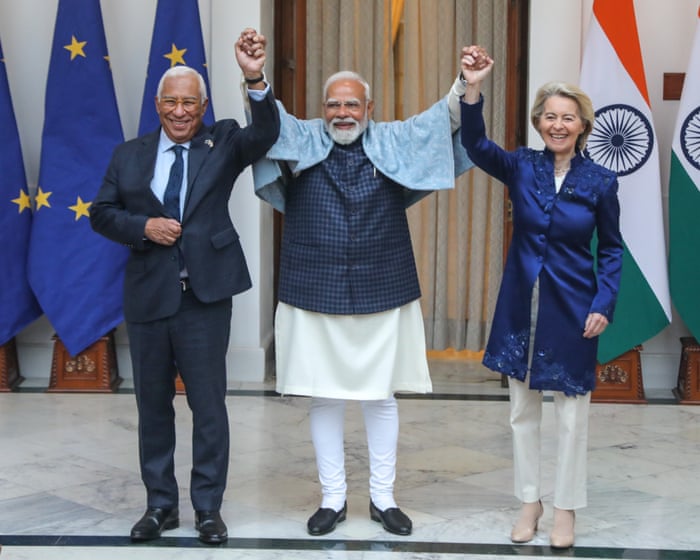
India and the European Union have finalized a landmark free trade agreement, which European Commission President Ursula von der Leyen called the “mother of all deals.”
The agreement follows nearly two decades of intermittent negotiations between India and the EU, which sped up dramatically over the past six months and were completed late Monday night.
The deal is set to open India’s vast and traditionally protected market to the 27 EU nations, focusing on manufacturing and services. It will improve market access for key European products like cars and wine, in exchange for easier exports of Indian textiles, gems, and pharmaceuticals.
The EU stated that the agreement is expected to double its exports to India by 2032 by eliminating or reducing tariffs on 96.6% of traded goods by value, saving European companies €4 billion (£3.5 billion) in duties. Tariffs will drop to zero for a wide range of industrial products, including nearly all iron and steel, plastics, chemicals, machinery, and pharmaceuticals.
“Europe and India are making history today,” von der Leyen said after arriving in Delhi, where she met Indian Prime Minister Narendra Modi on Tuesday. “We have concluded the mother of all deals. We have created a free trade zone of 2 billion people, with both sides set to benefit.”
Von der Leyen had earlier predicted that exports to India would double after the deal, giving the EU unprecedented access to India’s previously heavily protected market.
The agreement must still be ratified by EU member states, the European Parliament, and the Indian cabinet before it takes effect.
The trade deal is one of several agreements announced at a summit on Tuesday, as the EU and India navigate challenges like Donald Trump’s tariffs, China’s economic influence, and Russia’s invasion of Ukraine. The two sides are also set to sign a security pact to deepen cooperation on maritime security, hybrid threats, and counter-terrorism.
The EU has described the security agreement as a way to “advance alignment” amid concerns over India’s ties with Russia.
Additionally, the two sides reached a labor mobility agreement to create opportunities for young professionals and seasonal workers, while committing to start talks on including India in the EU’s Horizon research program.
India, the world’s most populous country with 1.4 billion people, is also one of the fastest-growing economies and is on track to become the fourth-largest economy this year, according to the International Monetary Fund.
Modi called Tuesday’s deal the “biggest free trade deal in history.” “This agreement has brought massive opportunities for 1.4 billion Indians and millions of people in European countries,” he said. “It has become a wonderful example of synergy between two of the world’s major economies.”
According to an EU statement, the deal will lead India to cut tariffs on cars to 10% over five years, down from as high as 110%, benefiting European automakers like Volkswagen, Renault, Mercedes-Benz, and BMW. Up to 250,000 European-made vehicles will eventually be able to enter India at preferential duty rates, far exceeding the 37,000 limit agreed with the UK in a separate deal last year.
India has also agreed to gradually reduce tariffs on European wines and spirits to 20% to 40%, down from the current 150%. Duties on olive oil and processed foods like pasta and chocolate will be eliminated.
In a concession to European farming interests, the EU will maintain tariffs on beef, chicken, sugar, flour, garlic, and ethanol—a move that may help the deal gain approval in the European Parliament, which is sensitive to agricultural concerns.Trade talks between the two countries began as early as 2007 but were suspended due to disagreements over market access for cars, agriculture, and dairy products.
However, negotiations resumed in 2022 and gained significant momentum over the past six months. This acceleration was driven by the heavy punitive tariffs imposed by the Trump administration in the U.S., as well as shared concerns over China’s dominance in global manufacturing and its restrictions on key exports.
India faces 50% tariffs on its exports to the U.S., while six EU nations were threatened with higher tariffs for opposing Trump’s attempts to acquire Greenland.
Officials state that the formal signing of the deal is expected later this year, with implementation possible by early next year.
EU officials note a turning point occurred when European Commission President Ursula von der Leyen and her team of 27 commissioners visited New Delhi last February to strengthen ties with India, committing to finalize the trade agreement by year’s end.
As part of its strategy to diversify trading partners, the EU has recently concluded trade deals with South America’s Mercosur bloc, Indonesia, and Switzerland. India, meanwhile, has signed agreements with the UK and Oman.
One key factor in overcoming past negotiation hurdles was separating the issue of worker mobility into a separate track. For instance, the UK, while still an EU member, had opposed India’s demands for easier access for skilled professionals on six-month visas.
The deal was promptly welcomed by centrist and center-right forces in the European Parliament. Angelika Niebler, a German Christian Democrat MEP who chairs the European Parliament’s delegation for India, said, “The EU is serious about cultivating new trading partners, and among the world’s relatively untapped markets, India stands out as one of the most promising.”
Frequently Asked Questions
FAQs EUIndia Free Trade Agreement
Basics Definition
Q What is this Mother of all Deals Im hearing about
A Its a nickname for a major free trade agreement recently signed between the European Union and India Its called that because of its huge scaleit connects two massive markets with over 18 billion people combined
Q What is a free trade agreement in simple terms
A An FTA is a deal between countries to make trading easier and cheaper They typically reduce or eliminate taxes on imports remove limits on how much can be traded and set common rules to make doing business smoother
Q Who exactly signed this agreement
A The agreement was signed between the European Union and the Government of India
Benefits Opportunities
Q How will this agreement benefit regular people
A Consumers should see more choices and potentially lower prices on a range of goods from European wines and cheeses to premium cars Indian products like textiles fruits and handicrafts could also become cheaper in Europe
Q What are the biggest benefits for businesses
A Businesses gain through tariff elimination easier regulations and better access to a huge new customer base Indian IT pharmaceutical and services companies get improved access to Europe while European machinery chemical and luxury goods makers get better access to India
Q Will this create jobs
A Yes potentially Increased trade and investment typically stimulate economic growth which can lead to job creation in exportoriented industries manufacturing and services in both regions
Concerns Challenges
Q What are the main criticisms or concerns about the deal
A Key concerns include
Farmers Dairy Indian farmers worry about competing with heavily subsidized European agricultural imports
Data Digital Rules Differences in data privacy laws are a sticking point
Intellectual Property Stricter EU IP rules could affect Indias generic pharmaceuticals industry