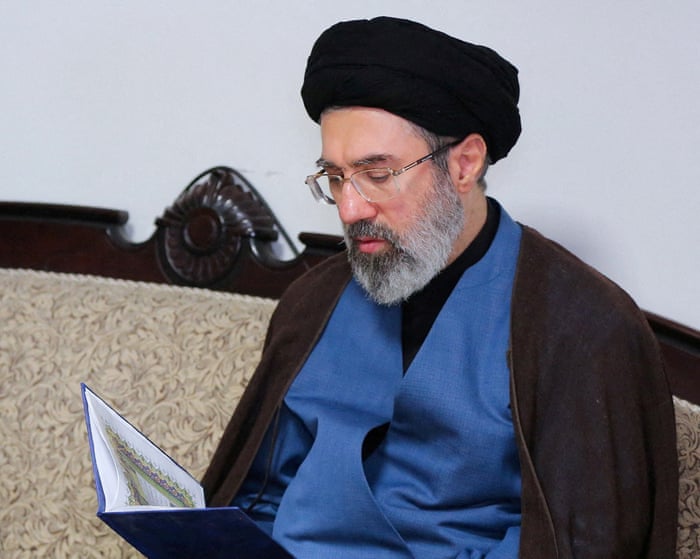
Mojtaba Khamenei, the second son of the late Ali Khamenei, is widely expected to succeed his father as Iran’s supreme leader. This would place a hardliner at the helm during the country’s most turbulent period in 48 years, signaling clearly that Iran does not intend to change direction.
While there is no official confirmation yet—and an announcement may wait until after Ali Khamenei’s postponed funeral—Mojtaba is believed to be the preferred candidate of the Islamic Revolutionary Guard Corps (IRGC). Israeli Defense Minister Gideon Saar has even warned that he could be assassinated.
Ayatollah Seyed Khatani, a member of the Assembly of Experts which selects the supreme leader, said the body is nearing a decision. Mojtaba Khamenei, known for his rigid anti-Western views, is not the candidate the U.S. would have chosen. U.S. Secretary of State Marco Rubio recently described Iran’s rulers as “religious fanatic lunatics,” an opinion unlikely to change with Khamenei’s appointment.
The supreme leader is chosen by the 88-member Assembly of Experts from a shortlist of six candidates. Mojtaba’s selection would strongly indicate that Iran is not seeking reconciliation with America—a scenario Donald Trump has called the “worst-case.”
Speculation about Mojtaba succeeding his father has circulated for over a decade and intensified after President Ebrahim Raisi, a Khamenei favorite, died in a helicopter crash.
Born in 1969, Mojtaba studied theology after high school and served in the Iran-Iraq war at 17. He gained public prominence in the late 1990s. Following the heavy defeat of his father’s preferred candidate in the 1997 presidential election, conservative groups sought to reorganize, with Mojtaba playing a central role.
He was also seen as key in suppressing the 2009 election protests, with his name cited by demonstrators as partly responsible. Reformist figure Mostafa Tajzadeh, imprisoned after the vote, claimed that his legal case was directly supervised by Mojtaba.
In 2022, he was granted the title of ayatollah, essential for his rise. By then, he was a constant presence at his father’s side and wielded influence at the state broadcaster, which many Iranians avoid in favor of foreign channels. He has also managed his father’s considerable financial empire.
His closest allies include newly appointed IRGC commander Ahmad Vahidi, former IRGC intelligence chief Hossein Taeb, and parliament speaker Mohammad Bagher Ghalibaf.
His rumored appointment, with its hereditary overtones, has long been opposed by reformists. Former Prime Minister Mir Hossein Mousavi noted in 2022 that rumors of Mojtaba’s succession had persisted for 13 years, questioning why authorities never firmly denied them.In response, the Assembly of Experts dismissed the doubts as “meaningless” and stated it would choose only “the most qualified and suitable” candidate. Meanwhile, on Tuesday, Israel struck a building in the Iranian city of Qom, a major center of Shia Islam, where the assembly was scheduled to meet. According to media affiliated with Iran’s Revolutionary Guard Corps, the building was empty at the time.
Frequently Asked Questions
Of course Here is a list of FAQs about Mojtaba Khamenei and the topic of succession in Iran designed to be clear and accessible
BeginnerLevel Questions
1 Who is Mojtaba Khamenei
Mojtaba Khamenei is the second son of Irans former Supreme Leader Ayatollah Ali Khamenei He is a midranking cleric known to be influential within certain hardline political and security circles in Iran
2 What is the Supreme Leader of Iran
The Supreme Leader is the highestranking political and religious authority in Iran The position established after the 1979 Islamic Revolution holds ultimate power over the military judiciary state media and key appointments It is a lifelong position
3 Is Mojtaba Khamenei officially the next Supreme Leader
No There is no official successor or heir apparent The next Supreme Leader will be chosen by the Assembly of Experts an elected body of senior clerics after the current Leaders passing
4 Why is his name mentioned for succession
His name comes up due to persistent rumors and analyses suggesting that powerful conservative factions within the regime see him as a continuity candidate who would uphold his fathers ideological legacy and maintain the current power structure
5 Does being the son of the Leader give him an advantage
Not officially as the system is not a formal monarchy However informally his family name his reported networks within the powerful Islamic Revolutionary Guard Corps and his understanding of the system are seen as significant political assets by his supporters
Advanced Practical Questions
6 What are the main arguments for Mojtaba as a candidate
Proponents argue he would ensure stability prevent internal power struggles and faithfully continue the ideological path of his father and the revolutions founder Ayatollah Khomeini He is seen as someone who understands the levers of power
7 What are the main arguments against him
Critics including some traditional clerics argue that selecting a leaders son would make the Islamic Republic look like a monarchy undermining its religious legitimacy Others question if he has the necessary high religious scholarly rank and public stature to unite the nation
8 Who are his main competitors
Other potential candidates are typically highranking