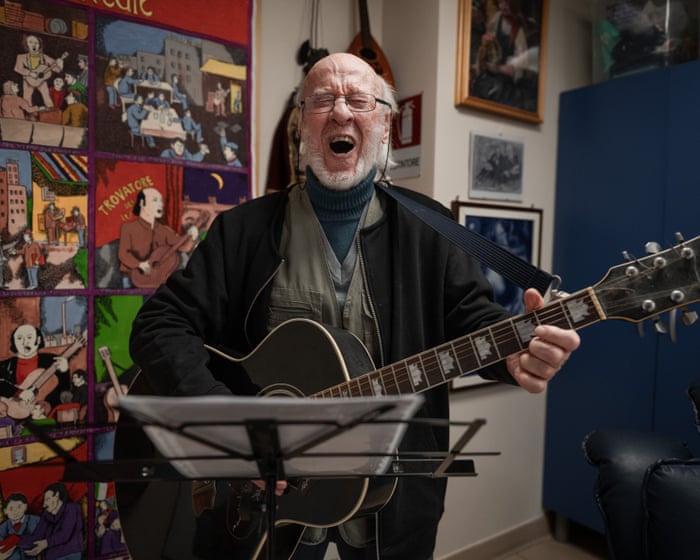
As a young barber’s apprentice, Franco Trincale would sing Sicilian songs during breaks, accompanied by his boss on guitar. He never imagined he would grow up to become Italy’s last great cantastorie—a fading tradition of wandering musicians who recount the news through song. Nor could he have predicted he’d still be performing at 90 years old, in a nursing home.
For sixty years, Trincale walked the streets of Milan, singing about pivotal moments in history—from the terrorism of the 1970s to Berlusconi’s election and the Iraq war. He has released over 30 albums and performed everywhere from the USSR to the United States. He also played a significant role in Italy’s labor rights movement, providing an anthem for workers’ protests.
Born in 1939 in Militello in Val di Catania, Sicily, he has lived in Milan for the past 70 years. We meet at Il Parco delle Cave, an assisted living facility in a simple red-brick building that has been his home for two years. Trincale has organized a Valentine’s Day concert, and the main hall is filled with 150 elderly residents and their relatives. He entertains them with a recently written song, “Long Live Love.” Though his voice strains on the high notes, the audience joins in to help. After learning the chorus, they sing and clap along. His wife Lina, who has Alzheimer’s and communicates only with her eyes, watches from the front row.
Decades ago, when many Italians couldn’t read, the arrival of a cantastorie in town was a major event. With the rise of television, their role shifted to that of wandering musicians who dramatized or satirized the news, accompanied by a guitar or accordion and large illustrated posters. Like other traveling musicians across Europe, cantastorie descend from medieval troubadours, but they are unique in singing only about true stories.
Traditionally, cantastorie supported themselves through public donations and by selling flyers with their song lyrics—and later, records. Between the 1920s and 1970s, famous performers like Ciccio Busacca, Otello Profazio, Rosa Balistreri, and Marino Piazza sang vivid tales of revenge, murder, migration, the mafia, and occasionally international news. For instance, Marino Piazza sang about the 1972 meeting between Nixon and Mao with the line: “Nixon and Mao to all wars say ciao.”
“Cantastorie followed current events,” says Mauro Geraci, an anthropologist at the University of Messina. He notes it’s no coincidence they emerged in the early 20th century, as public opinion was taking shape. It was a form of social commentary: “Salvatore Di Stefano, a Sicilian cantastorie, used to say that when he saw something wrong, it was time to write a song.”
Trincale became a cantastorie out of necessity: “I had just married Lina and left the navy after three years of service. I tried selling vegetables, but it didn’t work out, so I told myself, ‘I’ll be a cantastorie.'” He moved to Milan in 1959, starting out by performing traditional Neapolitan songs on the city’s main streets before playing outside factories that were employing thousands of southern migrants. It was there that he developed his signature style of “journalism in songs.”Traditional cantatas are hours long, but factory workers only had short breaks, so Trincale developed cantatas that lasted just a few minutes. Labor conditions became a theme: “The workers asked me why I didn’t write about their problems, like contract renewals. They gave me suggestions, and I put them into song.”
“Trincale’s ballads can capture and denounce a problem in just a few minutes,” says Geraci. Workers and immigrants saw him as their voice, writing him letters about their hardships.
Trincale also took an interest in true crime. One of his most famous works is about the 1969 kidnapping and murder of a 12-year-old boy, Ermanno Lavorini. It anticipated true crime podcasts: six separate recordings followed the investigation in real time, as Trincale sang about the frantic search for the child, the clues, and urged the kidnappers to come forward. He even did original reporting: “When Trincale sang about a seven-month-old baby killed by police tear gas during the eviction of an occupied house, he spoke to the mother. How is that different from journalism?” asks Geraci.
Later, Trincale began performing regularly in a corner of Piazza Duomo, singing about Tangentopoli—the early ’90s corruption scandal that swept away Italy’s political class—as well as Diego Maradona, the 2001 G8 summit in Genoa, and the advent of mobile phones. In 2002, the late Prime Minister Silvio Berlusconi asked to move a corruption trial away from Milan, arguing that Trincale’s performances mocking him were creating a biased environment.
In 2008, Milan awarded Trincale a medal. The government gave him a lifetime pension for his artistic achievements, and in 2018, a museum dedicated to him opened in his birthplace.
Today, Trincale’s life revolves around his wife. It was because of her condition that he decided to move to a retirement home so they could be together: “Lina and I have known each other since she was 13 and I was 17, and I am happy to spend the last part of my life with her. I visit her as often as possible. I sing songs to her when she opens her eyes and smiles at me. It’s as if I were recharging my batteries.”
Being in a nursing home hasn’t stopped him from performing: he now sings for the other residents and recently performed a concert in a nearby public library.
Trincale has filled his room with mementos: posters, awards, newspaper clippings, and even statuettes depicting him. He has a YouTube channel and proudly shows off a video with 400,000 views: “I am proud to be able to sing, and I will do so for as long as I can. I am happy to still be able to stir emotions, also because I have received so much from others.”
The nursing home staff are supportive: “It’s wonderful to see a resident who is still able to give a concert in the afternoon,” says manager Laura Sartori.
The San Valentino concert was a success, but the one he held for his 90th birthday in September was even bigger: “The hall was full—there was no room for anyone else,” recalls Trincale. He would like to hold a small music workshop for people with Alzheimer’s, such as his wife, but adds: “I should observe them first to see if they respond to the songs. I hope it’s possible.”
Before leaving, Trincale approaches his wife and sings her a song. Not one of his own—the love of his life is granted a rendition of “Era de Maggio,” a Neapolitan classic by Roberto Murolo. Hearing the familiar tune, she opens her eyes and smiles.
Frequently Asked Questions
FAQs Italys Last Cantastorie Still Singing the News at 90
Beginner Definition Questions
1 What is a cantastorie
A cantastorie is a traditional Italian street performer who tells stories often current news or historical tales through song They typically use a painted canvas scroll as a visual aid and accompany themselves with a guitar or accordion
2 Who is the last cantastorie mentioned
The article features Otello Profazio a legendary performer from Calabria Italy He is celebrated as one of the last true practitioners of this centuriesold folk tradition and continues to perform in his nineties
3 What does he sing about
Profazio sings about a wide range of topics current events social justice Italian history local folklore and political satire He transforms news stories and cultural narratives into rhyming melodic ballads
Benefits Cultural Importance
4 Why is this tradition important
The cantastorie tradition was a vital form of mass communication and social commentary especially before widespread literacy and modern media It preserved local history critiqued power and fostered community identity through shared storytelling
5 What can we learn from Profazios work today
His work reminds us of the power of art to document history question authority and connect people It shows an alternative deeply human way to engage with newsthrough emotion music and live performance rather than just screens
Common Problems Challenges
6 Why is he called the last cantastorie
The tradition has nearly vanished due to the rise of television the internet and changing social habits While some musicians draw inspiration from it few maintain the specific streetperformance style with narrative scrolls focused on current news
7 What are the biggest threats to this tradition
The main threats are modernization the decline of public square culture and a lack of new young performers taking up the specific role of a newssinging street minstrel It risks becoming a historical artifact rather than a living practice
Examples Practical Details
8 Can you give an example of a topic hes sung about
Yes he has created ballads about major events like the assassination of President John F Kennedy the struggles