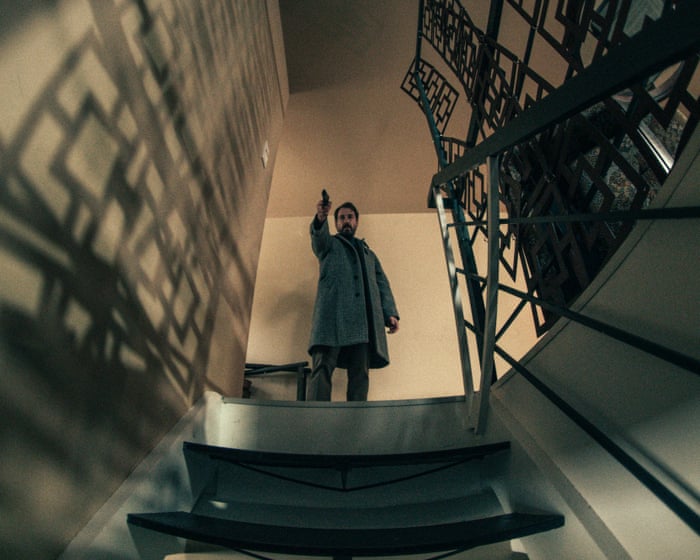
In the new Netflix series Unfamiliar, two spies working for Germany’s foreign intelligence agency attempt to assess the intentions of a Russian agent who has recently arrived in Berlin. They devise a creative solution: hacking into his taxi’s dashcam and capturing footage of the spy shaking hands with a well-known hitman.
The six-part show revels in such blatant disregard for bureaucracy—the kind of bold, rule-breaking action that Germany’s notoriously by-the-book Federal Intelligence Service (BND) can only dream of in real life.
Unfamiliar seems to have resonated with audiences. With over 20 million global views since its release in February, the series has become one of the most-watched non-English shows on the U.S. streaming platform over the past month.
The title refers to a married couple, Meret and Simon Schäfer (played by Susanne Wolff and Felix Kramer), former BND agents who now run a secret safe house in Berlin under new identities. However, the arrival of a GRU agent, Josef Koleev (Samuel Finzi), brings to light secrets—both state and marital—that the couple believed were buried.
One key way the show differs from others in the genre is its portrayal of the Schäfers’ employer, which is depicted as somewhat hapless, prone to gaffes, and constrained by parliamentary oversight, especially when compared to its more glamorous counterparts in the U.S., Britain, or France.
As the first series to be filmed partly on location at the BND’s Berlin headquarters, Unfamiliar shows analysts freely using facial recognition software to track down enemies and missing agents—a method that would clash with Germany’s strict data protection laws in reality.
Meanwhile, the Schäfers are well-versed in the darker arts of spycraft, hacking into hospital databases, breaking into a sheikh’s palace in Morocco, and using a hammer to extract information from a captive source.
The show’s portrayal of a less cautious BND comes at a time when there are real-world calls to relax postwar restrictions on the intelligence agency, amid concerns over Russian hybrid warfare and a strained alliance with the U.S.
Friedrich Merz’s government has increased the agency’s budget by about 26% to €1.51 billion (£1.3 billion) this year. Changes to the law regulating the BND’s activities are also expected to be presented to parliament in the autumn, where they will require a two-thirds majority to pass.
Drafts of the legislation leaked to the German press suggest the BND could be granted powers to actively retaliate against cyberattacks, fend off suspicious drones by “appropriate means,” use facial recognition software, and retain collected data for longer periods.
Under current law, the BND is allowed to infiltrate the IT systems of foreign powers preparing cyberattacks on German authorities but cannot sabotage them by deleting data, shutting down servers, or diverting data streams.
“As an intelligence agency, we have to be careful not to become too predictable, or else our enemies only need to study German law to know exactly what we’re doing,” said BND spokesperson Martin Heinemann.
The creators of Unfamiliar dismissed speculation that the series was conceived at the BND’s request, stating that the show’s concept was written two and a half years before they approached the agency for access. The BND confirmed it had provided advice but did not have veto power over the content.
The BND’s uniquely limited mandate stems from its origins. Founded in 1956 in West Germany, it grew out of…The BND traces its origins to a predecessor agency, the Gehlen Organisation, which was established by US occupying forces to monitor Soviet activity. Concerns about a resurgent Germany and the inclusion of former Nazis have led to lasting restrictions on the BND’s operations. Its role is limited to gathering intelligence through human sources, wiretaps, and satellite imagery analysis, which it then provides to the government.
“Due to our historical experience, there has been reluctance to grant too much power to a secret police force. Postwar Germany requires a strict separation between the police and intelligence agencies, which isn’t comparable to countries with different histories,” explained Bodo Hechelhammer, a longtime BND employee, former chief historian, and adjunct professor at the University of Southern Denmark.
More recently, the BND has faced accusations of self-inflicted incompetence. At the start of Russia’s invasion of Ukraine, its then-chief, Bruno Kahl, had to be evacuated from Kyiv, as the agency appeared caught off guard by the Kremlin’s plans. This week, reports emerged that a former vice-president, Arndt Freytag von Loringhoven, fell for a phishing attempt linked to Russian hackers on the Signal messaging service. To prevent domestic terror attacks, Germany has relied heavily on allied agencies like the CIA.
“As someone who wrote for spy shows in the UK, I had to learn that things are done differently in Germany,” said Paul Coates, the British scriptwriter for Unfamiliar, who has also written for Red Election, Casualty, Holby City, and EastEnders. “I was definitely told more than once that spies in Germany wouldn’t be allowed to do certain things—not just by the BND, but by my own producer,” he added.
Given the staid reputation of contemporary German spycraft, film and fiction often look further back in history for dramatic stories, focusing on the Nazi Gestapo or the East German Stasi, as seen in Robert Harris’s novel Fatherland or Florian Henckel von Donnersmarck’s 2006 film The Lives of Others. A 1967 film meant to glorify the BND in the style of James Bond’s MI6—titled Mr. Dynamite in German and Spy Today, Die Tomorrow in English—was a critical and commercial failure. The German agency is notably absent from the original Bond film franchise.
Unfamiliar may help modernize the BND’s public image. Yet, to build suspense, the show still draws on the agency’s reputation for unreliability. The plot centers on a GRU agent, Josef Koleev, who has a mole within the BND feeding him information. “Our allies will go back to ignoring us and not sharing intelligence for years,” laments one senior officer in the series.
This storyline has a solid historical basis. KGB agent Heinz Felfe infiltrated the Gehlen Organisation and later the BND, remaining undetected for a decade, largely due to his Nazi past. In 2023, another high-ranking BND officer was charged with treason for passing state secrets to Russia.
“We are in a new era where Berlin is becoming a hub for spies again,” said Andreas Bareiss, producer of Unfamiliar. “It feels a bit like a new cold war.”
Frequently Asked Questions
Of course Here is a list of FAQs about the news that a hit Netflix series has Germanys spy agency hoping for a future with fewer embarrassing mistakes
General Beginner Questions
1 What is this news story about
A popular German Netflix series called Kleo has been praised by the reallife German Federal Intelligence Service They see it as a positive portrayal that could help improve their public image and attract new techsavvy recruits
2 Why is a spy agency commenting on a TV show
Intelligence agencies often struggle with public perception The BND has faced realworld scandals and mistakes in recent years They believe the shows cool competent portrayal of intelligence work can help modernize their brand and distance themselves from past failures
3 What is the BND
The BND is Germanys foreign intelligence agency Its like Germanys version of the CIA or MI6 responsible for gathering information outside of Germany
4 What is the Netflix series Kleo about
Kleo is a thriller about a Stasi assassin who is betrayed and imprisoned right before the Berlin Wall falls After her release in postreunification Berlin she seeks revenge uncovering a conspiracy that involves former East and West German officials
Advanced Contextual Questions
5 What embarrassing mistakes is the BND trying to move past
The BND has faced several highprofile issues including failing to predict major events like the Ukraine war in 2014 being implicated in the US NSA surveillance scandals and suffering from internal mismanagement and outdated technology These eroded public and political trust
6 How can a fictional show help a real intelligence agency
The BND hopes it aids in employer branding Kleo makes spy work look dynamic and morally complex which can attract a younger generation of talented candidates who might not have previously considered a career with the agency
7 Isnt it strange for a democratic agency to like a show about a Stasi agent
Its ironic The BND is focusing less on the protagonists Stasi past and more on the shows overall aesthetic of intelligence work