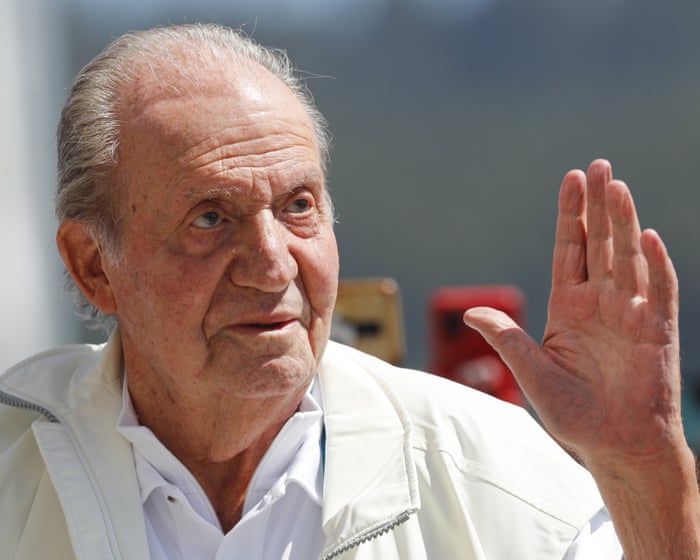
When Spain’s King Juan Carlos fell and broke his hip while on an elephant hunt with a former girlfriend in Botswana in 2012, he likely assumed Spaniards would dismiss it as a minor misstep after his lifetime of public service. After all, the monarch had survived numerous scandals over his 37-year reign, including extramarital affairs and investigations into his family’s finances. Money was never an issue in his life.
This time, however, Spaniards had reached their limit. It was the peak of the eurozone crisis, and there was widespread anger that Juan Carlos was on what was reported to be a free hunting trip while people suffered through poverty, mass unemployment, and the terror of a collapsing economy. Within two years, the king had abdicated, passing the crown to his son, Felipe VI.
This act of humility seemed, at least, to promise a quiet retirement for a man who—though handpicked by Francisco Franco as the right-wing dictator’s successor—was later credited with restoring and safeguarding Spanish democracy after a failed coup in 1981.
But the scandals kept piling up. In June 2018, his son-in-law Iñaki Urdangarín began serving a sentence of five years and ten months in Ávila for embezzlement, fraud, abuse of power, influence peddling, and tax evasion. Two years later, in August 2020, Juan Carlos went into self-imposed exile in Abu Dhabi amid a scandal over a $100 million payment into his secret Swiss bank accounts from Saudi Arabia’s royal family.
Newspapers alleged the money—which Juan Carlos called a “gift” from the Saudi king—was for helping secure a contract between Saudi and Spanish companies to build a $6.7 billion high-speed railway from Medina to Mecca. Swiss authorities later dropped an investigation due to lack of evidence. The married king gave a portion of the money to the same former lover from the Botswana elephant hunt—the glamorous German businesswoman Corinna zu Sayn-Wittgenstein-Sayn. The money was never returned, with zu Sayn-Wittgenstein-Sayn stating it was a personal gift.
From his Gulf hideaway, Juan Carlos admitted failing to declare millions of euros in income to Spanish tax authorities. He eventually paid over €5 million in back taxes and fines, just in time for authorities to clear him. The former king could not be prosecuted for anything done while on the throne, as Spanish monarchs enjoy legal immunity.
With Abu Dhabi now feeling like a gilded cage, the former monarch wants to return home and is determined to restore his reputation. Late last year, he published a memoir, Reconciliation, widely criticized as self-congratulatory, unrevealing, and self-justifying. Yet, three months later, it remains among Spain’s 100 bestselling books, suggesting significant affection remains for the now 88-year-old former king.
Last month, with support from conservative politicians, Juan Carlos began intensifying his campaign to return to Spain, convinced he will be welcomed as a hero—or so some Spanish media report.
The Sánchez government’s decision to declassify a batch of previously hidden documents about a crucial episode from Juan Carlos’s reign may have fueled this delusion. The files shed light on the 1981 coup attempt that nearly crushed Spain’s young democracy in its cradle.
The coup spawned numerous conspiracy theories, including that Juan Carlos himself was in cahoots with the armed men who stormed parliament and took 350 deputies hostage for 18 hours on February 23, 1981. After all, when Civil Guard officer Lt. Col. Antonio Tejero, wearing a shiny patent leather tricorn hat,He led 200 soldiers and civil guards into parliament, convinced that he had King Juan Carlos’s support. As terrified deputies crouched on the floor, Tejero’s men fired shots into the ceiling. Their goal was to turn back time to the Franco era by installing a military-led government.
The plotters believed democracy was ruining Spain. Basque separatism was growing, leftist terrorists roamed the streets, and communists sat in parliament. In fact, communist leader Santiago Carrillo was taken at gunpoint to a separate room along with other opposition leaders, including future socialist prime minister Felipe González. “Many of us wondered whether they would ever be seen again,” recalled former socialist deputy Juan de Dios Heredia earlier this month.
As now revealed in the released files, some rebels—like those who stormed the state broadcaster RTVE—had orders to shoot to kill if opposed. Miraculously, no one died. Tejero, the ringleader, remained unrepentant until the end, dying at 93 on the very day the coup documents were made public.
The 167 released files are deeply disappointing. While they clear Juan Carlos, they represent only a fraction of what was once a much larger archive. Generations of politicians and spies have stripped Spanish history, allowing crucial firsthand sources to be either destroyed or hidden.
Five years ago, El País published a batch of court documents not included in this release. Veteran investigative journalist Antonio Rubio published military documents two decades ago about the coup in Valencia, where tanks rolled through the streets. Those are also missing.
“What the government needs to do now is launch an investigation into who took away documents and who destroyed them,” Rubio told me, adding that this includes tapes of phone conversations through the parliamentary switchboard before and during the coup.
Rubio has copies of documents absent from the official release. One involves a double agent, Catalina Abad, who worked for both the Soviet Union and Spain’s military intelligence. In it, she relays a report that Prime Minister Adolfo Suárez—who had by then fallen out with Juan Carlos—was threatened by two generals. According to Abad, alias Katia, the king left Suárez alone with the officers, who placed their pistols on the table as a threat. Days later, the prime minister resigned. The coup attempt took place as deputies were preparing to vote in his successor, Leopoldo Calvo-Sotelo.
The Abad evidence is hearsay—based on a report by a well-connected lawyer—and may be inaccurate. The king may not have known about the alleged threats and has not commented on the document. But where has that file gone? And where are the rest? A likely explanation is that much of this material was destroyed long ago by the country’s intelligence agencies or their political overseers.
This historical vandalism was carried out under the protection of one of Europe’s strictest state secrecy laws, written by Franco in 1968, which sets no deadline for declassifying state documents. As a result, those who hid or destroyed records may never be identified or held to account.
Efforts to reform that law in the current parliament have been blocked. Right-wing parties, including Catalan nationalists, are obstructing the change, according to El País, raising questions about whether they have something to hide. Historians still seek answers, for example, about the coup’s civilian backers and its funding.
The coup ended after Juan Carlos personally ordered military units not to follow the rebels.Then the insurrectionists, and dressed in his commander-in-chief’s uniform, he made a historic televised address to the nation. This cemented his reputation as the savior of democracy.
Javier Cercas, author of the definitive account of the coup, Anatomy of a Moment, believes the new documents resolve the debate over the former king’s role. “Juan Carlos did not mount the coup. He stopped it,” he wrote in El País.
For his part, Juan Carlos has indicated that, to use a bullfighting metaphor, he intends to make a triumphant return—to re-enter through the “puerta grande,” the main gate reserved for victorious matadors—by coming back to live in the royal palace at La Zarzuela in Madrid.
In reality, the greatest stain on Juan Carlos’s legacy is his lack of humility. Officials close to his son say that if the former king wishes to return, he must expect to pay taxes like everyone else, including on gifts. He no longer receives a royal stipend, so the source of his income remains unclear.
It is likely that he truly did save democracy and deserves honor for that, and for guiding Spain out of dictatorship. But an honest reckoning requires access to all files related to his reign, as well as transparency about the origins of his wealth. For that, Spain urgently needs a new official secrets act.
Giles Tremlett is the author of El Generalísimo and Ghosts of Spain.
Do you have an opinion on the issues raised in this article? If you would like to submit a response of up to 300 words by email to be considered for publication in our letters section, please click here.
This article was amended on 19 March 2026. A previous version referred to Corinna zu Sayn-Wittgenstein-Sayn as “Corinna Larsen,” her former name. The text was updated to clarify her position regarding funds transferred to her by Juan Carlos and to note that she was not in a romantic relationship with him at the time of his hip injury in Botswana. Additionally, a hunting photo of the couple in Botswana was taken some years before 2012, not in that year as originally stated.
Frequently Asked Questions
FAQs Juan Carloss Potential Return from Exile
BeginnerLevel Questions
1 Who is Juan Carlos and why is he a disgraced former king
Juan Carlos I was the King of Spain from 1975 until his abdication in 2014 He is widely credited with helping guide Spains transition to democracy after the Franco dictatorship However he is now considered disgraced due to multiple financial scandals and investigations into alleged corruption which led him to leave Spain and live in selfimposed exile in 2020
2 Why did he go into exile
He left Spain to protect the Spanish monarchy from further damage due to ongoing investigations into his finances These included probes into alleged undeclared funds secret offshore accounts and receiving questionable commissions particularly from business deals in Saudi Arabia
3 What does he hope to achieve by returning
Reports suggest he hopes to return to Spain and rehabilitate his public image potentially to be seen as an elder statesman or historical figure rather than a symbol of scandal He may wish to live out his final years in his home country without the legal threat of prosecution
Advanced Contextual Questions
4 Why is Spains past described as complicated and how does it haunt him
Spains complicated past refers primarily to the legacy of the Franco dictatorship a brutal civil war and the subsequent transition to democracy Juan Carloss role is dual he was appointed by Franco but then facilitated democracy This history haunts him because his current scandals clash with his former heroic narrative forcing a reexamination of whether corruption was embedded in the transitions political and economic structures
5 What are the main legal and financial scandals surrounding him
The key issues include
Saudi Arabia Commissions An investigation into an alleged 100 million commission he received from a highspeed rail contract in Saudi Arabia
Secret Offshore Accounts The discovery of undeclared funds in offshore tax havens facilitated by a distant relative
Credit Card Use The use of credit cards linked to accounts not in his name for personal expenses raising questions about the source of the funds
6 Could he face legal consequences if he returns
As of now its unlikely Spains Supreme Court dropped its formal investigations in 2022