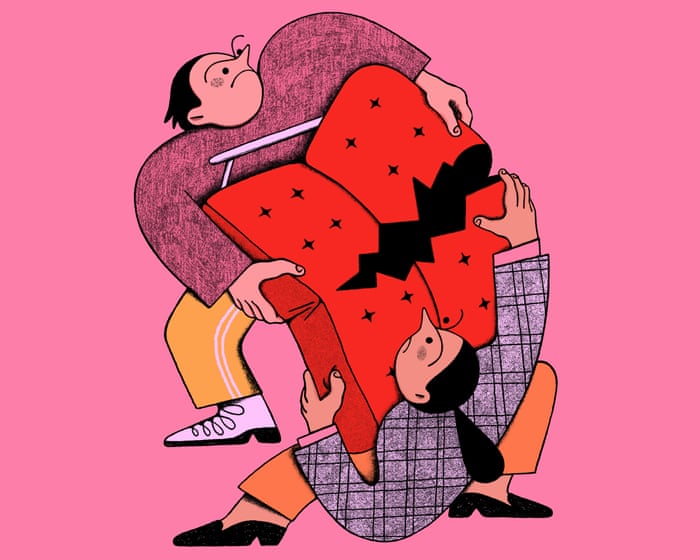
When most couples first move in together, wandering arm-in-arm through IKEA, they’re too excited about their new sofa, Billy bookcase, or the giant houseplant they’re about to wrestle into an Uber to think about what might happen to those things if the relationship goes wrong. But these days, many young couples can’t afford to buy a home or have kids, so furniture can end up being the only thing worth fighting over when a relationship ends. And with the rising cost of living, having to replace furniture after a breakup can really hit people’s finances hard.
“It took me a couple of years to recover financially,” says Becca, talking about her 2022 breakup. The 35-year-old, who lives in Leeds, had been in a relationship for about a year when her then-girlfriend asked her to move into her house. At the time, Becca was renting her own flat, which she describes as “amazing: big garden, really bright and lovely.” But being what she calls “young, stupid and in love,” she left that behind to move in with her partner. Becca reluctantly agreed to get rid of all the furniture she had bought for her flat, since her girlfriend didn’t want any of it in her place.
“I said: ‘OK, I’m going to put some stuff in storage because I think that’s a big risk, or maybe we can think about putting some things in the attic.'” But her partner got angry, saying that meant she wasn’t committed to the relationship and was already “thinking of an exit plan.” The argument turned into a big fight, and Becca eventually gave in to her girlfriend’s point of view. She sold some of her furniture, and what she couldn’t sell she left behind in the flat, with her landlord’s agreement.
After moving into her girlfriend’s place, she paid half the cost of furnishing the second bedroom, which they turned into an office for Becca. But when the couple broke up six months later, and Becca moved in with her family, “it didn’t even cross my mind” to take any of that furniture or ask for the money she had spent on it back.
It was only a year later, when she moved out of her family’s home to rent her own place again, that she realized how much she had spent on furniture. “But I also didn’t want to get back in touch,” she says; she had moved on.
Becca thinks she lost about £3,000 in total, counting the money she spent on furniture for her old place that she couldn’t sell. She managed to get by – “I’m in a lucky position that I earn enough” – and eventually made back the money she lost. But it did mean that when she moved into her current flat, she was more careful with her spending: “Half the stuff is secondhand.” Looking back, she especially regrets getting rid of a cabinet with glass doors that her mother had given her as a graduation gift. She sold it for about a third of its original price when she moved in with her ex. “It’s replaceable – I can go and buy it again – but it’s really expensive,” she says. “I’m really sad about it because I’d always wanted it.”
“Furniture is rarely just about the object itself,” says Kalanit Ben-Ari, a couples and family therapist who runs a private clinic in London. “People often project other feelings onto furniture. It can reflect power dynamics, resistance to letting go of the relationship or partner, resentment, or in some sad cases, revenge.” When advising clients at the end of a relationship, she tells them: “If something costs you your peace of mind, it is too expensive. Let go, and put your energy into moving forward.”
That might be true, but “letting go” is easier for some than others: a poll of 3,000 people last year found that one in five people in the UK aged 18-40 have delayed a breakup to make the cost of living more affordable.
Four years on, Becca wishes she hadn’t given up her stuff so easily. Looking back, it was “a bit of a red flag that I wasn’t allowed” to keep her things.She didn’t need to bring any of her own furniture. But keeping her things wouldn’t have been simple either. Renting a storage unit big enough for everything from her old flat would have cost her about £100 a month.
A lack of storage has also been a problem for Emily, 30, who lives in London. Three years ago, she and her boyfriend of one year broke up “reasonably mutually.” When they moved in together, she had brought most of the furniture from her old place. Her partner had lived in furnished accommodation before and didn’t have his own furniture. “I think the only thing we bought together was a set of dining chairs,” she says.
Because of their tenancy agreement, the couple had to live together for two months after the breakup, “which was really awful,” Emily says. When it was finally time to move out, her ex asked if he could take some of the furniture. This surprised her, since these were items she had owned before they got together. She refused most of his requests but let him take a rug that was “almost impractically big,” which her aunt had given her.
“I really associated it with the flat” and the relationship, she says. “It just made me feel really heavy and sad.” Its size was also a problem: “I wouldn’t have anywhere to put it or store it.” Emily agreed that her ex could take it, on the condition that if he no longer wanted it, he would return it to her.
“But then when my aunt came to see my new flat and the rug wasn’t there, she asked what had happened to it,” Emily says. “She was quite disappointed that I had given it up so easily to someone I had chosen not to be with.”
Now, Emily feels she needs to ask him to return the rug, a task she has been putting off. “We’ve seen each other a couple of times since we moved out, but I’m not really in touch with him much, so it would be a specific conversation to say: ‘Excuse me, can I have my rug back?’” But out of a sense of duty to her aunt, she now feels she probably should, sooner rather than later.
Matt, 45, also lost some furniture after a breakup two years ago. When his ex-girlfriend moved out of the flat they had shared for 10 years, they agreed she would only take items she had paid for herself. But she ended up taking the living room table as well. When he went to visit the cats they had once shared, he noticed she had also taken some vases that were technically his. But he decided it wasn’t worth fighting over those items. “The new chapter is so much more important,” he says. He took the stance: “You can keep that along with your bad karma.”
With nowhere to store large items and a desire to move on quickly from their shared home, Jade, 32, felt she had no choice but to take the financial loss on furniture she co-owned with her partner when they broke up last year—a decision that was mostly hers. She left the Bedfordshire house she had shared with her partner of five years, taking only a desk “because that was mine and only ever used by me.” She left everything else, including a fridge and washing machine that she had paid half for. She even left the bed and mattress she had bought before the relationship. “It felt a bit weird to say, ‘I’m leaving you and also taking the bed from underneath you,’” she says.
There had been some back and forth about random items in the house, she says, but “because I was the one leaving, I just didn’t want to bring all of that up.” But now that things have settled, she can’t help but wonder: “Why didn’t I just take that? Or why didn’t we actually talk about it?”
“If you’re not married, you just have to be prepared to take a bit of a hit.”Srdjanns74/Getty Images
She’s especially upset about losing a handmade candle holder shaped like a whale shark, which she and her partner had bought together. “We went back and forth on whether to buy it for a while,” she says. “When I was moving out, I thought, ‘Well, who gets the whale shark?’ But we never decided.” To avoid more conflict, she left it behind.
In total, she estimates she paid nearly £5,000 for all the furniture and appliances she left behind. “I think it’s really tough when you’re not legally married. We didn’t own our house. What we had and shared were the things inside it, and there’s no rulebook for being fair about that—you just have to be ready to take a loss.”
James Davies, a family lawyer and partner at Blake Morgan, says the law isn’t designed for unmarried couples. “The legal framework is seriously lacking and very hard to navigate,” he says. But he explains that when there’s no marriage or property involved and the dispute is just over furniture, it’s probably not worth getting lawyers involved. “Once you start paying lawyers to argue over these things, the cost can quickly outweigh the value of what you’re fighting about.” Instead, he recommends hiring a trained mediator, which he says is cheaper and less confrontational. “You’re both part of it, you can set the agenda, and you can come up with creative, unusual solutions that the law might not offer.”
It’s not very romantic, but a cohabitation agreement is incredibly valuable for preventing problems.
He would always advise couples to sign a cohabitation agreement—a legally binding document that outlines how assets and finances will be handled, both during the relationship and in case of a breakup—before moving in together. “It’s not very romantic,” he admits. “But it’s truly worth its weight in gold for avoiding future problems,” since “it can be enforced in court if needed.”
Cohabitation agreements aren’t just for couples. Zoe, 29, who lives in the UK but used to be based in Berlin, wishes she had signed a pre-rental agreement with her former housemate. They were friends and got along well during the tenancy, but when she decided to move out, things got tense.
When Zoe and her housemate moved in together, they split the cost of furniture. “We furnished the whole flat for about €200 each—this isn’t big money,” she says. They made a verbal agreement that if one moved out and the other stayed, the person staying would buy out the other’s share. But when Zoe decided to leave, her housemate said, “I think we should factor in a 4.5% annual depreciation rate.”
“We ended up sending Excel spreadsheets back and forth,” she says. Frustrated with the whole process, Zoe eventually gave in and let her ex-housemate set the price. After she moved out, they never spoke again.
Jade thinks she would want clearer agreements about who owns what if she ever moves in with someone again. Even though she admits it’s “weird to even bring it up when you’re moving in with someone,” she thinks it might be better to say, “I’ll buy this, you buy that, and if anything happens, we just take what we paid for.”
That said, in some ways Jade is glad to be free of the items she chose with her ex. Those pieces of furniture “feel like part of that chapter of my life. And I think it will be nice, even if it’s not cost-effective, to have the freedom to do things differently next time,” she says.
Names and some locations have been changed.
Do you have an opinion on the issues raised in this article? If you would like to submit a response of up to 300 words by email to be considered for publication in our letters section, please click here.
Frequently Asked Questions
Here is a list of FAQs about Who gets the sofa The furniture fights at the center of modern breakups
BeginnerLevel Questions
1 I just broke up Why is everyone fighting over the couch
The couch is usually the most expensive piece of furniture you bought together Its also the center of the living room so it has high sentimental and practical value People fight over it because it represents the home theyre losing
2 If my name isnt on the receipt do I automatically lose the couch
Not necessarily If you paid for it with your own money or if your partner gave it to you as a gift its likely yours But if you split the cost it gets trickier
3 What if we both paid for the sofa 5050
Then neither of you automatically owns it The most common solution is to sell the couch and split the money or for one person to buy out the others half
4 Does it matter who uses the couch more
No Use doesnt equal ownership Even if you bingewatch TV on it every night it doesnt legally belong to you unless you paid for it or it was a gift
5 Whats the easiest way to avoid a fight over furniture
Agree on a split plan before you move in together Write down who owns what or agree that everything bought together will be sold if you break up
IntermediateLevel Questions
6 What happens if we bought the couch on a joint credit card
Then you both technically own it The couch is marital property You cant just take it without paying your partner for their share or paying off the card
7 Does the gift rule apply to furniture
Yes If your partner bought the sofa for your birthday or as a housewarming gift its legally yours But if you both picked it out and split the cost its not a giftits a joint purchase
8 What if we live in a state with common law marriage rules
Most states dont recognize common law marriage In those that do furniture is treated like marital property and split fairly In other states its still