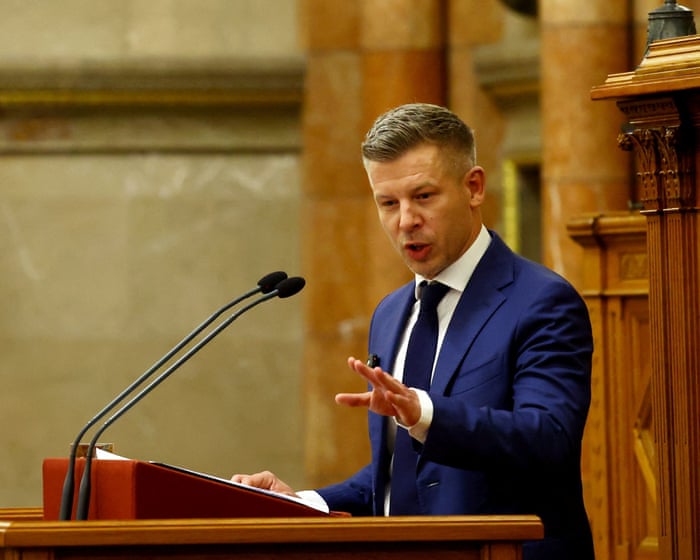
Hungary’s lawmakers have voted overwhelmingly to keep the country in the International Criminal Court (ICC), reversing a decision made by Viktor Orbán’s previous government.
The vote took place just days before Hungary was set to become the only EU member state not to recognize the court’s authority. The ICC prosecutes individuals accused of war crimes, genocide, and crimes against humanity.
In April last year, Orbán announced that Hungary would begin the process of leaving what he called a “political court.” He made these remarks while hosting Israeli Prime Minister Benjamin Netanyahu in Budapest. Netanyahu, a longtime ally of Orbán, is the subject of an ICC arrest warrant.
After Péter Magyar won a landslide victory in last month’s election and became prime minister, he repeatedly promised that his government would reverse the withdrawal before it took effect on June 2.
On Monday, Magyar’s government submitted a bill to parliament, fast-tracking the process. Out of 199 lawmakers, 133 voted in favor of the bill.
The legislation now needs to be signed into law by President Tamás Sulyok, an appointee from the Orbán era whom Magyar has repeatedly called on to resign.
Earlier this week, the ICC’s legislative body welcomed Hungary’s plan to reverse the withdrawal, calling it “essential” for ensuring accountability for the world’s most serious crimes.
This turnaround is a bright spot for the embattled institution. Since Donald Trump returned to power in the US last year, his administration has worked steadily to weaken the Hague-based court, imposing sanctions on 11 of its officials.
Several judges and the chief prosecutor have been dealing with the fallout, including canceled credit cards and disappearing Amazon and Google accounts. One judge described this as a “direct and flagrant attack” on one of the world’s most prominent courts.
For weeks, Magyar made it clear that his Tisza party would work to ensure that Hungary—a founding member of the ICC treaty—would not join countries like China, Israel, Russia, and the US that refuse to recognize the court’s jurisdiction.
Can Hungary’s Magyar deliver on his promises of reform and restore the country’s relationship with the EU?
Read more
This week’s legislation framed the decision as one aimed at maintaining global peace and protecting human rights. It stated: “It is essential that those who commit the most serious international crimes be held accountable before an international judicial forum.”
Reversing the ICC withdrawal would mean that Netanyahu would be arrested if he set foot in Hungary, Magyar told reporters last month. He indicated that the end of Orbán’s time in power meant Israel had lost one of its strongest allies in Europe.
“I believe that if the country is a member of the International Criminal Court, and a person who is wanted by the court enters our territory, then that person must be taken into custody,” Magyar said.
In 2024, the ICC issued an arrest warrant for Netanyahu over allegations of crimes against humanity and war crimes—including using starvation as a method of warfare—in Israel’s war against Hamas in Gaza. His office has rejected the court’s “false and absurd” accusations, describing them as fueled by antisemitism and the politically motivated actions of “a biased and discriminatory political body.”
In July last year, a panel of ICC judges determined that Hungary had failed to meet its legal obligation to arrest Netanyahu during his visit to Budapest. Noting that Hungary had been clearly informed of its duty to cooperate, the judges said the “failure to arrest suspects severely undermines the court’s ability to carry out its mandate.”
The judges also noted that before the visit, Hungary had not raised any concerns about the arrest warrants with the court. “Hungary did not engage wThe court before or during Mr. Netanyahu’s visit, they chose to withhold cooperation on their own, instead of working with the court.
Frequently Asked Questions
Here is a list of FAQs about Hungarys decision to remain in the International Criminal Court reversing Prime Minister Viktor Orbáns earlier stance
BeginnerLevel Questions
Q What is the International Criminal Court
A Its a permanent global court that prosecutes individuals for the worst international crimes genocide war crimes crimes against humanity and the crime of aggression It steps in when national courts cannot or will not act
Q Why did Hungarys lawmakers vote to stay in the ICC
A They reversed a previous decision by Prime Minister Viktor Orbán to leave the court The vote was largely symbolic confirming that Hungary would remain a member and uphold its treaty obligations
Q What was Prime Minister Orbáns original decision
A Orbán had announced that Hungary would start the process of withdrawing from the ICC This was seen as a protest against the ICCs arrest warrant for Israeli Prime Minister Benjamin Netanyahu a close ally of Orbán
Q Is Hungary leaving the ICC now
A No The parliamentary vote overturned Orbáns withdrawal order Hungary remains a full member of the ICC
Q Why did the parliament go against the Prime Minister
A The decision was made by lawmakers including some from Orbáns own party Many argued that leaving the ICC would damage Hungarys international reputation isolate it from EU allies and undermine global justice efforts
IntermediateLevel Questions
Q What triggered Orbáns initial threat to leave the ICC
A It was a direct reaction to the ICC issuing an arrest warrant for Israeli Prime Minister Benjamin Netanyahu in November 2024 over alleged war crimes in Gaza Orbán called the warrant outrageous and said he would invite Netanyahu to Hungary anyway
Q How does this vote affect Hungarys relationship with the EU
A It avoids a major diplomatic clash Most EU countries strongly support the ICC Had Hungary left it would have been the first EU member to do so likely triggering legal challenges and political isolation within the bloc
Q What happens if Israels Netanyahu visits Hungary now