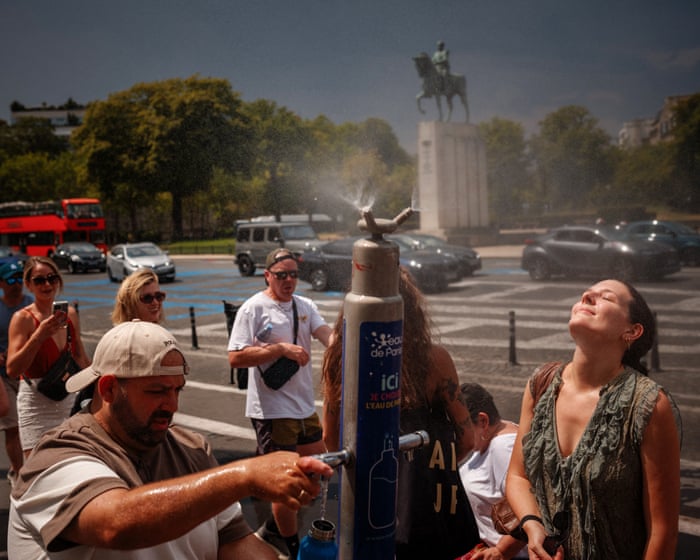
Spain and France are getting ready for another possible heatwave that could bring temperatures of 44C (111F) in the coming days. This comes as figures show that June’s extreme heat caused over 2,000 excess deaths in the two countries.
Spain’s state weather agency, Aemet, said a mass of dry, very hot air would bring consistently high temperatures to much of Spain starting Saturday. It added that parts of the southeast could hit 42C to 44C on Tuesday.
“Temperatures will start to rise over the weekend, and we can’t rule out another heatwave,” said Rubén del Campo, an Aemet spokesperson. The agency warned that the high temperatures could increase the risk of forest fires next week and advised older people and those with heart problems to be extra careful during the daytime heat.
Aemet said last month was the second hottest June on record—only beaten by June 2025—with an average temperature 3.2C (5.8F) above normal.
Scientists have said the heatwave, which was the most severe and widespread to hit western Europe, was only possible because of the climate crisis caused by burning fossil fuels.
Provisional figures from Spain and France show that about 1,000 people died in each country due to the extreme heat. According to data from Spain’s health ministry daily mortality monitoring system, MoMo, there were 1,029 excess deaths linked to high temperatures in June.
France’s public health agency said last Sunday that the 10-day late June heatwave, which experts described as the most extreme the country has ever experienced, caused about 1,000 additional deaths compared to previous months between June 24 and 28. A final number has not yet been released.
Nicolas Revel, head of hospitals in the Paris area, said this week he didn’t expect the excess death toll to match the 15,000 recorded in 2003, France’s worst previous heatwave, “because we’ve made a lot of progress in many areas.” But he said he expected the number of heat-related deaths to be higher than the 5,700 recorded last year.
The medical emergency service SOS-Médecins said it had seen an 85% increase in deaths among people over 75 during the last two weeks of June. A total of 513 elderly people died during the week of June 22, compared to 278 the week before.
Call-outs to that age group, mainly for high temperature and anxiety, rose by 14%. Hospitalizations of people over 75 increased by 19%. Across all age groups, call-outs for heatstroke and dehydration jumped by 480% and 315% respectively.
Marina Ferrari, the sports and youth minister, told French radio on Thursday that the number of drowning deaths had risen to “more than 90” since June 19.
“It’s a worrying figure,” said Ferrari. “We’ve seen a decrease in recent days, so it’s clear this is also linked to a heatwave where people are trying to cool down.”
The extreme heat created dry conditions in southern France, where firefighters are battling several wildfires being fanned by strong winds.
Interior Minister Laurent Nuñez said three fires, two of which started on the western edge of the Mediterranean port city of Marseille, had burned a combined area of 1,210 hectares (2,990 acres).
Meanwhile, the return of high temperatures to the Paris region has led to sometimes fierce competition for air conditioning units. Hundreds of people crowded Lidl supermarkets in and around the French capital.On Thursday, scuffles and shouting broke out as people rushed to grab discounted air-cooling units before the next heatwave hit.
With few air conditioners available elsewhere for under €1,200 (£1,028), police were called to at least two stores as large crowds descended on Lidl supermarkets, hoping to buy basic models for as little as €179.
Mousa Traore had been waiting for over an hour with about 200 other customers at a small Lidl in a northern Paris neighborhood. He said he was told only two units were available. “But then the police came and we were told there were none. The police officers took them, I think,” he said, laughing.
Because summers have historically been mild, few homes and schools in France have air conditioning. This makes them poorly equipped to handle the increasingly frequent heatwaves that scientists say are linked to human-caused climate change.
Hundreds more people showed up at a supermarket in Sevran, with cars queuing up and blocking the center of the poor northern suburb. The scene was similar in the nearby suburb of Livry-Gargan.
“I give up, it’s madness,” one man said. “I abandoned my car several streets away to get here on foot, but there’s already a huge queue of people in the parking lot. It’s impossible.”
Agence France-Presse and Reuters contributed to this report.
Frequently Asked Questions
Here is a list of FAQs about the extreme heat in Spain and France written in a natural tone with clear concise answers
BeginnerLevel Questions
1 Why are Spain and France suddenly in the news for extreme heat
Both countries experienced a recordbreaking heatwave in June with temperatures soaring well above normal for that time of year
2 How many people died because of the June heat
Reports estimate that around 2000 excess deaths were linked to the scorching June heatwave
3 Is this just a onetime thing or is it getting worse
Its part of a clear trend Climate change is making heatwaves more frequent more intense and starting earlier in the year
4 What is a heatwave exactly
Its a prolonged period of unusually hot weather often with high humidity that lasts for several days or weeks
5 Who is most at risk during these heatwaves
The elderly young children people with chronic illnesses outdoor workers and those living alone or without air conditioning are most vulnerable
AdvancedLevel Questions
6 How do officials count heatrelated deaths
They often measure excess mortalitythe number of deaths above the average for that time of year This includes deaths directly from heatstroke and indirect causes like heart attacks or strokes worsened by the heat
7 What specific temperatures did France and Spain hit in June
In France some areas reached over 42C In Spain cities like Seville and Córdoba hit 44C or higher
8 What are the main differences between how Spain and France handle heat emergencies
Both have heat alert systems but France has a more centralized national plan that triggers public cooling centers and hospital protocols Spain relies more on regional responses though both have early warning systems
9 Does the June heatwave mean summer will be worse than usual
Not necessarily but it sets a worrying precedent A hot June can dry out soil and vegetation which can make later heatwaves even more intense due to less evaporative cooling
10 What practical steps are cities taking to adapt to extreme heat
Many are creating cool islands installing misting stations painting roofs white to reflect heat and opening public